Persian carpets are hand-knotted pile rugs woven in Iran for at least five centuries of surviving examples and much longer by tradition. The oldest known pile carpet, the Pazyryk carpet of about the 5th century BCE, may reflect Achaemenid designs; the great court carpets of the Safavids in the 16th and 17th centuries set the classic style; and a 19th-century export boom made “Persian rug” a household phrase worldwide.

| Persian words | farsh, qâli (carpet); gelim (flat-weave) |
|---|---|
| Oldest pile carpet | Pazyryk carpet, Altai, c. 5th century BCE (origin debated) |
| Oldest dated Persian carpets | The Ardabil pair, 946 AH (1539–40) |
| Classic centres | Tabriz, Kashan, Isfahan, Kerman, Herat (Safavid); Arak, Heriz, Qom, Nain (19th–20th c.) |
| UNESCO | Carpet weaving in Fars and in Kashan, Intangible Heritage lists, 2010 |
Pazyryk: a carpet from a frozen tomb
In 1949 the Soviet archaeologist Sergei Rudenko opened a burial mound at Pazyryk in the Altai Mountains of Siberia. Ice had filled the tomb and preserved a woollen pile carpet about two metres square, now in the Hermitage in St Petersburg. It is the oldest knotted carpet known, usually dated to the 5th or 4th century BCE. Its borders show horsemen and grazing deer that recall the reliefs of Persepolis, which is why many scholars think it was made in, or copied from, the Achaemenid world; others argue for Armenia or Central Asia. Either way, it proves that the knotting technique was fully developed 2,500 years ago.
From Sasanian legend to the Mongol age
For the next two thousand years almost nothing survives from Iran itself. Texts fill the gap. Arab historians describe the enormous garden carpet of the Sasanian palace at Ctesiphon, the Spring of Khosrow, cut up by the conquerors in 637 (see Sasanian art and our page on the Persian garden). Medieval geographers list carpets among the products of Fars, Tabaristan and Khorasan. Timurid and early Safavid manuscript paintings show carpets with small, repeated geometric patterns under thrones and in tents, which is the best evidence of what 15th-century Persian carpets looked like.
The Safavid court carpet
The great change came in the 16th century. Safavid shahs, especially Tahmasp I and Abbas I, ran royal workshops where carpets were woven from full-size drawings made by court artists, the same artists who illuminated books. Designs became curved and flowing: a large central medallion (toranj), corner pieces, flowering vines, cloud bands, animals and hunting scenes. Wool was joined by silk, and the finest pieces used silver and gold thread.
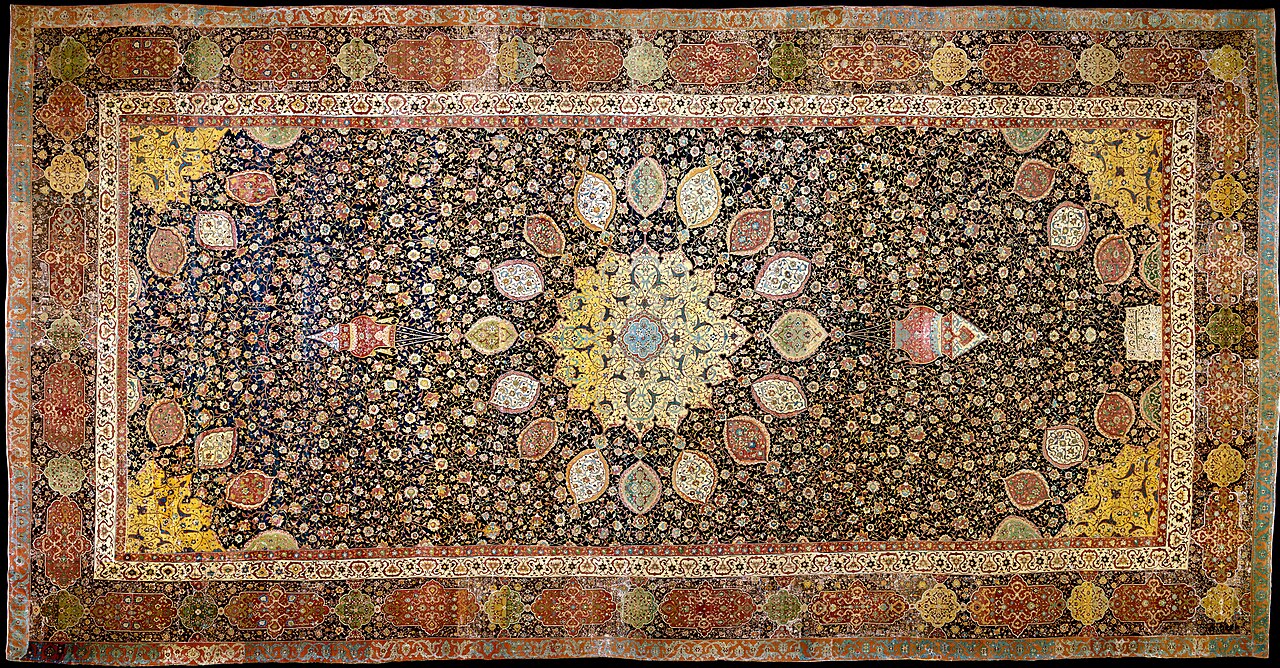
The most famous are the two Ardabil carpets, made for the shrine of Sheikh Safi in Ardabil, the dynasty’s ancestral sanctuary (see the Sheikh Safi al-Din shrine). One is in the Victoria and Albert Museum in London, the other in the Los Angeles County Museum of Art. An inscription gives a couplet of Hafez, the date 946 AH (1539–40) and the name of Maqsud of Kashan, probably the designer or workshop head. Other Safavid types include the “vase” carpets of Kerman and the silk-and-metal carpets of Isfahan and Kashan around 1600, later called “Polonaise” because some were found in Polish noble collections. Many were diplomatic gifts to Europe and the Ottoman and Mughal courts. Our page on Safavid art places these carpets beside the painting and tilework of the period.
Village and tribal weaving
Court carpets are only part of the story. Most carpets in Iran were always woven at home by women in villages and among nomadic tribes: the Qashqai and Khamseh of Fars, the Bakhtiari, the Afshar of Kerman, Kurds, Lurs, Baluch and Turkmen. They wove from memory, not from drawings, using the wool of their own flocks and local dyes such as madder, indigo and pomegranate rind. Their designs are bolder and more geometric, and each group has its own repertoire. Flat-woven gelims and the thick, simple gabbeh rugs of Fars belong to this tradition. Both main knot types are used in Iran: the asymmetrical “Persian” knot and the symmetrical “Turkish” knot, which is common in Azerbaijan and among Turkic and Kurdish weavers.
The 19th-century export boom
After the fall of Isfahan in 1722 court weaving collapsed. Its revival in the later 19th century came from abroad. European and American buyers wanted “oriental carpets”, and merchants of Tabriz began organising production for export through Istanbul. In the 1880s the Manchester firm Ziegler and Co. set up a large operation around Sultanabad, now Arak, supplying wool and designs adapted to Western rooms; other foreign and Iranian firms followed in Kerman, Kashan, Heriz and Mashhad. Carpets became one of Iran’s leading exports. Cheap synthetic dyes arrived at the same time and caused a long debate about quality; the Qajar government tried to restrict them. The period is also covered in our page on Qajar art and society.
The 20th century and today
In the Pahlavi era the state founded the Iran Carpet Company in the 1930s to organise weaving and keep standards up, and new centres such as Qom and Nain became famous for very fine wool and silk carpets. The Carpet Museum of Iran in Tehran opened in the late 1970s. After 1979 Iran remained the world’s best-known producer of hand-knotted carpets, but competition from India, China and machine-made rugs, rising wages, and US sanctions on Iranian carpets, applied on and off since 1987, have shrunk the trade. In 2010 UNESCO listed the traditional carpet-weaving skills of Kashan and of Fars as Intangible Cultural Heritage. For carpets alongside other crafts, see Iranian handicrafts, and for buying in a bazaar, the Tabriz historic bazaar.
Persian words from this page
| فرش | farsh | carpet |
| قالی | qâli | pile carpet |
| قالیچه | qâliche | small rug |
| گلیم | gelim | flat-woven rug |
| گبه | gabbe | thick tribal rug |
| ترنج | toranj | central medallion |
| گره | gereh | knot |
Sources and further reading
- Encyclopaedia Iranica, “Carpets” (series of articles on the history of Persian carpets).
- Sergei I. Rudenko, Frozen Tombs of Siberia: The Pazyryk Burials of Iron Age Horsemen, 1970.
- Arthur Upham Pope and Phyllis Ackerman (eds), A Survey of Persian Art, vol. on carpets.
- Victoria and Albert Museum, “The Ardabil Carpet” (collection record).
- UNESCO Intangible Cultural Heritage, “Traditional skills of carpet weaving in Fars” and “Traditional skills of carpet weaving in Kashan” (2010).
Want to learn Persian? Get the free Starter Pack
Get the 14-page printable Starter Pack (all 32 letters, a 7-day reading plan, 100 core words and 20 survival phrases) and a short 5-email course. Free.
More in Themes Across Iranian History (3000 BCE–today)
- A History of the Persian Language
- Zoroastrianism through the Ages
- Shi’a Islam in Iranian History
- The Jews of Iran
- The Armenians of Iran
- Christians of Iran
- The Baha’i Faith in Iran
- The Kurds in Iranian History
- Azerbaijanis in Iranian History
- The History of the Iranian Calendar
- Nowruz through History
- The Persian Garden (Pardis) through History
- Qanats: Iran’s Ancient Water Tunnels
- A History of Persian Carpets
- A History of Persian Architecture
- A History of Persian Painting
- A History of Persian Music
- Science in Iranian History
- Women in Iranian History
- Iran and the Silk Road
- Iran and China through History
- Iran and India through History
- Iran and Greece: Perceptions and Exchanges
- Persia and Rome: Seven Centuries of Rivalry
- Iran and the Ottoman Empire
- Iran and Russia through History
- Iran and Britain through History
- Iran and the United States
- How Iran’s Borders Changed
- The Capitals of Iran through History
- Coins of Iran through History: From the Daric to the Rial
- Flags and Symbols of Iran through History
- Myth and History in the Shahnameh: The Epic’s Kings and the Real Past
- Timeline of Iranian History: Key Dates from Elam to Today
- A History of Persian Cuisine: From Royal Banquets to Chelow Kabab
- A History of Persian Poetry: From Rudaki to Forough
- Wine in Iranian History: From Hajji Firuz to Hafez and Prohibition
- Sports in Iranian History: Polo, the Zurkhaneh and Wrestling
- List of Iranian Dynasties and Rulers