Shah Cheragh (شاه چراغ, “King of the Lamp”) is the most important Shi’a shrine in Shiraz, built over the grave of Ahmad ibn Musa, a son of the seventh Shi’a imam and brother of Imam Reza, who died in Shiraz in the early 9th century. It is a working place of pilgrimage, not a museum, and its interior is covered almost entirely in mirror mosaic.
| Persian name | Ârâmgâh-e Shâh Cherâgh |
|---|---|
| Who is buried here | Sayyed Ahmad ibn Musa al-Kazim, also called Amir Ahmad; died in Shiraz c. 835 (dates vary in the sources) |
| Main building phases | 13th century (first tomb), 14th century (Injuid expansion), Safavid and Qajar rebuilding, dome rebuilt in the 20th century |
| Status | Active shrine; on Iran’s National Heritage List since 1942 |
| Location | Central Shiraz, a few minutes’ walk south-east of the Vakil Bazaar |
Who was Shah Cheragh
Ahmad ibn Musa was one of the sons of Musa al-Kazim, the seventh imam of Twelver Shi’ism, and a brother of Ali al-Rida, the eighth imam, whose shrine is in Mashhad. Shi’a tradition says that Ahmad and his brother Mohammad travelled towards Khorasan to join Imam Reza, were stopped in Fars, and died in Shiraz, by some accounts killed by agents of the Abbasid caliphate. The date usually given is about 835, though the sources do not agree in detail.
Local tradition explains the name. The grave was forgotten for centuries, until a light was seen shining over it at night. When the spot was dug, a body was found, and the place became known as the tomb of the “King of the Lamp”. Pilgrims today call him Shah Cheragh, and the whole complex, with its courtyard, mosque and tomb, carries the name.
From a small tomb to a great shrine
- 13th century A first domed tomb is built under the Salghurid atabegs who ruled Fars, the same patrons Saadi served.
- 14th century Tashi Khatun, mother of the Injuid ruler Abu Ishaq, enlarges the shrine and adds a mosque and a school around the tomb.
- 16th–17th centuries Major renovation under the Safavids, when Shi’ism became Iran’s state religion and shrines of the imams’ families gained new importance.
- 18th century Earthquakes in Shiraz badly damage the complex and bring down the Safavid dome.
- 1827–1828 Repairs under Fath-Ali Shah Qajar, including a silver screen around the grave.
- 20th century The dome is rebuilt on a modern frame, and the mirror and tile decoration is renewed.
The politics of Hafez’s Shiraz, when the Injuids and then the Muzaffarids fought over the city, are told on our page about the Injuids and Muzaffarids.
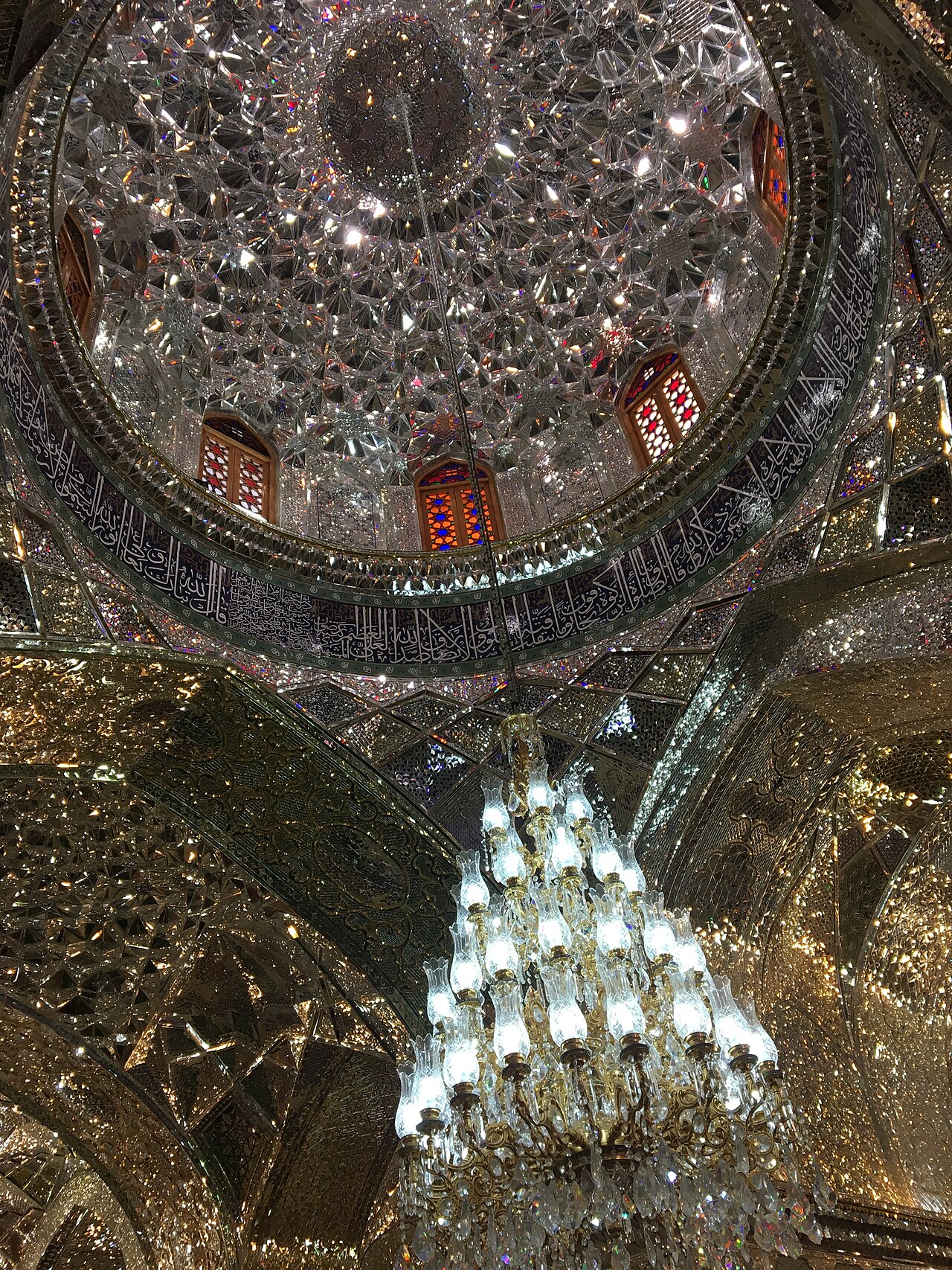

What you see inside
The courtyard
The shrine opens onto a very large paved courtyard (sahn), surrounded by arcades. Families sit here after prayers, children run between the pilgrims, and in the evening the courtyard is lit up and crowded. From here you see the bulbous tiled dome and the short minarets at the ends of the portico.
Mirror work
The reason the shrine is famous outside Iran is its âyene-kâri (آینهکاری), mirror mosaic. Thousands of small pieces of cut glass are set into plaster across the walls, vaults and ceilings of the halls around the tomb. Under the lamps the surfaces break the light into green, white and silver points. The craft goes back to the Safavid period, when broken pieces of imported European mirrors were first used this way, and was developed further under the Qajars. Here it covers almost every surface.
The tomb
The grave sits inside a zarih, a screen of silver and gold-coloured metal, placed in an alcove next to the space under the dome rather than directly beneath it. Pilgrims touch the screen, tie threads or slip notes and coins through it, and pray. Men and women enter the tomb area from separate sides.
The museum
The complex has a small museum with objects given to the shrine over the centuries, including pottery, coins from the Parthian and Sasanian periods, Safavid and Qajar weapons and manuscripts. Opening is irregular, so ask on site.
The attacks of 2022 and 2023
On 26 October 2022 a gunman opened fire on worshippers at the shrine. Reports put the number killed at 13 or 15, including children, with dozens wounded. The Islamic State group claimed responsibility. Iranian authorities said the attackers were not Iranian nationals, and two men convicted of involvement were executed in July 2023. The United Nations condemned the attack.
On 13 August 2023 another gunman attacked the shrine, killing two people and wounding seven, according to Iranian officials. Iran’s Intelligence Ministry later said it had arrested people it described as linked to the Islamic State. Security at the entrances was tightened after both attacks, and visitors should expect bag checks.
Visiting respectfully
- Shah Cheragh is a holy place. Foreign and non-Muslim visitors have generally been welcome, often accompanied by a guide from the shrine’s office for foreign visitors, but access to the tomb chamber can be limited. Follow the instructions of the staff.
- Women are expected to wear a chador (چادر), which the shrine usually lends at the women’s entrance. Men should wear long trousers and avoid sleeveless shirts.
- Photography rules change and phones may be checked at the gate. Ask before photographing people, and do not film people praying.
- Avoid visiting during the main prayer times and on religious holidays if you want space to look around; visit then if you want to see the shrine at its busiest.
- There is no fixed ticket for the shrine. For opening rules and current conditions, check locally and see your own government’s travel advice.
The mirror work here pairs well with the coloured glass of the Nasir al-Mulk Mosque nearby. For the city’s other sights, see our Shiraz page, and for the shrine of Ahmad’s brother, the Imam Reza Shrine in Mashhad.
Persian words from this page
| شاه چراغ | Shâh Cherâgh | “King of the Lamp” |
| چراغ | cherâgh | lamp, light |
| آینهکاری | âyene-kâri | mirror mosaic |
| ضریح | zarih | metal screen around a holy grave |
| صحن | sahn | shrine courtyard |
| حرم | haram | shrine, sanctuary |
| چادر | châdor | full-length cloak worn by women |
Sources and further reading
- Encyclopaedia Iranica, “SHIRAZ i. History to 1940“.
- Arthur J. Arberry, Shiraz: Persian City of Saints and Poets (University of Oklahoma Press, 1960).
- John R. Limbert, Shiraz in the Age of Hafez (University of Washington Press, 2004).
- Reports on the October 2022 attack: Al Jazeera, “Attack on Shiraz shrine kills 15: Iranian state media”, 26 October 2022; The Guardian, 26 October 2022.
- Wikipedia, “2022 Shah Cheragh attack” and “Assassination and terrorism in Iran” (summaries of both attacks with links to news reports), consulted November 2026.
Want to learn Persian? Get the free Starter Pack
Get the 14-page printable Starter Pack (all 32 letters, a 7-day reading plan, 100 core words and 20 survival phrases) and a short 5-email course. Free.
More in Top Places to Visit in Iran
- Naqsh-e Jahan Square
- Shah (Imam) Mosque, Isfahan
- Sheikh Lotfollah Mosque
- Ali Qapu Palace
- Jameh Mosque of Isfahan
- Si-o-se Pol and Khaju Bridge
- Vank Cathedral
- Hasht Behesht Palace
- Naqsh-e Rostam
- Eram Garden, Shiraz
- Nasir al-Molk (Pink) Mosque
- Tomb of Hafez (Hafezieh)
- Tomb of Saadi (Saadieh)
- Shah Cheragh Shrine
- Arg of Karim Khan
- Fin Garden, Kashan
- Historic Houses of Kashan
- Jameh Mosque of Yazd
- Yazd Fire Temple and Towers of Silence
- Dowlatabad Garden and Windcatcher
- Amir Chakhmaq Complex
- Golestan Palace
- National Museum of Iran
- Treasury of National Jewels
- Tehran Grand Bazaar
- Milad Tower
- Imam Reza Shrine, Mashhad
- Tomb of Ferdowsi, Tus
- Tomb of Omar Khayyam, Neyshabur
- Tomb of Avicenna, Hamadan
- Ganjnameh Inscriptions, Hamadan
- Behistun (Bisotun): Visiting the Site
- Taq-e Bostan: Visiting the Site
- Tabriz Historic Bazaar
- Takht-e Soleyman
- Armenian Monastic Ensembles of Iran
- Sheikh Safi al-Din Shrine, Ardabil
- Dome of Soltaniyeh
- Alamut Castle
- Falak-ol-Aflak Castle
- Shushtar Historical Hydraulic System
- Chogha Zanbil: Visiting the Ziggurat
- Susa Archaeological Site
- Arg-e Bam
- Ganjali Khan Complex, Kerman
- Shazdeh Garden, Mahan
- Rayen Castle
- Dasht-e Lut (Lut Desert)
- Maranjab Desert and Caravanserai
- Varzaneh Desert
- Mount Damavand
- Hyrcanian Forests
- Lake Urmia
- Badab-e Surt Springs
- Ali Sadr Cave
- The Kaluts of Shahdad
- Qeshm Geopark
- Hormuz Island Colours
- Visiting Persepolis: A Day Trip from Shiraz
- Visiting Pasargadae
- Persian Caravanserais
- The Qanat of Gonabad
- Meymand Village
- Sasanian Sites of Fars: Firuzabad, Bishapur and Sarvestan
- Gonbad-e Qabus: Visiting the Tower
- Zayandeh Rud and Isfahan’s Bridges
- Tochal and Darband: Hiking Above Tehran
- Mount Sabalan
- Skiing in Iran: Dizin and Shemshak
- Golestan National Park