Naqsh-e Jahan Square (میدان نقش جهان) is the great open square at the centre of Isfahan, about 510 metres long, laid out by Shah Abbas I around 1600. Four Safavid buildings face each other across it: the Shah (Imam) Mosque, the Sheikh Lotfollah Mosque, the Ali Qapu palace and the gateway of the royal bazaar. It is a UNESCO World Heritage Site and the place most visitors to Isfahan see first.
| Persian name | Meydân-e Naqsh-e Jahân; also called Meydân-e Emâm (Imam Square), and Meydân-e Shâh before 1979 |
|---|---|
| Location | Central Isfahan, south-west of the old city, a short walk east of Chahar Bagh avenue |
| Built | c. 1590 to c. 1630, under Shah Abbas I and his successors |
| Size | About 510 by 160 metres inside the arcades |
| UNESCO | Meidan Emam, Esfahan, inscribed 1979 |
| Time to allow | Half a day for the square and its buildings; longer with the bazaar |
This page is a visitor’s guide to the square as a whole: how it is laid out, how to move around it, and what to look for between the monuments. The story of how Shah Abbas built it and what happened there in Safavid times is told in The Building of Naqsh-e Jahan Square, and our older article Naghsh-e Jahan Square gives a short tour of the sights.
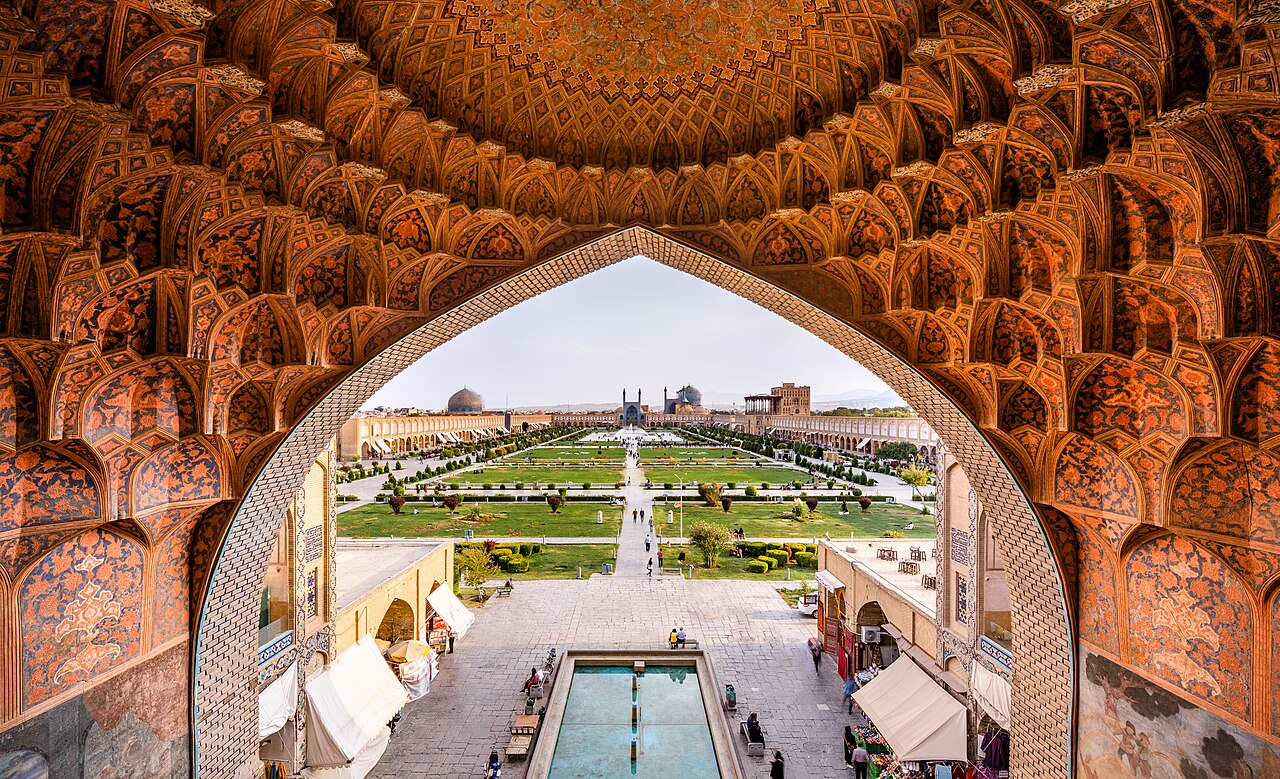

How the square is laid out
The square runs roughly north to south. A continuous two-storey arcade frames all four sides, broken only by the four great buildings, one in the middle of each side:
- South: the Shah (Imam) Mosque, with its tall portal and the blue dome rising behind it.
- East: the Sheikh Lotfollah Mosque, the small cream-domed mosque with no minarets.
- West: the Ali Qapu palace, the tall gatehouse with a wooden-columned porch looking over the square.
- North: the Qeysariyeh portal, the entrance to the Grand Bazaar, which leads on through covered lanes towards the old city and the Jameh Mosque.
The middle of the square is a long garden with lawns, rows of trees, a long pool and fountains. In Safavid times this was open, beaten ground used for polo, parades and markets. The two stone goalposts at the north and south ends are a reminder of the polo games that the shah watched from the Ali Qapu.
Walking the arcades
The arcades are not just a frame. Each bay on the ground floor is a shop, and today most of them sell Isfahan crafts: hand-printed cotton (qalamkâr), enamelled copper (minâ), engraved metal, inlaid boxes (khâtam), miniature paintings and carpets. Some workshops still have the craftsman at work in the back, hammering a copper tray or carving a printing block, and many will let you watch. Our page on Iranian handicrafts explains the techniques.
A slow walk round the whole square is about 1.4 kilometres. It is worth doing once at street level before visiting any of the buildings, because the views change at every corner: from the north end the whole length of the square opens out towards the mosque portal, and from the arcades on the east side the Ali Qapu porch faces you across the garden.
The Qeysariyeh gate and the bazaar
The north side is easy to overlook, because the bazaar portal is less famous than the mosques. Look up at the tiled panel over the entrance arch: it shows an archer who is half man and half beast, usually read as Sagittarius, the sign under which Isfahan’s new centre is said to have been founded. Above it, on the gallery, are faded Safavid wall paintings of hunting and battle scenes. The balcony over the gate once held the royal drum and trumpet band, the naqqâre-khâne, which played at sunset.
Through the gate, the Qeysariyeh was the royal market for fine cloth and other luxuries. Beyond it the bazaar continues for well over a kilometre under brick vaults, past caravanserais, small domed crossings and covered courts, until it reaches the old square by the Jameh Mosque. Walking it end to end is the best way to see how the Safavid centre was tied to the older city.
When to visit
The square has two quite different moods.
- Morning: quieter, cooler and best for the buildings. The interior of the Sheikh Lotfollah Mosque is at its most striking when sunlight enters its windows, and the Shah Mosque courtyard is calmer before tour groups arrive.
- Late afternoon and evening: the square fills with Isfahanis. Families spread picnic rugs on the lawns, children ride bicycles, and horse-drawn carriages (doroshke) circle the garden. The domes are lit after dark, and the reflections in the pool make this the best time for photographs of the square itself.
Summer afternoons are very hot; spring and autumn are the most comfortable seasons. See Climate of Iran and the Best Time to Visit for more. On Friday the Shah Mosque is used for midday prayers, and parts of the religious buildings may be closed to visitors at prayer times. Opening hours and tickets for each building change, so check current information locally.
War damage in 2026
In March 2026, during the US and Israeli strikes on Iran, a strike on government buildings in the old palace quarter beside the square caused blast damage to monuments nearby. According to Iranian officials quoted by The Art Newspaper, windows and doors of the Ali Qapu were shattered and sections of tilework on the Shah Mosque were damaged, and the Chehel Sotoun palace a few hundred metres to the west was also hit by the blast. UNESCO said it had documented shockwave damage at several World Heritage properties, three of them in Isfahan. The extent of the damage and the state of repairs may have changed since; check current reports and your own government’s travel advice before planning a visit.
Fitting the square into a visit to Isfahan
Most visitors spend a full day around the square: the two mosques and the Ali Qapu in the morning, lunch nearby, then the Chehel Sotoun and Hasht Behesht palaces just to the west, and back to the square for the evening. A second day usually takes in the Jameh Mosque through the bazaar, the bridges over the Zayandeh Rud and the Armenian quarter around Vank Cathedral. For an overview of the city, see our Isfahan city guide.
Persian words from this page
| میدان | meydân | square, open ground |
| نقش جهان | naqsh-e jahân | image of the world |
| بازار | bâzâr | bazaar, market |
| قیصریه | Qeysariye | the royal market and its gate |
| چوگان | chowgân | polo |
| درشکه | doroshke | horse-drawn carriage |
| قلمکار | qalamkâr | hand-printed cotton |
Sources and further reading
- UNESCO World Heritage Centre, Meidan Emam, Esfahan.
- Encyclopaedia Iranica, “Isfahan” (article series on the city and its monuments).
- Sussan Babaie, Isfahan and Its Palaces: Statecraft, Shi’ism and the Architecture of Conviviality in Early Modern Iran (Edinburgh University Press, 2008).
- Robert Hillenbrand, “Safavid Architecture”, in The Cambridge History of Iran, vol. 6 (1986).
- The Art Newspaper, report on damage to UNESCO sites in Isfahan, 10 March 2026; NPR, report on damage to Iran’s cultural heritage, 19 March 2026.
Want to learn Persian? Get the free Starter Pack
Get the 14-page printable Starter Pack (all 32 letters, a 7-day reading plan, 100 core words and 20 survival phrases) and a short 5-email course. Free.
More in Top Places to Visit in Iran
- Naqsh-e Jahan Square
- Shah (Imam) Mosque, Isfahan
- Sheikh Lotfollah Mosque
- Ali Qapu Palace
- Jameh Mosque of Isfahan
- Si-o-se Pol and Khaju Bridge
- Vank Cathedral
- Hasht Behesht Palace
- Naqsh-e Rostam
- Eram Garden, Shiraz
- Nasir al-Molk (Pink) Mosque
- Tomb of Hafez (Hafezieh)
- Tomb of Saadi (Saadieh)
- Shah Cheragh Shrine
- Arg of Karim Khan
- Fin Garden, Kashan
- Historic Houses of Kashan
- Jameh Mosque of Yazd
- Yazd Fire Temple and Towers of Silence
- Dowlatabad Garden and Windcatcher
- Amir Chakhmaq Complex
- Golestan Palace
- National Museum of Iran
- Treasury of National Jewels
- Tehran Grand Bazaar
- Milad Tower
- Imam Reza Shrine, Mashhad
- Tomb of Ferdowsi, Tus
- Tomb of Omar Khayyam, Neyshabur
- Tomb of Avicenna, Hamadan
- Ganjnameh Inscriptions, Hamadan
- Behistun (Bisotun): Visiting the Site
- Taq-e Bostan: Visiting the Site
- Tabriz Historic Bazaar
- Takht-e Soleyman
- Armenian Monastic Ensembles of Iran
- Sheikh Safi al-Din Shrine, Ardabil
- Dome of Soltaniyeh
- Alamut Castle
- Falak-ol-Aflak Castle
- Shushtar Historical Hydraulic System
- Chogha Zanbil: Visiting the Ziggurat
- Susa Archaeological Site
- Arg-e Bam
- Ganjali Khan Complex, Kerman
- Shazdeh Garden, Mahan
- Rayen Castle
- Dasht-e Lut (Lut Desert)
- Maranjab Desert and Caravanserai
- Varzaneh Desert
- Mount Damavand
- Hyrcanian Forests
- Lake Urmia
- Badab-e Surt Springs
- Ali Sadr Cave
- The Kaluts of Shahdad
- Qeshm Geopark
- Hormuz Island Colours
- Visiting Persepolis: A Day Trip from Shiraz
- Visiting Pasargadae
- Persian Caravanserais
- The Qanat of Gonabad
- Meymand Village
- Sasanian Sites of Fars: Firuzabad, Bishapur and Sarvestan
- Gonbad-e Qabus: Visiting the Tower
- Zayandeh Rud and Isfahan’s Bridges
- Tochal and Darband: Hiking Above Tehran
- Mount Sabalan
- Skiing in Iran: Dizin and Shemshak
- Golestan National Park