The Pahlavi family ruled Iran for two generations, from Reza Shah’s accession in 1925 to Mohammad Reza Shah’s departure in 1979. Its best known members after the two shahs were Princess Ashraf, the second shah’s politically active twin sister, and his three wives, Fawzia, Soraya and Farah. The question of a male heir shaped the shah’s private life for twenty years, and after 1979 the family scattered into exile.
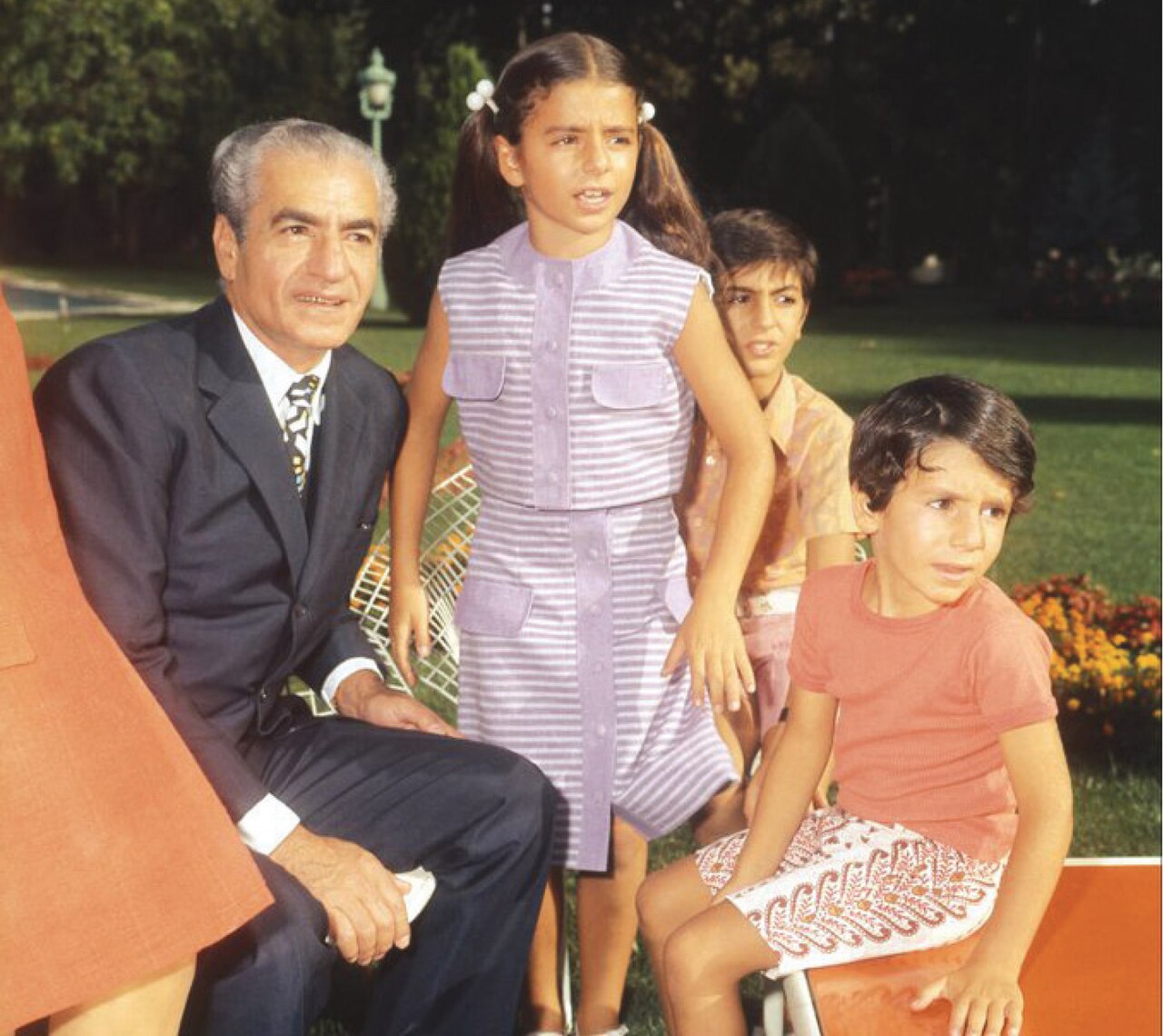

Reza Shah’s household
Reza Shah married several times and had eleven children. The four who mattered most at court were the children of his wife Tadj ol-Molouk, who became the first Pahlavi queen:
- Shams (1917–1996), the eldest daughter, who presided over the Red Lion and Sun Society, Iran’s Red Cross.
- Mohammad Reza (1919–1980), the crown prince, who became shah in 1941.
- Ashraf (1919–2016), his twin sister, born on the same day, 26 October 1919.
- Ali Reza (1922–1954), next in line to the throne until he was killed in a plane crash in 1954.
Reza Shah’s other wives gave him further sons, including Gholam Reza, Abdul Reza and Hamid Reza, who held honorary posts and ran foundations and sporting bodies. His wish to found a dynasty was explicit: he took the name Pahlavi, after the Middle Persian language of the pre-Islamic empires, and had his eldest son educated in Switzerland and at the military academy in Tehran.
Princess Ashraf
Ashraf ol-Molouk Pahlavi (اشرف پهلوی) was the most forceful personality in the family. She was married at eighteen to Ali Qavam, the son of a political ally of her father, and later to the Egyptian Ahmad Shafiq and to Mehdi Bushehri. Unlike her brother in his early years, she enjoyed politics and was widely seen as a power behind the throne.
1953
In July 1953, according to the CIA’s own history of the operation, Ashraf travelled from Europe to Tehran to urge her hesitant brother to back the plan to remove Mosaddegh. Her visit is one of several steps described on the page about the 1953 coup.
Women’s causes and the United Nations
From the 1960s she represented Iran at the United Nations. She chaired the UN Commission on the Status of Women in 1965, led Iran’s delegation to the Commission on Human Rights, which she chaired in 1970, and was president of the Women’s Organization of Iran from 1967 to 1979. Her supporters credit her with helping to win the reforms described on the page about women in Pahlavi Iran. Her critics, at home and abroad, accused her of corruption and of using her position for business deals; she rejected these charges in her memoir, Faces in a Mirror (1980).
After the revolution she lived in New York, Paris and Monaco. Her son Shahriar Shafiq, a naval officer, was shot dead in Paris in December 1979. She died in Monte Carlo on 7 January 2016, at the age of 96.
The shah’s three marriages
Fawzia of Egypt (married 1939)
In 1939 the crown prince married Princess Fawzia, sister of King Farouk of Egypt, in a match arranged by Reza Shah to raise the status of the new dynasty. They had one daughter, Shahnaz, born in 1940. The marriage was unhappy, Fawzia returned to Egypt, and the divorce was finalised in 1948. Shahnaz later married Ardeshir Zahedi, son of General Fazlollah Zahedi.
Soraya Esfandiary-Bakhtiary (married 1951)
Soraya, the daughter of a Bakhtiari tribal noble and a German mother, married the shah in February 1951, just as the oil crisis was beginning. She was with him when he fled to Rome in August 1953. The couple had no children, and in 1958 the shah divorced her, explaining that the dynasty needed an heir. Soraya lived in Europe, acted in a film and became a favourite of the European press, and died in Paris in 2001.
Farah Diba (married 1959)
The shah’s third marriage, in December 1959, produced the heir he wanted: Crown Prince Reza, born in 1960, followed by Farahnaz, Ali Reza and Leila. Farah was crowned empress in 1967. Her life and work have their own page: Farah Pahlavi.
A family at court
By the 1970s the royal family and the court ran a wide network of foundations, the largest being the Pahlavi Foundation, which held hotels, factories, shares and land and funded charities. Members of the family sat on the boards of companies and cultural bodies. To admirers this was a monarchy using its wealth for public causes; to critics, including many who were otherwise loyal to the shah, the business dealings of relatives and courtiers became a source of public resentment in the years before 1978.
Exile
Most of the family left Iran before or during the revolution. The shah died in Cairo in July 1980, and in October that year his son Reza announced that he regarded himself as his father’s successor. The younger generation’s losses continued in exile: Leila died in London in 2001 and Ali Reza in Boston in 2011. Reza Pahlavi has lived mainly in the United States and is active in opposition politics outside Iran.
Persian words from this page
| پهلوی | Pahlavi | Pahlavi (dynasty; also Middle Persian) |
| والاحضرت | vâlâhazrat | Royal Highness |
| شاهزاده | shâhzâde | prince, princess |
| ولیعهد | vali’ahd | crown prince |
| دوقلو | doqolu | twin |
| ثریا | Sorayyâ | Soraya |
Sources and further reading
- Ashraf Pahlavi, Faces in a Mirror: Memoirs from Exile, Prentice-Hall, 1980.
- Abbas Milani, The Shah, Palgrave Macmillan, 2011.
- Gholam Reza Afkhami, The Life and Times of the Shah, University of California Press, 2009.
- Donald N. Wilber, Clandestine Service History: Overthrow of Premier Mossadeq of Iran (CIA, 1954; published 2000).
- Farah Pahlavi, An Enduring Love: My Life with the Shah, Miramax Books, 2004.
Want to learn Persian? Get the free Starter Pack
Get the 14-page printable Starter Pack (all 32 letters, a 7-day reading plan, 100 core words and 20 survival phrases) and a short 5-email course. Free.
More in The Pahlavi Era (1925–1979)
- Reza Shah Pahlavi
- Reza Shah’s Reforms
- The Trans-Iranian Railway
- Why Persia Became “Iran” in 1935
- The Unveiling Decree of 1936 (Kashf-e Hijab)
- The Anglo-Soviet Invasion of Iran (1941)
- The Persian Corridor and the Tehran Conference
- The Iran Crisis of 1946
- Mohammad Reza Shah’s Early Reign (1941–1953)
- The Tudeh Party
- Mohammad Mosaddegh
- The Nationalisation of Iranian Oil (1951)
- The 1953 Coup in Iran
- Fazlollah Zahedi
- The 1954 Oil Consortium Agreement
- SAVAK: The Shah’s Security Service
- The White Revolution (1963)
- The Uprising of June 1963 and Khomeini’s Exile
- The Hoveyda Years (1965–1977)
- The 2,500-Year Celebration of the Persian Empire (1971)
- The Oil Boom of the 1970s
- Intellectuals and Opposition in the 1960s–70s
- Iran as a Regional Power under the Shah
- Women in Pahlavi Iran
- The Cinema Rex Fire (1978)
- Black Friday (September 1978)
- The Shah Leaves Iran (January 1979)
- Farah Pahlavi
- The Pahlavi Family
- Forough Farrokhzad and Modern Persian Poetry
- Iranian Cinema before 1979