The Persian Corridor was the Allied supply route through occupied Iran that carried American and British war materiel from the Persian Gulf to the Soviet Union between 1941 and 1945. It made Iran a key logistics base of the Second World War, and in late 1943 Tehran hosted the first meeting of Stalin, Roosevelt and Churchill. The Tehran Conference ended with a declaration promising to respect Iran’s independence after the war.
| Period | 1941–1945 |
|---|---|
| Route | Persian Gulf ports (Khorramshahr, Bandar Shahpur, Bushehr, Abadan) by rail and road to the Caspian ports and the Soviet border |
| Operators | British forces from 1941; from late 1942 the US Persian Gulf Service Command (later Persian Gulf Command) |
| Tehran Conference | 28 November – 1 December 1943, Soviet embassy, Tehran |
| Declaration on Iran | Signed 1 December 1943 by Roosevelt, Churchill and Stalin |
| Persian name | پل پیروزی (Pol-e Piruzi, “Bridge of Victory”), the name the Allies gave Iran |
Why Iran mattered to the war
After Germany invaded the Soviet Union in June 1941, Britain and the United States needed ways to send weapons, vehicles, food and fuel to the Red Army. The Arctic convoys to Murmansk and Arkhangelsk were exposed to German submarines and aircraft and blocked by ice for part of the year. The Pacific route to Vladivostok could carry only non-military goods once Japan entered the war. The third route ran through Iran: ships unloaded at the head of the Persian Gulf, and goods travelled north by the new Trans-Iranian Railway and by road to the Caspian Sea and the Soviet frontier. Securing that route was the main reason for the Anglo-Soviet invasion of 1941.
Building the supply line
The railway that Reza Shah had finished in 1938 was designed for a modest peacetime traffic. In 1941–1942 British engineers began to expand ports and add rolling stock. From late 1942 the United States, now in the war, took over most of the work through the Persian Gulf Service Command, later renamed the Persian Gulf Command. Tens of thousands of American soldiers, most of them in service and engineering units, ran the railway, enlarged the ports and built roads. Assembly plants near the Gulf put together trucks shipped in pieces from the United States, many of them Studebakers, which were driven north in convoys and handed to the Soviets. Aircraft were assembled at Abadan and flown north.
Estimates of the total cargo vary with what is counted: figures from about four million to nearly eight million long tons appear in the literature. Either way the corridor carried a large share of Western aid to the Soviet Union in 1943–1945, and the Allies called Iran the “Bridge of Victory”.

Life in occupied Iran
For Iranians the war years were hard. The Soviets occupied the north, including the grain-growing provinces of Azerbaijan, Gilan and Mazandaran, and the British the south. Allied purchases, the diversion of trains and trucks to military traffic, poor harvests and hoarding produced shortages and inflation. In December 1942 bread riots broke out in Tehran. Typhus and hunger spread in several towns.
The war also brought new people. In 1942 more than 100,000 Polish soldiers and civilians, released from Soviet camps to form General Anders’s army, crossed the Caspian to Bandar Pahlavi (today Bandar Anzali). Many stayed in Tehran, Isfahan and Ahvaz for months or years, and some are buried in the Polish section of the Doulab cemetery in Tehran. American advisers arrived too: Arthur Millspaugh returned in 1943 to run Iran’s finances, as he had in the 1920s, and Colonel H. Norman Schwarzkopf reorganised the gendarmerie. The page on Iran and the United States follows that relationship.
In September 1943 Iran declared war on Germany, which allowed it to join the United Nations as a founding member.
The Tehran Conference, 1943
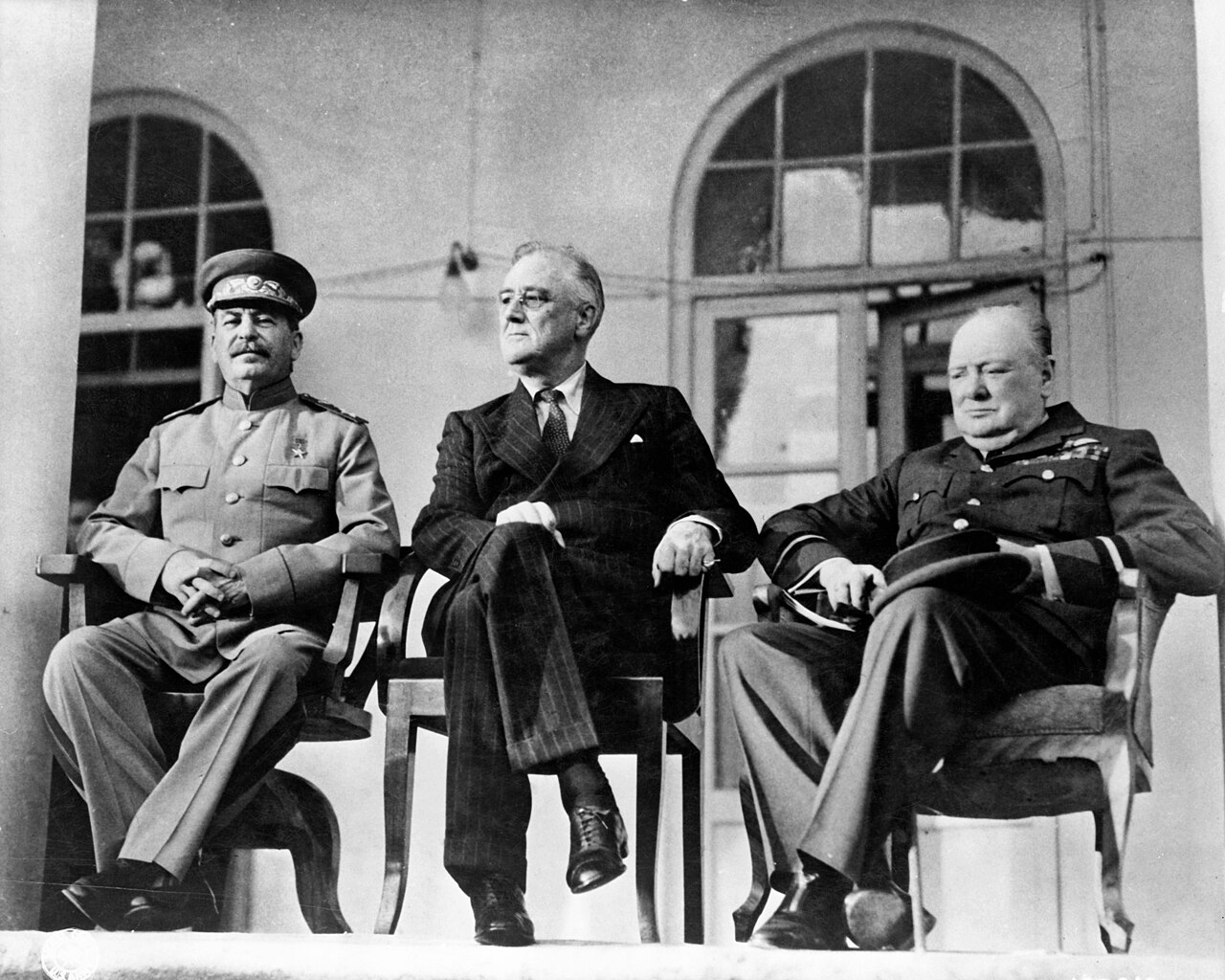
Stalin would not travel far from the Soviet Union, and Tehran, with Soviet and British troops already present, was a place all three leaders could reach. The conference, code-named Eureka, met from 28 November to 1 December 1943. Roosevelt stayed in the Soviet embassy compound, officially for security after Soviet warnings about a German assassination plot, a plot whose seriousness historians doubt. Churchill celebrated his 69th birthday at the British legation, and he presented Stalin with a ceremonial sword from King George VI honouring the defenders of Stalingrad.
The main business was the war in Europe. Stalin pressed for a second front, and Roosevelt and Churchill committed to the cross-Channel invasion of France in May 1944, the future D-Day. The leaders also discussed Poland’s borders, Turkey and a future United Nations organisation. Iran itself was not on the main agenda.
The Declaration Regarding Iran
Iranian diplomats, with American support, secured a short declaration signed by the three leaders on 1 December 1943. It thanked Iran for its help in the war, promised economic assistance during and after the war, and stated that the three governments shared Iran’s wish to maintain its independence, sovereignty and territorial integrity. For the Iranian government the text was a guarantee that the occupation would end. It was soon tested.
The 24-year-old Mohammad Reza Shah met the three leaders separately. Abbas Milani, in his biography The Shah, describes how the young monarch felt slighted by Roosevelt and Churchill, who received him in their own quarters, while Stalin made a point of calling on him, an impression that shaped the shah’s view of the powers. His position at home is covered on the page on Mohammad Reza Shah’s early reign.
- August 1941 Anglo-Soviet invasion opens the route
- January 1942 Tripartite Treaty gives the Allies use of Iran’s communications
- 1942 Polish evacuation across the Caspian; US troops arrive
- December 1942 Bread riots in Tehran
- September 1943 Iran declares war on Germany
- 28 Nov – 1 Dec 1943 Tehran Conference; Declaration Regarding Iran
- 1945 War ends; supply operations close
Legacy
The corridor tied Iran firmly to Allied strategy, and the American presence of 1942–1945 was the start of a much larger US role in the country. It also left the Soviet army in northern Iran when the war ended. When Soviet troops did not leave by the deadline of March 1946 the Tehran Declaration and the Tripartite Treaty became Iran’s main arguments at the new United Nations, in the Iran crisis of 1946. Historians including Ervand Abrahamian and Abbas Amanat note that the war years also opened Iranian politics: the press, parties and parliament flourished under occupation, in part because no single power could control the capital.
Persian words from this page
| پل پیروزی | pol-e piruzi | bridge of victory |
| کنفرانس تهران | konferâns-e Tehrân | Tehran Conference |
| جنگ جهانی دوم | jang-e jahâni-ye dovvom | Second World War |
| خرمشهر | Khorramshahr | port city on the Shatt al-Arab |
| نان | nân | bread |
Sources and further reading
- T. H. Vail Motter, The Persian Corridor and Aid to Russia (US Army in World War II series, Center of Military History, 1952).
- “Declaration of the Three Powers Regarding Iran”, 1 December 1943, in Foreign Relations of the United States: The Conferences at Cairo and Tehran, 1943.
- Abbas Milani, The Shah (Palgrave Macmillan, 2011).
- Ervand Abrahamian, Iran Between Two Revolutions (Princeton University Press, 1982).
- Abbas Amanat, Iran: A Modern History (Yale University Press, 2017).
Want to learn Persian? Get the free Starter Pack
Get the 14-page printable Starter Pack (all 32 letters, a 7-day reading plan, 100 core words and 20 survival phrases) and a short 5-email course. Free.
More in The Pahlavi Era (1925–1979)
- Reza Shah Pahlavi
- Reza Shah’s Reforms
- The Trans-Iranian Railway
- Why Persia Became “Iran” in 1935
- The Unveiling Decree of 1936 (Kashf-e Hijab)
- The Anglo-Soviet Invasion of Iran (1941)
- The Persian Corridor and the Tehran Conference
- The Iran Crisis of 1946
- Mohammad Reza Shah’s Early Reign (1941–1953)
- The Tudeh Party
- Mohammad Mosaddegh
- The Nationalisation of Iranian Oil (1951)
- The 1953 Coup in Iran
- Fazlollah Zahedi
- The 1954 Oil Consortium Agreement
- SAVAK: The Shah’s Security Service
- The White Revolution (1963)
- The Uprising of June 1963 and Khomeini’s Exile
- The Hoveyda Years (1965–1977)
- The 2,500-Year Celebration of the Persian Empire (1971)
- The Oil Boom of the 1970s
- Intellectuals and Opposition in the 1960s–70s
- Iran as a Regional Power under the Shah
- Women in Pahlavi Iran
- The Cinema Rex Fire (1978)
- Black Friday (September 1978)
- The Shah Leaves Iran (January 1979)
- Farah Pahlavi
- The Pahlavi Family
- Forough Farrokhzad and Modern Persian Poetry
- Iranian Cinema before 1979