The Hoveyda years were the twelve and a half years, from January 1965 to August 1977, when Amir-Abbas Hoveyda served as Mohammad Reza Shah’s prime minister, the longest premiership in Iran’s history. They were years of fast economic growth, new industry and a swelling state, but also of a political system in which real decisions rested with the shah and opposition was shut out. Hoveyda, the urbane manager of that system, was arrested on the shah’s orders in 1978 and executed after the revolution.
| Prime minister | Amir-Abbas Hoveyda (1919–1979) |
|---|---|
| In office | 26 January 1965 – 7 August 1977 |
| Party | Iran Novin; from 1975 the single Rastakhiz (Resurgence) party |
| Development plans | Third (1962–68), Fourth (1968–73), Fifth (1973–78) |
| Successor | Jamshid Amouzegar |
| Fate | Arrested November 1978; executed 7 April 1979 |
An accidental prime minister
Hoveyda was born in Tehran in 1919 and spent much of his youth in Beirut, where he attended a French school while his father served as a diplomat in the region. He studied in Brussels, joined the foreign ministry, worked for the UN refugee agency and, from 1958, on the board of the National Iranian Oil Company. With his friend Hassan Ali Mansur he belonged to the Progressive Circle, a group of Western-educated technocrats that became the Iran Novin party. When Mansur became prime minister in 1964, Hoveyda was his finance minister. After Mansur was shot in January 1965, the shah chose Hoveyda to replace him, expecting a caretaker.
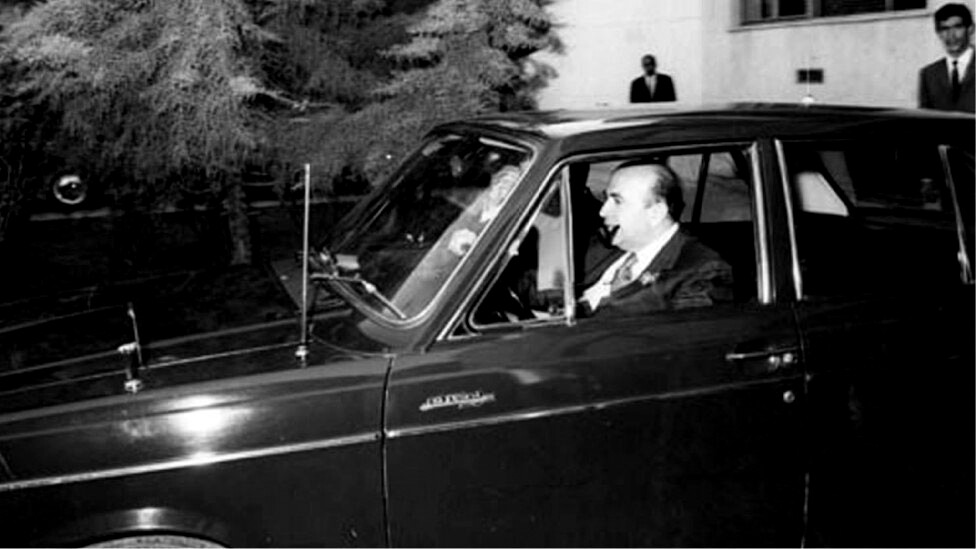

How the system worked
Hoveyda lasted because he understood the limits of his office. Foreign policy, the army, oil and SAVAK reported to the shah directly. The prime minister ran the ministries, managed parliament through the Iran Novin majority and took the blame when things went wrong. His biographer Abbas Milani portrays him as a cultivated, witty man who read French literature and wanted to modernise the administration, but who chose to stay at the centre of an authoritarian regime and swallowed humiliations to do so. He was known for his pipe, cane and the flower in his lapel, and for living modestly by the standards of the elite.
The two-party system of these years, with the Mardom party as a tame opposition, was replaced in March 1975 when the shah announced a single party, Rastakhiz, and said those who did not wish to join could leave the country. Hoveyda became its first secretary-general. Many historians, among them Ervand Abrahamian, treat the creation of Rastakhiz as one of the regime’s costliest mistakes, since it pulled the bazaar and the clergy into direct conflict with the state.
Growth and its strains
From the mid-1960s Iran’s economy grew at high rates, often given as around 8 to 10 per cent a year before the oil price rises of 1973. The development plans, drawn up by the Plan Organisation, funded dams, roads, ports and electricity. State and private investment produced a steel mill at Isfahan built with Soviet help, a machine-tool industry at Arak and Tabriz, petrochemical plants, and the Paykan car, assembled in Tehran from 1967 and soon a symbol of the new middle class. Universities, schools and the civil service expanded, and the number of Iranians with a modern education grew quickly.
The strains were real too. Industry clustered around Tehran, incomes became more unequal, and agriculture lagged behind after land reform. Corruption around state contracts was widely talked about, and Hoveyda’s campaigns against it came to little. After 1973 the flood of oil money, described in the oil boom of the 1970s, brought inflation, shortages and bottlenecks that the government could not control.
The fall
By the summer of 1977 Tehran had power cuts, high rents and rising prices, and the Carter administration was talking about human rights. The shah replaced Hoveyda with Jamshid Amouzegar in August 1977 and made him minister of court. As the revolution gathered pace in 1978, Hoveyda lost that post too. On 7 November 1978, in an attempt to appease the protesters, the shah had him arrested along with other former officials.
When the shah left in January 1979, Hoveyda was still in custody; in February, as his guards melted away, he did not flee and gave himself up to the revolutionaries. He was tried in April by a revolutionary court under Sadegh Khalkhali on charges including “corruption on earth”, without a real defence, and shot on 7 April 1979. For many Iranians the trial became a symbol of the new regime’s justice; for others he was a fair target as the face of the old one. Milani’s biography, published in English in 2000, did much to restore a fuller picture of him.
How the period is judged
Admirers of the Pahlavi state look back on the Hoveyda years as a time of stability, rising living standards and growing opportunities, especially for women and the educated middle class. Critics argue that the same years built a political system with no outlet for dissent, so that when economic trouble came after 1975 there was no way to channel it except into the street. Both views appear in the work of historians such as Milani and Abrahamian, who differ less on the facts than on the weight they give them. For the opposition of these years, see intellectuals and opposition in the 1960s and 1970s.
Persian words from this page
| نخستوزیر | nokhost-vazir | prime minister |
| هویدا | Hoveydâ | Hoveyda |
| حزب ایران نوین | Hezb-e Irân-e Novin | New Iran Party |
| حزب رستاخیز | Hezb-e Rastâkhiz | Resurgence Party |
| پیکان | Peykân | Paykan (car; the word means “arrow”) |
| دادگاه انقلاب | dâdgâh-e enqelâb | revolutionary court |
Sources and further reading
- Abbas Milani, The Persian Sphinx: Amir Abbas Hoveyda and the Riddle of the Iranian Revolution (Mage, 2000).
- Ervand Abrahamian, Iran Between Two Revolutions (Princeton University Press, 1982).
- Homa Katouzian, The Political Economy of Modern Iran: Despotism and Pseudo-Modernism, 1926–1979 (Macmillan, 1981).
- Robert Graham, Iran: The Illusion of Power (Croom Helm, 1978).
- Encyclopaedia Iranica, “Hoveyda, Amir-Abbas”.
Want to learn Persian? Get the free Starter Pack
Get the 14-page printable Starter Pack (all 32 letters, a 7-day reading plan, 100 core words and 20 survival phrases) and a short 5-email course. Free.
More in The Pahlavi Era (1925–1979)
- Reza Shah Pahlavi
- Reza Shah’s Reforms
- The Trans-Iranian Railway
- Why Persia Became “Iran” in 1935
- The Unveiling Decree of 1936 (Kashf-e Hijab)
- The Anglo-Soviet Invasion of Iran (1941)
- The Persian Corridor and the Tehran Conference
- The Iran Crisis of 1946
- Mohammad Reza Shah’s Early Reign (1941–1953)
- The Tudeh Party
- Mohammad Mosaddegh
- The Nationalisation of Iranian Oil (1951)
- The 1953 Coup in Iran
- Fazlollah Zahedi
- The 1954 Oil Consortium Agreement
- SAVAK: The Shah’s Security Service
- The White Revolution (1963)
- The Uprising of June 1963 and Khomeini’s Exile
- The Hoveyda Years (1965–1977)
- The 2,500-Year Celebration of the Persian Empire (1971)
- The Oil Boom of the 1970s
- Intellectuals and Opposition in the 1960s–70s
- Iran as a Regional Power under the Shah
- Women in Pahlavi Iran
- The Cinema Rex Fire (1978)
- Black Friday (September 1978)
- The Shah Leaves Iran (January 1979)
- Farah Pahlavi
- The Pahlavi Family
- Forough Farrokhzad and Modern Persian Poetry
- Iranian Cinema before 1979