The Iran crisis of 1946 was the first great confrontation of the Cold War. Soviet troops stayed in northern Iran beyond the agreed withdrawal date of 2 March 1946, while Soviet-backed autonomous governments ruled Iranian Azerbaijan from Tabriz and a Kurdish republic held Mahabad. Prime Minister Ahmad Qavam, the new United Nations and American pressure brought the Red Army out by May, and in December 1946 the Iranian army retook both regions.
| Dates | Late 1945 – December 1946 (oil agreement rejected October 1947) |
|---|---|
| Azerbaijan | Azerbaijan People’s Government, Tabriz, 12 December 1945 – 12 December 1946; leader Ja’far Pishevari |
| Kurdistan | Republic of Mahabad, proclaimed 22 January 1946; president Qazi Mohammad |
| Iran’s prime minister | Ahmad Qavam (Qavam al-Saltaneh), from January 1946 |
| At the UN | Iran’s complaint of January 1946 was the first case brought before the Security Council |
| Persian names | فرقه دموکرات آذربایجان (Ferqe-ye Demokrât-e Âzarbâyjân); جمهوری مهاباد (Jomhuri-ye Mahâbâd) |
Northern Iran under Soviet occupation
Since the invasion of 1941 the Red Army had held the northern provinces. Under the Tripartite Treaty of 1942 all Allied forces were to leave within six months of the end of the war; after Japan’s surrender on 2 September 1945, that meant 2 March 1946. In 1944 the Soviet Union had asked for an oil concession in the north. In December 1944 the Majlis, on a bill sponsored by Mohammad Mosaddegh, made it a crime for ministers to negotiate oil concessions with foreign governments or companies without parliament’s approval.
Azerbaijan had real grievances. Its Turkic-speaking people had seen their language banned from schools and offices under Reza Shah, taxes flow to Tehran and investment flow the other way. Tabriz had been at the heart of the Constitutional Revolution and resented its decline. Many Kurds, too, had suffered from Reza Shah’s campaigns against the tribes. The Soviets found local allies with their own demands. Our pages on Azerbaijanis in Iranian history and the Kurds in Iranian history give the longer background.
The Azerbaijan People’s Government
In September 1945 Ja’far Pishevari, a veteran communist who had worked in Baku and spent years in Reza Shah’s prisons, founded the Azerbaijan Democratic Party. The local branch of the Tudeh Party was merged into it. With Soviet troops preventing Iranian forces from moving north, the party took control of the province, and on 12 December 1945 an elected National Assembly in Tabriz formed a government with Pishevari as prime minister. It declared autonomy within Iran rather than independence.
In its year in power the government made Azerbaijani Turkish the language of schools and administration, opened a university and a radio station in Tabriz, distributed state and absentee-owned land, and began public works. It also had its own militia and secret police, and many landlords and opponents fled. Documents from Soviet archives, studied by Jamil Hasanli and Fernande Scheid Raine, show that Stalin’s leadership ordered and financed the creation of the movement in mid-1945. Historians such as Ervand Abrahamian stress that it also drew on genuine local support and grievances. Both points are now widely accepted.
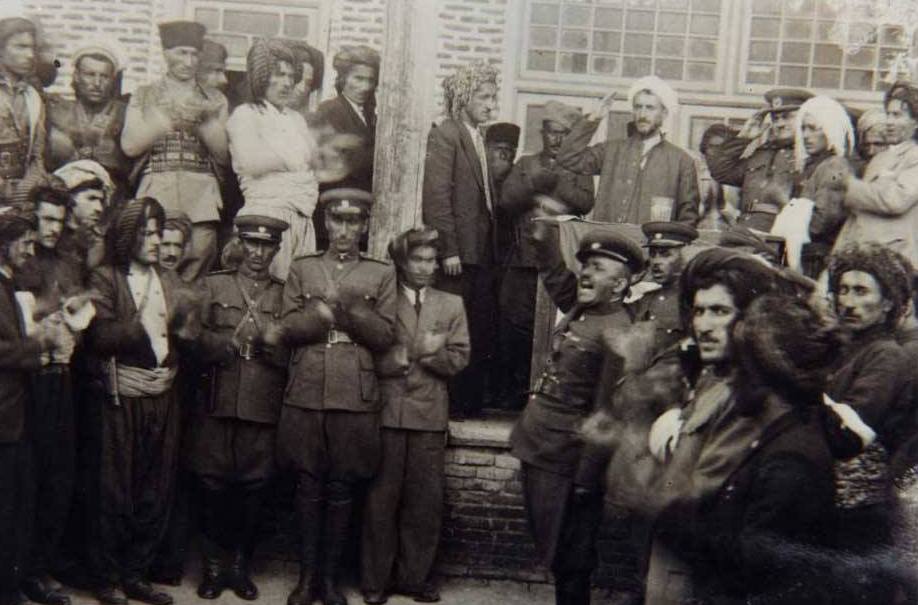

The Republic of Mahabad
South of Lake Urmia, in the Kurdish town of Mahabad, a nationalist society called Komala had grown during the war. In 1945 it became the Kurdistan Democratic Party under Qazi Mohammad, a respected judge and religious leader from a leading local family. On 22 January 1946, at a gathering in the town’s main square, he proclaimed a Kurdish republic. It was small, controlling only Mahabad and the surrounding districts, and depended on Soviet support and on the fighters of Mustafa Barzani, an Iraqi Kurdish leader who had crossed into Iran. It opened Kurdish-language schools, printed Kurdish newspapers and is remembered by many Kurds as the first modern Kurdish state.
Deadline, the UN and Qavam’s bargain
On 19 January 1946 Iran complained to the new United Nations Security Council about Soviet interference, the first dispute the Council handled. Days later the Majlis made Ahmad Qavam prime minister. An experienced and ambitious politician, Qavam travelled to Moscow in February to negotiate directly with Stalin. When 2 March passed, British and American troops had left, but Soviet forces remained, and reports spoke of Soviet columns moving towards Tehran and the Turkish border. Iran raised the issue again at the Security Council, with strong support from the United States.
On 4 April 1946 Qavam reached an agreement with the Soviet ambassador: the Red Army would leave within six weeks, a joint Soviet-Iranian oil company would be formed in the north, subject to approval by the next Majlis, and Azerbaijan would be treated as an internal Iranian matter. Soviet troops completed their withdrawal in May. Qavam then brought three Tudeh ministers into his cabinet in August, a move that alarmed the court, the army and the British. In the autumn a tribal revolt in the south, led by the Qashqai, demanded their removal, and Qavam dropped them in October.
The fall of Tabriz and Mahabad
With the Soviets gone and elections for the new Majlis announced, Qavam sent the army north, officially to supervise the vote. Moscow did not intervene. The Azerbaijan government collapsed almost without a fight, and Iranian troops entered Tabriz on 12–13 December 1946. Crowds attacked the party’s supporters, and hundreds were killed in reprisals; thousands fled to Soviet Azerbaijan. Pishevari himself crossed the border and died in a car accident there in 1947.
Mahabad surrendered days later. Qazi Mohammad, who chose to stay with his people, was tried by a military court and hanged in Mahabad’s main square on 31 March 1947 with his brother and a cousin. Barzani and his men fought their way out and reached the Soviet Union.
In October 1947 the new Majlis rejected the Soviet oil agreement by a large majority. Stalin had withdrawn his army and received nothing in return.
- Sept 1945 Azerbaijan Democratic Party founded
- 12 Dec 1945 Azerbaijan People’s Government formed in Tabriz
- 19 Jan 1946 Iran complains to the UN Security Council
- 22 Jan 1946 Republic of Mahabad proclaimed
- 2 Mar 1946 Treaty deadline for withdrawal passes
- 4 Apr 1946 Qavam–Soviet agreement
- May 1946 Soviet troops leave Iran
- 12–13 Dec 1946 Iranian army enters Tabriz
- 31 Mar 1947 Qazi Mohammad executed
- Oct 1947 Majlis rejects the Soviet oil deal
Why the Soviets left: competing explanations
Harry Truman later said that he had sent Stalin an ultimatum, but historians have found no such document. Louise Fawcett and others credit a combination of factors: firm American and British diplomacy, the publicity of the Security Council, Stalin’s unwillingness to risk a confrontation over a secondary prize, and the skill of Qavam, who offered an oil deal he may never have meant the Majlis to approve. Iranian nationalists credit Qavam above all; monarchists stress the role of the young shah and the army, who took Tabriz in December. The crisis made Iran an early front of the Cold War and strengthened the shah’s ties with the United States, which shaped his early reign.
Persian words from this page
| آذربایجان | Âzarbâyjân | Azerbaijan (the Iranian provinces) |
| تبریز | Tabriz | capital of Iranian Azerbaijan |
| مهاباد | Mahâbâd | Kurdish town south of Lake Urmia |
| قوام السلطنه | Qavâm al-Saltane | title of Ahmad Qavam |
| خودمختاری | khod-mokhtâri | autonomy |
| ۲۱ آذر | bist-o yek-e Âzar | 21 Azar, the date Tabriz was retaken |
Sources and further reading
- Louise L’Estrange Fawcett, Iran and the Cold War: The Azerbaijan Crisis of 1946 (Cambridge University Press, 1992).
- Jamil Hasanli, At the Dawn of the Cold War: The Soviet-American Crisis over Iranian Azerbaijan, 1941–1946 (Rowman and Littlefield, 2006).
- William Eagleton Jr., The Kurdish Republic of 1946 (Oxford University Press, 1963).
- Ervand Abrahamian, Iran Between Two Revolutions (Princeton University Press, 1982), chapter 8.
- Encyclopaedia Iranica, article “Azerbaijan v. History from 1941” (iranicaonline.org).
Want to learn Persian? Get the free Starter Pack
Get the 14-page printable Starter Pack (all 32 letters, a 7-day reading plan, 100 core words and 20 survival phrases) and a short 5-email course. Free.
More in The Pahlavi Era (1925–1979)
- Reza Shah Pahlavi
- Reza Shah’s Reforms
- The Trans-Iranian Railway
- Why Persia Became “Iran” in 1935
- The Unveiling Decree of 1936 (Kashf-e Hijab)
- The Anglo-Soviet Invasion of Iran (1941)
- The Persian Corridor and the Tehran Conference
- The Iran Crisis of 1946
- Mohammad Reza Shah’s Early Reign (1941–1953)
- The Tudeh Party
- Mohammad Mosaddegh
- The Nationalisation of Iranian Oil (1951)
- The 1953 Coup in Iran
- Fazlollah Zahedi
- The 1954 Oil Consortium Agreement
- SAVAK: The Shah’s Security Service
- The White Revolution (1963)
- The Uprising of June 1963 and Khomeini’s Exile
- The Hoveyda Years (1965–1977)
- The 2,500-Year Celebration of the Persian Empire (1971)
- The Oil Boom of the 1970s
- Intellectuals and Opposition in the 1960s–70s
- Iran as a Regional Power under the Shah
- Women in Pahlavi Iran
- The Cinema Rex Fire (1978)
- Black Friday (September 1978)
- The Shah Leaves Iran (January 1979)
- Farah Pahlavi
- The Pahlavi Family
- Forough Farrokhzad and Modern Persian Poetry
- Iranian Cinema before 1979