Mohammad Reza Shah came to the throne on 16 September 1941, aged 21, when the Allies forced his father to abdicate. For the next twelve years he was a constitutional monarch with limited power, sharing the stage with an assertive Majlis, veteran prime ministers, foreign embassies and new mass parties. Between 1941 and 1953 he worked steadily to build up his authority through the army, and the period ended with the fall of Mohammad Mosaddegh in August 1953.
| Born | 26 October 1919, Tehran (twin of Princess Ashraf) |
|---|---|
| Accession | 16 September 1941; oath before the Majlis 17 September |
| Marriages | Princess Fawzia of Egypt (1939, divorced 1948); Soraya Esfandiary-Bakhtiary (1951) |
| Key events | Allied occupation; 1946 crisis; assassination attempt 1949; Constituent Assembly 1949; oil nationalisation 1951; coup of August 1953 |
| Persian name | محمدرضا شاه پهلوی (Mohammad-Rezâ Shâh-e Pahlavi) |
A crown prince shaped by his father
Mohammad Reza was six when his father was crowned and he was named crown prince, ولیعهد (valiahd). Reza Shah had him educated for rule: from 1931 to 1936 at the Le Rosey boarding school in Switzerland, then at the officers’ college in Tehran. In 1939 he married Princess Fawzia, sister of King Farouk of Egypt, a match arranged for prestige; their daughter Shahnaz was born in 1940. Abbas Milani, in his biography The Shah, describes a young man overshadowed by a domineering father, intelligent and well read but shy and unsure of himself, a portrait most historians share.
Accession under occupation
The Anglo-Soviet invasion gave him the throne in humiliating circumstances. British and Soviet troops entered Tehran the day he took the oath. To reassure the Majlis and the Allies he promised to rule as a constitutional monarch, released political prisoners and returned to the state many of the lands his father had seized.
Real power moved elsewhere. The Majlis, filled with landlords, tribal chiefs and notables now freed from Reza Shah’s control, made and unmade governments: Iran had more than a dozen prime ministers between 1941 and 1951, among them Mohammad Ali Foroughi, Ali Soheili, Ahmad Qavam, Ebrahim Hakimi and Mohammad Sa’ed. The British and Soviet embassies, and increasingly the American one, had a hand in many changes. The press flourished, and new parties appeared, from the communist Tudeh Party to conservative and religious groups.
The army as the shah’s base
The young shah’s chosen ground was the army. He insisted on his right as commander-in-chief to appoint officers and to deal directly with the war minister, against prime ministers who wanted civilian control. American military missions from 1942 helped rebuild the army and the gendarmerie. Ervand Abrahamian describes the politics of the 1940s as a three-way struggle among the court, which controlled the army; the Majlis notables, who controlled the countryside; and the new urban middle and working classes organised by the Tudeh and, later, the National Front.
The Iran crisis of 1946 strengthened his position. Although Prime Minister Ahmad Qavam negotiated the Soviet withdrawal, it was the army that reoccupied Tabriz in December 1946, and the shah took much of the credit. Qavam was forced out at the end of 1947.

1949: the assassination attempt and new powers
On 4 February 1949, at a ceremony at the University of Tehran, a young man named Naser Fakhrara’i fired several shots at the shah from close range, wounding him in the face and shoulder. The gunman was killed on the spot. He carried a press card from a religious newspaper and had links to the Tudeh, and the government blamed the communists. Martial law was declared, the Tudeh Party was banned and its leaders arrested or driven into exile, and the politically active cleric Ayatollah Abolqasem Kashani was sent into exile.
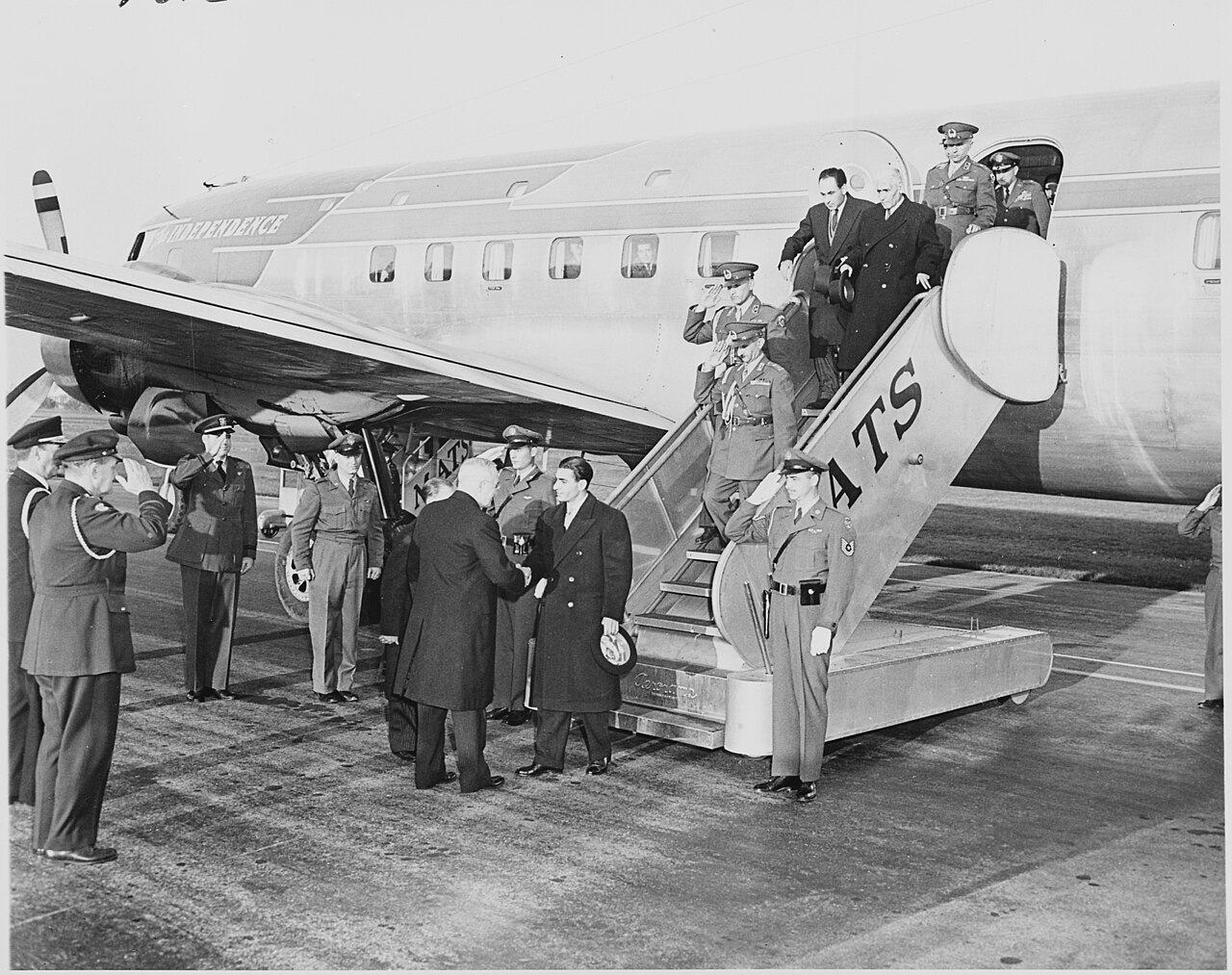
The shah used the moment to increase his powers. A Constituent Assembly convened in 1949 amended the constitution to allow the shah to dissolve parliament, and the Senate, provided for in 1906 but never assembled, was created, with half its members appointed by the shah. The same year the Plan Organisation was founded to run a seven-year development plan financed by oil revenue. In November 1949 he made his first state visit to the United States and met President Truman.
Oil, Mosaddegh and 1953
From 1949 the dominant issue was oil. The National Front, led by Mohammad Mosaddegh, demanded the nationalisation of the Anglo-Iranian Oil Company. The shah’s prime minister General Ali Razmara opposed full nationalisation and was assassinated on 7 March 1951 by a member of the Fada’iyan-e Islam. Within weeks the Majlis passed the nationalisation law and the shah appointed Mosaddegh prime minister. In February 1951 he married Soraya Esfandiary-Bakhtiary, and the same year he began distributing some crown lands to peasants, an early sign of later reforms.
The next two years were a contest between the shah and his prime minister over control of the army and of government. In July 1952 Mosaddegh resigned when the shah refused him the war ministry; after the uprising of 30 Tir (21 July 1952), the shah had to reappoint him on his terms. In August 1953, after a failed first attempt to dismiss Mosaddegh, the shah left the country for Baghdad and Rome. A coup organised with American and British support overthrew Mosaddegh on 19 August, and the shah returned to Tehran on 22 August. These events are covered on the pages on the nationalisation of Iranian oil and the 1953 coup.
- 1919 Born in Tehran
- 1926 Named crown prince
- 1939 Marries Princess Fawzia of Egypt
- 1941 Becomes shah after his father’s abdication
- 1946 Army retakes Azerbaijan
- 1949 Survives assassination attempt; Constituent Assembly increases royal powers
- 1951 Marries Soraya; Mosaddegh becomes prime minister
- 1952 Uprising of 30 Tir returns Mosaddegh to office
- 1953 Leaves Iran; returns after the coup of 19 August
How historians read these years
Historians differ mainly on how to judge the shah’s role. Milani portrays him as hesitant and dependent on others, especially foreign powers and his twin sister Ashraf, until 1953 gave him the confidence to rule alone. Gholam Reza Afkhami, in a more sympathetic biography, presents him as a patriot trying to hold together a country threatened by Soviet pressure and chaotic politics. Abrahamian and Homa Katouzian see the years 1941–1953 as Iran’s best chance of parliamentary government, ended by the court and its foreign allies in 1953. Abbas Amanat stresses the shah’s steady pursuit of control over the army as the thread running through the period. What followed 1953, a much more personal rule, is covered in later pages of this section.
Persian words from this page
| محمدرضا شاه | Mohammad-Rezâ Shâh | Mohammad Reza Shah |
| ولیعهد | valiahd | crown prince |
| نخستوزیر | nakhost-vazir | prime minister |
| مجلس سنا | Majles-e Senâ | the Senate |
| ارتش | artesh | army |
| سی تیر | si-ye Tir | 30 Tir (21 July 1952) |
Sources and further reading
- Abbas Milani, The Shah (Palgrave Macmillan, 2011).
- Gholam Reza Afkhami, The Life and Times of the Shah (University of California Press, 2009).
- Ervand Abrahamian, Iran Between Two Revolutions (Princeton University Press, 1982), chapters 4–6.
- Homa Katouzian, Musaddiq and the Struggle for Power in Iran (I.B. Tauris, 1990).
- Abbas Amanat, Iran: A Modern History (Yale University Press, 2017).
Want to learn Persian? Get the free Starter Pack
Get the 14-page printable Starter Pack (all 32 letters, a 7-day reading plan, 100 core words and 20 survival phrases) and a short 5-email course. Free.
More in The Pahlavi Era (1925–1979)
- Reza Shah Pahlavi
- Reza Shah’s Reforms
- The Trans-Iranian Railway
- Why Persia Became “Iran” in 1935
- The Unveiling Decree of 1936 (Kashf-e Hijab)
- The Anglo-Soviet Invasion of Iran (1941)
- The Persian Corridor and the Tehran Conference
- The Iran Crisis of 1946
- Mohammad Reza Shah’s Early Reign (1941–1953)
- The Tudeh Party
- Mohammad Mosaddegh
- The Nationalisation of Iranian Oil (1951)
- The 1953 Coup in Iran
- Fazlollah Zahedi
- The 1954 Oil Consortium Agreement
- SAVAK: The Shah’s Security Service
- The White Revolution (1963)
- The Uprising of June 1963 and Khomeini’s Exile
- The Hoveyda Years (1965–1977)
- The 2,500-Year Celebration of the Persian Empire (1971)
- The Oil Boom of the 1970s
- Intellectuals and Opposition in the 1960s–70s
- Iran as a Regional Power under the Shah
- Women in Pahlavi Iran
- The Cinema Rex Fire (1978)
- Black Friday (September 1978)
- The Shah Leaves Iran (January 1979)
- Farah Pahlavi
- The Pahlavi Family
- Forough Farrokhzad and Modern Persian Poetry
- Iranian Cinema before 1979