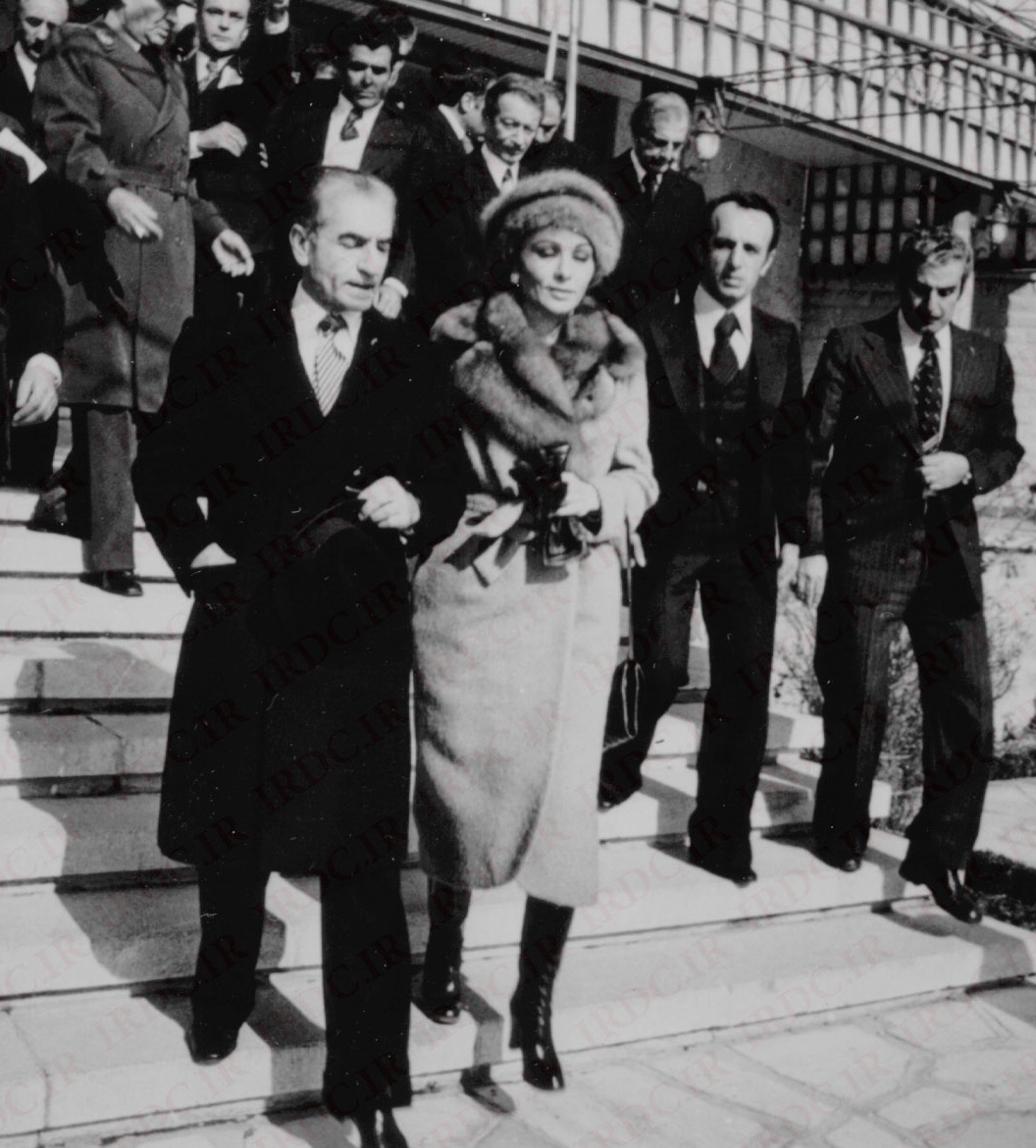
On 16 January 1979 Mohammad Reza Shah and Empress Farah flew out of Mehrabad airport in Tehran, officially for a rest abroad. He left behind a new prime minister, Shapour Bakhtiar, and a regency council, but neither survived the return of Ayatollah Khomeini two weeks later. The shah never came back, and his departure is remembered in Iran by the newspaper headline of that afternoon: “The shah left” (شاه رفت).
| Date | 16 January 1979 (26 Dey 1357) |
|---|---|
| From | Mehrabad airport, Tehran |
| First stop | Aswan, Egypt |
| Prime minister left in office | Shapour Bakhtiar (January to 11 February 1979) |
| Death of the shah | 27 July 1980, Cairo |

Autumn 1978: a government that could not govern
After Black Friday in September 1978, strikes spread to the oil fields, the banks, the customs and the newspapers. Oil exports, the state’s main source of income, collapsed. On 6 November the shah replaced Sharif-Emami with a military government under General Gholam-Reza Azhari and, in a televised speech, told the nation that he had “heard the voice of your revolution”. Neither the soldiers nor the apology ended the protests. In early December, during the month of Muharram, enormous marches on Tasua and Ashura filled the streets of Tehran and demanded the end of the monarchy.
The shah, who was secretly being treated for cancer, appeared indecisive to those around him. He refused to order a large-scale crackdown, and the generals would not act without him. By December he was looking for a civilian politician from the opposition who would take office on condition that he left the country.
Shapour Bakhtiar’s gamble
Shapour Bakhtiar (1914–1991) was a veteran of Mosaddegh’s National Front, educated in France, from a family of the Bakhtiari tribal aristocracy. He had been jailed several times under the shah. At the end of December 1978 he agreed to form a government on his own terms: the shah would leave Iran, SAVAK would be dissolved and political prisoners freed. His old colleagues in the National Front, who had by then allied themselves with Khomeini, expelled him.
In his few weeks in office Bakhtiar released prisoners, lifted press censorship, announced the dissolution of SAVAK, and stopped oil sales to Israel and South Africa. He presented himself as the defender of the constitution of 1906 against both dictatorship and theocracy. But to most of the crowds he was the shah’s last prime minister, and Khomeini, from Paris, declared his government illegal.
16 January 1979
The departure came shortly after parliament had approved Bakhtiar’s cabinet. A small group of officials and officers saw the royal couple off at Mehrabad. Photographs from the airport show the shah close to tears. The official line was that the shah was going abroad for a rest and medical treatment, and a regency council was formed to act in his absence.
In Tehran the news brought crowds into the streets to celebrate. Cars drove with their headlights on, people handed out sweets, and statues of the shah and his father were pulled down in several cities. The evening papers came out with the two-word headline “The shah left”.
Washington and the generals
The United States was divided over what to do. Some officials in the Carter administration wanted the army to keep the monarchy in power; others thought the shah was finished and that Washington should talk to the opposition. In early January President Carter sent General Robert Huyser, deputy commander of US forces in Europe, to Tehran to keep the Iranian high command united behind Bakhtiar and to discourage a coup. Western leaders discussed Iran at a summit on the island of Guadeloupe in early January. Historians still argue over whether American policy hastened the collapse or simply could not prevent it.
After the departure
Khomeini returned to Tehran on 1 February 1979 and named Mehdi Bazargan head of a provisional government in rivalry with Bakhtiar. On 11 February the army declared itself neutral and Bakhtiar’s government collapsed. These events are told on the page about Khomeini’s return and the fall of the monarchy. Bakhtiar escaped to France, where he led an opposition group, and was murdered at his home near Paris in August 1991; a French court later convicted Iranians of the killing.
The shah’s own exile was a journey between countries reluctant to keep him:
- January 1979 Aswan, Egypt, as guest of President Anwar Sadat
- January–March 1979 Morocco
- March–June 1979 The Bahamas
- June–October 1979 Mexico
- October 1979 New York, for cancer treatment; his admission to the United States was followed on 4 November by the seizure of the US embassy in Tehran (see the hostage crisis)
- December 1979 Panama
- March 1980 Egypt again
- 27 July 1980 Death in Cairo; buried in the Al-Rifa’i Mosque
For his life before 1979 see Mohammad Reza Shah’s early reign, and for the family he took into exile see Farah Pahlavi.
Persian words from this page
| شاه رفت | shâh raft | the shah left |
| فرودگاه مهرآباد | forudgâh-e Mehrâbâd | Mehrabad airport |
| شورای سلطنت | shurâ-ye saltanat | regency council |
| بختیار | Bakhtiâr | Bakhtiar |
| تبعید | tab’id | exile |
| اعتصاب | e’tesâb | strike |
Sources and further reading
- Ervand Abrahamian, Iran Between Two Revolutions, Princeton University Press, 1982.
- Abbas Milani, The Shah, Palgrave Macmillan, 2011.
- Gary Sick, All Fall Down: America’s Tragic Encounter with Iran, Random House, 1985.
- Robert E. Huyser, Mission to Tehran, Harper and Row, 1986.
- Farah Pahlavi, An Enduring Love: My Life with the Shah, Miramax, 2004.
Want to learn Persian? Get the free Starter Pack
Get the 14-page printable Starter Pack (all 32 letters, a 7-day reading plan, 100 core words and 20 survival phrases) and a short 5-email course. Free.
More in The Pahlavi Era (1925–1979)
- Reza Shah Pahlavi
- Reza Shah’s Reforms
- The Trans-Iranian Railway
- Why Persia Became “Iran” in 1935
- The Unveiling Decree of 1936 (Kashf-e Hijab)
- The Anglo-Soviet Invasion of Iran (1941)
- The Persian Corridor and the Tehran Conference
- The Iran Crisis of 1946
- Mohammad Reza Shah’s Early Reign (1941–1953)
- The Tudeh Party
- Mohammad Mosaddegh
- The Nationalisation of Iranian Oil (1951)
- The 1953 Coup in Iran
- Fazlollah Zahedi
- The 1954 Oil Consortium Agreement
- SAVAK: The Shah’s Security Service
- The White Revolution (1963)
- The Uprising of June 1963 and Khomeini’s Exile
- The Hoveyda Years (1965–1977)
- The 2,500-Year Celebration of the Persian Empire (1971)
- The Oil Boom of the 1970s
- Intellectuals and Opposition in the 1960s–70s
- Iran as a Regional Power under the Shah
- Women in Pahlavi Iran
- The Cinema Rex Fire (1978)
- Black Friday (September 1978)
- The Shah Leaves Iran (January 1979)
- Farah Pahlavi
- The Pahlavi Family
- Forough Farrokhzad and Modern Persian Poetry
- Iranian Cinema before 1979