Reza Shah Pahlavi (1878–1944) was a soldier of humble origins who rose through the Persian Cossack Brigade, seized power in the coup of 1921 and ruled Iran as shah from 1925 until 1941. He founded the Pahlavi dynasty and built a centralised state with a modern army, courts and schools, but he ruled as an autocrat who tolerated no rivals. The Allied invasion of 1941 forced him to abdicate, and he died in exile in Johannesburg.
| Born | 15 March 1878, Alasht, Savadkuh district, Mazandaran |
|---|---|
| Reign | Proclaimed shah 12 December 1925; crowned 25 April 1926; abdicated 16 September 1941 |
| Predecessor | Ahmad Shah Qajar (deposed by the Majlis, 31 October 1925) |
| Successor | His son, Mohammad Reza Shah |
| Died | 26 July 1944, Johannesburg, South Africa |
| Persian name | رضا شاه پهلوی (Rezâ Shâh-e Pahlavi) |
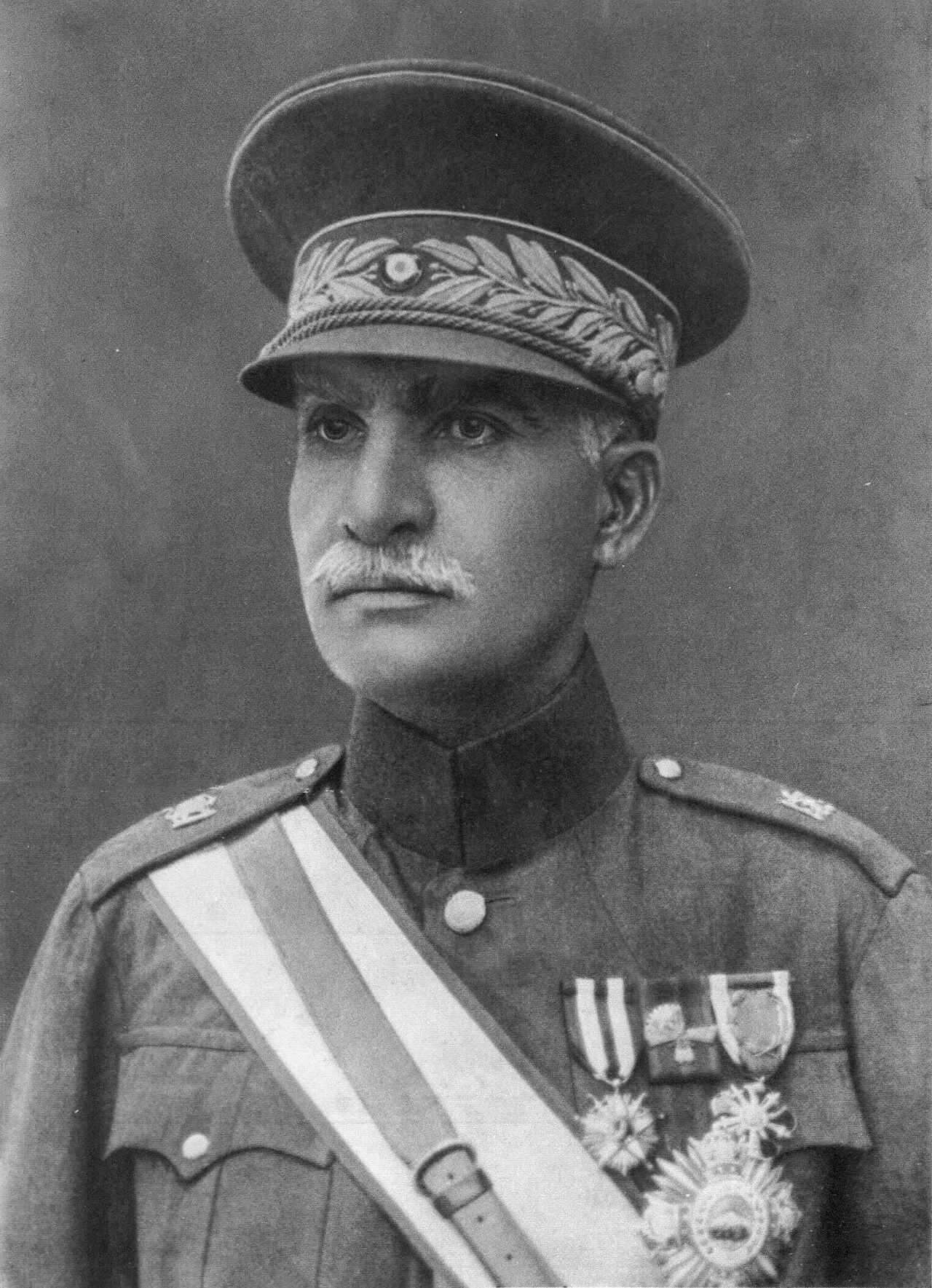

From Savadkuh to the Cossack Brigade
Reza was born in the village of Alasht in the forested hills of Savadkuh, south of the Caspian coast. His father, an officer in a local regiment, died when he was an infant, and his mother took him to Tehran. As a teenager he joined the Persian Cossack Brigade, the Russian-officered force that was the Qajar shahs’ most effective unit. He was tall, physically imposing and barely schooled; he learned to read late. His skill with the Maxim gun earned him the nickname Reza Khan Maxim.
By the end of the First World War he was one of the brigade’s senior Iranian officers. In February 1921, with British officers in northern Iran looking for a strong man and the journalist Sayyed Zia al-Din Tabatabai looking for an army, he led his Cossacks into Tehran. How he then rose from minister of war to prime minister to shah, and how the Qajar dynasty was voted out, is told on the pages on the coup of 1921 and the end of the Qajar dynasty. This page picks up the story at his coronation.
A coronation and a new name
On 25 April 1926 Reza Shah crowned himself in the Golestan Palace in Tehran, placing on his own head a new crown made for the occasion. His six-year-old son Mohammad Reza was named crown prince. The family name he had registered under the new civil registration law, Pahlavi, was chosen with care: it is the name of the Middle Persian language of the Sasanian era, and it linked the new dynasty to Iran’s pre-Islamic empires rather than to the Turkic tribal origins of the Qajars. The palace where he was crowned is described in our post on Golestan Palace.
The choice summed up the ideology of the reign. Reza Shah presented himself as the restorer of a strong, unified and ancient nation after a century of weakness and foreign interference. Official history, school textbooks and architecture drew on Achaemenid and Sasanian imagery, and in 1935 the government asked foreign states to call the country Iran instead of Persia.
How he ruled
Reza Shah kept the constitution of 1906 and the Majlis, but emptied both of independence. Elections were managed by the court, the army and provincial governors, and from the late 1920s the Majlis approved what the shah wanted. Ervand Abrahamian describes the regime as resting on three pillars: the new army, an expanding state bureaucracy and the patronage of the court. Abrahamian estimates that the army grew from about 40,000 men in 1925 to 127,000 by 1941, and it took a large share of the budget throughout the reign.
The army was first used inside Iran. Campaigns in the 1920s broke the power of tribal leaders among the Lurs, Kurds, Bakhtiari, Qashqai, Turkmen and Baluch. Many nomadic groups were forced to settle, a policy known as تخته قاپو (takhte-qâpu). Supporters saw this as the end of banditry and local warlords; critics, and many tribal people themselves, remembered loss of herds, disease and humiliation.
The fate of his allies
The men who helped Reza Shah to power rarely survived his favour. Abdolhossein Teymourtash, the able minister of court who ran much of the government in the late 1920s, was dismissed in 1932 and died in Qasr prison in 1933. Jafar Qoli Khan Sardar Asad, the Bakhtiari chief and minister of war, died in custody in 1934. Prince Firuz Nosrat al-Dowleh, a former finance minister, was arrested and later killed in confinement. The cleric and deputy Sayyed Hasan Modarres, the most outspoken opponent of the new dynasty in the Majlis, was exiled to Khorasan in 1928 and killed there in 1937. The poet and editor Farrokhi Yazdi died in prison in 1939. Ali-Akbar Davar, the architect of the legal reforms, took his own life in 1937 amid the shah’s displeasure.
Land and wealth
The shah also became very rich. Through purchase, pressure and confiscation he acquired estates across the country, especially in his native Mazandaran, where he built hotels, roads and palaces. Abrahamian and others describe him as the largest landowner in Iran by 1941. Defenders argue that much of this land was developed and that the estates were later handed to the state; critics see it as plunder that blurred the line between the crown and the treasury.
Modernisation from above
The reign brought rapid change to the institutions of the state. A conscription law of 1925 created a national army. New civil, commercial and criminal codes replaced most of the authority of religious courts. The foreign legal privileges known as capitulations were abolished in 1928. Government schools multiplied, students were sent to Europe at state expense, and the University of Tehran opened in 1934. Modern roads, a national bank and state factories followed, and the Trans-Iranian Railway linked the Caspian Sea to the Persian Gulf in 1938. These changes are covered in detail on the page on Reza Shah’s reforms.
Social change was also imposed by decree. The dress law of 1928 required men to wear Western-style clothes and the round Pahlavi cap, replaced in 1935 by the European brimmed hat. In January 1936 the state banned the veil in public, the measure known as kashf-e hijab. A protest against the new hat at the Goharshad Mosque in Mashhad in July 1935 was crushed by troops.
Oil, Britain and Germany
Reza Shah wanted to reduce the influence of Britain and the Soviet Union, the two powers that had divided Iran into spheres in 1907. In November 1932 he cancelled the D’Arcy concession held by the Anglo-Persian Oil Company. After Britain took the case to the League of Nations, a new agreement was signed in 1933. It raised Iran’s royalties and reduced the area of the concession, but extended it to 1993. Many Iranians, and later Mohammad Mosaddegh, regarded the 1933 agreement as a defeat; the background is on the page on the D’Arcy concession.
To balance the old powers, the shah turned to Germany, which by the late 1930s was Iran’s largest trading partner and supplied engineers, machinery and technicians. This connection, and Iran’s position between British India, Iraq and the Soviet Union, made the country a target once Germany invaded the USSR in June 1941.
Abdication, exile and burial
On 25 August 1941 British and Soviet forces invaded Iran. The army that Reza Shah had built over twenty years collapsed within days. Facing the prospect of Allied troops in Tehran and with no support among the political class, he abdicated in favour of his son on 16 September 1941. The story is told on the page on the Anglo-Soviet invasion.
The British took him first to Mauritius and then to Johannesburg, where he died on 26 July 1944. His body was embalmed and kept in Cairo, then brought back to Iran in 1950 and placed in a mausoleum at Rey, south of Tehran. After the 1979 revolution the mausoleum was demolished.
How historians judge Reza Shah
No figure of modern Iranian history divides opinion more sharply, apart from his son. Monarchists and many secular nationalists see him as the founder of modern Iran, the man who rescued a disintegrating country, gave it an army, a legal system, a university and a railway, and opened public life to women. Clerical critics, the left and many liberals see a dictator who destroyed constitutional government, enriched himself and attacked religion and the tribes.
Historians have moved beyond these positions. Stephanie Cronin’s edited volume The Making of Modern Iran (2003) argues that the state’s projects were shaped by resistance and negotiation with tribes, clergy, workers and women, not simply imposed. Homa Katouzian, in State and Society in Iran (2000), places Reza Shah in a long Iranian pattern of arbitrary rule, in which a strong ruler restores order after chaos and then rules without legal limits. Ali Ansari, in Modern Iran since 1921, stresses how nationalist myth-making legitimised the dynasty. Abbas Amanat, in Iran: A Modern History (2017), credits the reign with lasting institutions while describing the growing fear and isolation of its final decade. Most agree on two points: Iran’s modern state took shape under Reza Shah, and the way it was built, by force and without consent, left a legacy of distrust that shaped the next half century.
- 1878 Born in Alasht, Mazandaran
- 1921 Leads the Cossack coup in Tehran
- 1923 Becomes prime minister
- 1925 Majlis deposes the Qajars; constituent assembly makes him shah
- 1926 Coronation at the Golestan Palace
- 1932–1933 Cancels and renegotiates the oil concession
- 1936 Unveiling decree
- 1941 Anglo-Soviet invasion; abdicates on 16 September
- 1944 Dies in Johannesburg
Persian words from this page
| رضا شاه | Rezâ Shâh | Reza Shah |
| پهلوی | Pahlavi | the dynasty’s name; also Middle Persian |
| سوادکوه | Savâdkuh | his home district in Mazandaran |
| قزاق | qazzâq | Cossack |
| مجلس | Majles | parliament |
| تخته قاپو | takhte-qâpu | forced settlement of nomads |
Sources and further reading
- Ervand Abrahamian, Iran Between Two Revolutions (Princeton University Press, 1982), chapter 3.
- Stephanie Cronin (ed.), The Making of Modern Iran: State and Society under Riza Shah, 1921–1941 (Routledge, 2003).
- Homa Katouzian, State and Society in Iran: The Eclipse of the Qajars and the Emergence of the Pahlavis (I.B. Tauris, 2000).
- Ali M. Ansari, Modern Iran since 1921: The Pahlavis and After (Longman, 2003).
- Abbas Amanat, Iran: A Modern History (Yale University Press, 2017).
- Cyrus Ghani, Iran and the Rise of Reza Shah: From Qajar Collapse to Pahlavi Power (I.B. Tauris, 1998).
Want to learn Persian? Get the free Starter Pack
Get the 14-page printable Starter Pack (all 32 letters, a 7-day reading plan, 100 core words and 20 survival phrases) and a short 5-email course. Free.
More in The Pahlavi Era (1925–1979)
- Reza Shah Pahlavi
- Reza Shah’s Reforms
- The Trans-Iranian Railway
- Why Persia Became “Iran” in 1935
- The Unveiling Decree of 1936 (Kashf-e Hijab)
- The Anglo-Soviet Invasion of Iran (1941)
- The Persian Corridor and the Tehran Conference
- The Iran Crisis of 1946
- Mohammad Reza Shah’s Early Reign (1941–1953)
- The Tudeh Party
- Mohammad Mosaddegh
- The Nationalisation of Iranian Oil (1951)
- The 1953 Coup in Iran
- Fazlollah Zahedi
- The 1954 Oil Consortium Agreement
- SAVAK: The Shah’s Security Service
- The White Revolution (1963)
- The Uprising of June 1963 and Khomeini’s Exile
- The Hoveyda Years (1965–1977)
- The 2,500-Year Celebration of the Persian Empire (1971)
- The Oil Boom of the 1970s
- Intellectuals and Opposition in the 1960s–70s
- Iran as a Regional Power under the Shah
- Women in Pahlavi Iran
- The Cinema Rex Fire (1978)
- Black Friday (September 1978)
- The Shah Leaves Iran (January 1979)
- Farah Pahlavi
- The Pahlavi Family
- Forough Farrokhzad and Modern Persian Poetry
- Iranian Cinema before 1979