The White Revolution was a programme of reforms launched by Mohammad Reza Shah and approved in a referendum on 26 January 1963. Its centre was land reform, which broke up the great estates and made many sharecroppers owners of land; it also gave women the vote and sent young conscripts to teach in villages. The shah called it a “revolution of the shah and the people”, meant to modernise Iran without bloodshed. It changed rural society deeply, but it also set off the clerical opposition that grew into the revolution of 1979.
| Persian name | Enqelab-e Sefid; officially Enqelab-e Shah va Mardom (Revolution of the Shah and the People) |
|---|---|
| Referendum | 26 January 1963 (6 Bahman 1341) |
| Official result | 5,598,711 in favour, 4,115 against; opposition boycott |
| Original points | Six, extended to 19 by 1977 |
| Key ministers | Ali Amini (prime minister 1961–62); Hassan Arsanjani (agriculture) |

Why reform came from the throne
By 1960 Iran was still a country of landlords and villages. Most farmland belonged to large owners, the crown, religious endowments and the state, and most peasants worked it as sharecroppers. The Kennedy administration in Washington, worried about revolution in poor countries, pressed allies to reform. In Iran an economic crisis in 1960–61 and protests over rigged elections pushed the shah to appoint Ali Amini, a reformer with American backing, as prime minister in May 1961.
Amini’s minister of agriculture, Hassan Arsanjani, began land reform in January 1962 under a law that limited each landlord to one village. Arsanjani toured the country and made the reform popular with peasants, and with himself. The shah, who did not want either man to take the credit, dismissed Amini in July 1962 and later moved Arsanjani aside. He then took over the programme as his own and widened it.
The six points of January 1963
The shah announced six measures in January 1963 and put them to a national vote:
- land reform, buying land from landlords and selling it to peasants on long-term credit
- nationalisation of forests and pastures
- sale of state factories to fund compensation for landlords
- profit-sharing for industrial workers
- a new electoral law that gave women the vote and the right to stand for parliament
- a Literacy Corps of conscripts who taught in villages instead of doing military service
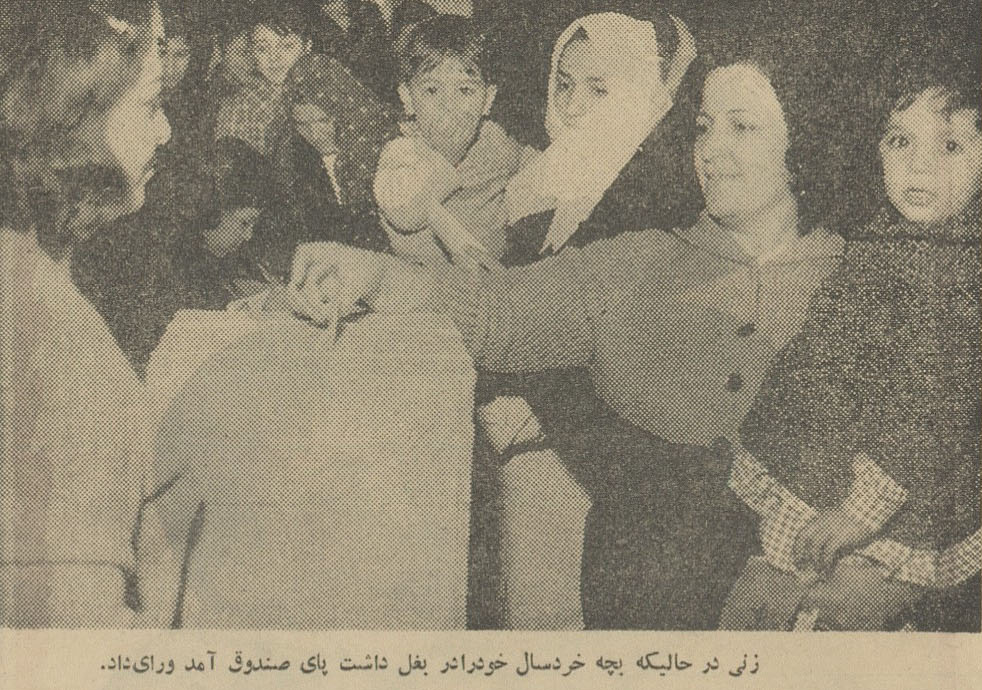
The National Front answered with the slogan “reforms yes, dictatorship no” and called for a boycott. Many senior clerics objected to land reform as a breach of property rights protected by Islamic law, and to votes for women. The referendum was organised by the government and the official majority was over 99 per cent. Women voted in it at separate ballot boxes, although their votes were not formally counted. Later points added a Health Corps, a Development Corps, village “houses of equity” to settle small disputes, nationalisation of water resources and, in the 1970s, free schooling and free meals for schoolchildren.
What land reform did
Land reform was carried out in three stages between 1962 and the early 1970s. In the first, landlords holding more than one village had to sell the rest. In the second, from 1964, owners could keep land but had to sell, lease or divide it with their tenants. In the third, from 1968, remaining tenancies were turned into ownership. Official figures speak of around two million families who received land; estimates in the literature vary with what is counted.
The old landlord class lost its hold on the countryside, and with it much of its power in parliament. But many new owners received plots too small to live on, and village labourers who had no sharecropping rights, the khoshneshin, received nothing. Ann Lambton, who studied the reform on the ground, saw it as a real social change undermined by bureaucracy and the lack of credit and cooperatives. Eric Hooglund argued that it left most peasants little better off and drove many to the cities. Large commercial farms and agribusiness projects favoured by the state in the late 1960s pushed in the same direction. Millions of rural migrants to Tehran and other cities in the 1960s and 1970s later supplied many of the crowds of 1978.
Votes for women and the Literacy Corps
Women voted and stood in parliamentary elections for the first time in September 1963, when six women entered the Majlis and two were appointed to the Senate. The story of women’s rights under the dynasty is told on women in Pahlavi Iran. The Literacy Corps, Sepah-e Danesh, sent tens of thousands of young men, and from 1968 young women, to village schools; literacy rose, though Iran still had high illiteracy in 1979, especially among rural women.
Revolution from above
The shah presented the White Revolution as the heart of his reign, and the regime marked 6 Bahman every year. Supporters, including historians such as Abbas Milani and Gholam Reza Afkhami, point to the end of landlord rule, the spread of schools and clinics, and economic growth. Critics, from Ervand Abrahamian to Homa Katouzian, argue that it was reform imposed from the top, which removed old elites without allowing new ones to share power, and so concentrated everything in the shah. The most immediate result was political: Ayatollah Ruhollah Khomeini’s attacks on the programme and the government led directly to the uprising of June 1963. The economic side of the following decade is covered in the Hoveyda years.
Persian words from this page
| انقلاب سفید | Enqelâb-e Sefid | White Revolution |
| انقلاب شاه و مردم | Enqelâb-e Shâh va Mardom | Revolution of the Shah and the People |
| اصلاحات ارضی | eslâhât-e arzi | land reform |
| سپاه دانش | Sepâh-e Dânesh | Literacy Corps |
| ارباب | arbâb | landlord |
| خوشنشین | khoshneshin | landless village labourer |
| همهپرسی | hameporsi | referendum |
Sources and further reading
- Ann K.S. Lambton, The Persian Land Reform, 1962–1966 (Clarendon Press, 1969).
- Eric J. Hooglund, Land and Revolution in Iran, 1960–1980 (University of Texas Press, 1982).
- Ervand Abrahamian, A History of Modern Iran (Cambridge University Press, 2008).
- Abbas Milani, The Shah (Palgrave Macmillan, 2011).
- Ali M. Ansari, “The Myth of the White Revolution”, Middle Eastern Studies 37:3 (2001).
Want to learn Persian? Get the free Starter Pack
Get the 14-page printable Starter Pack (all 32 letters, a 7-day reading plan, 100 core words and 20 survival phrases) and a short 5-email course. Free.
More in The Pahlavi Era (1925–1979)
- Reza Shah Pahlavi
- Reza Shah’s Reforms
- The Trans-Iranian Railway
- Why Persia Became “Iran” in 1935
- The Unveiling Decree of 1936 (Kashf-e Hijab)
- The Anglo-Soviet Invasion of Iran (1941)
- The Persian Corridor and the Tehran Conference
- The Iran Crisis of 1946
- Mohammad Reza Shah’s Early Reign (1941–1953)
- The Tudeh Party
- Mohammad Mosaddegh
- The Nationalisation of Iranian Oil (1951)
- The 1953 Coup in Iran
- Fazlollah Zahedi
- The 1954 Oil Consortium Agreement
- SAVAK: The Shah’s Security Service
- The White Revolution (1963)
- The Uprising of June 1963 and Khomeini’s Exile
- The Hoveyda Years (1965–1977)
- The 2,500-Year Celebration of the Persian Empire (1971)
- The Oil Boom of the 1970s
- Intellectuals and Opposition in the 1960s–70s
- Iran as a Regional Power under the Shah
- Women in Pahlavi Iran
- The Cinema Rex Fire (1978)
- Black Friday (September 1978)
- The Shah Leaves Iran (January 1979)
- Farah Pahlavi
- The Pahlavi Family
- Forough Farrokhzad and Modern Persian Poetry
- Iranian Cinema before 1979