Fazlollah Zahedi (1892–1963) was an Iranian army general who became prime minister when Mohammad Mosaddegh was overthrown in August 1953. His career ran from the Cossack Brigade that brought Reza Shah to power, through British internment in the Second World War, to twenty months as head of government in which the shah’s authority was restored and a new oil agreement signed.
| Born | 1892, Hamadan |
|---|---|
| Died | 2 September 1963, Geneva |
| Persian name | فضلالله زاهدی |
| Rank | Sepahbod (lieutenant general) |
| Prime minister | August 1953 to April 1955 |
| Son | Ardeshir Zahedi, later foreign minister |
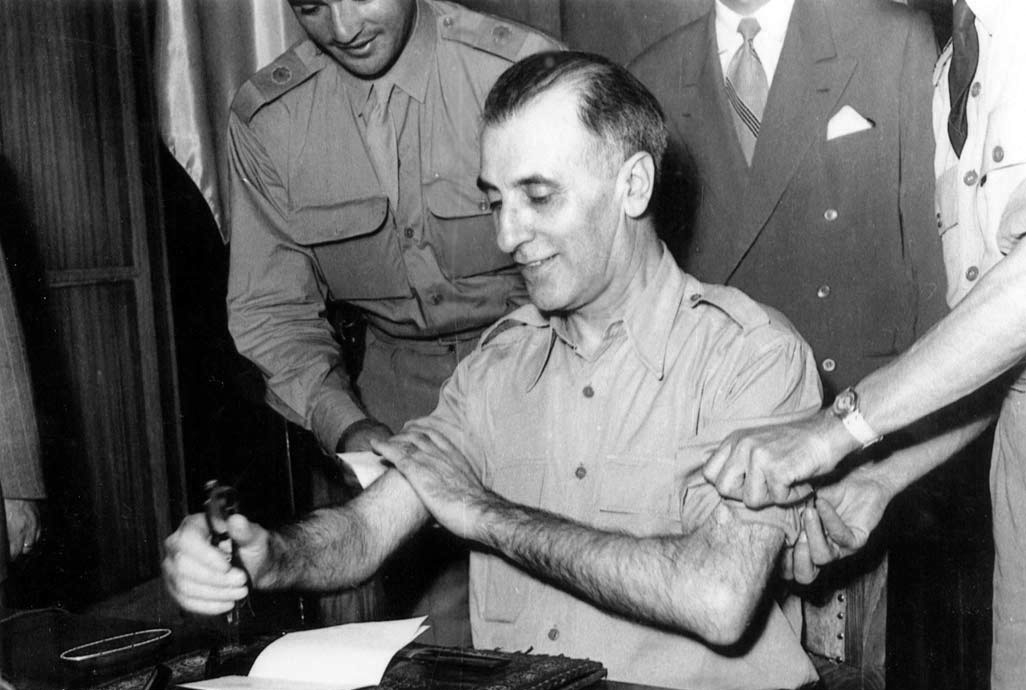

A Cossack officer under Reza Khan
Zahedi was born in Hamadan in 1892 into a landowning family and entered the Persian Cossack Brigade as a young man. One of his commanders there was Reza Khan, the officer who seized power in Tehran in 1921 and was crowned Reza Shah in 1926. Zahedi rose with him. He fought against the Jangali movement of Mirza Kuchik Khan in Gilan and against tribal revolts in the north, and in the mid-1920s he served in the campaign that ended the autonomy of Sheikh Khazal in Khuzestan, where he was then made military governor.
Under Reza Shah he held a string of senior posts. He was chief of the national police in the early 1930s and, by 1941, commander of the army division in Isfahan. The title سپهبد (sepahbod), the rank he later held, is an old Persian word for an army commander that Reza Shah revived for the highest generals of his new army.
Arrested by the British, 1942
After Britain and the Soviet Union invaded Iran in August 1941 and forced Reza Shah to abdicate (see the Anglo-Soviet invasion), the British came to suspect Zahedi of working with German agents and of hoarding grain while Isfahan went hungry. In 1942 he was seized in his own house by a small team led by the British officer Fitzroy Maclean, who later described the operation in his memoir Eastern Approaches (1949). Zahedi was flown out of the country and held in British-ruled Palestine until the end of the war.
The episode mattered later. It made Zahedi a man the British had once treated as an enemy, which helped his standing as a nationalist when, ten years on, he worked with British and American intelligence against Mosaddegh.
From Mosaddegh’s minister to his rival
Back in Iran in 1945, Zahedi held military inspection posts and in 1949 was again appointed head of the national police. He became a senator in 1950. When the oil crisis began, he at first stood on the nationalist side: he was interior minister under Hossein Ala in 1951 and kept the post when Mohammad Mosaddegh became prime minister in April that year, during the nationalisation of the oil industry.
The partnership did not last. Mosaddegh dismissed him after the police killed demonstrators in Tehran in July 1951, during protests at the visit of the American envoy Averell Harriman. Zahedi then became a leader of the opposition to Mosaddegh among retired officers and conservative politicians. He objected in particular to the government’s tolerance of the communist Tudeh Party, and Mosaddegh’s supporters accused him of plotting. In early 1953 he took refuge for a time in the Majlis building to avoid arrest.
The candidate of the coup
When the American CIA and British MI6 planned to remove Mosaddegh in 1953, they needed an Iranian officer to lead the operation and take over the government. A CIA history of the operation, written in 1954 and later published, explains that Zahedi was chosen because he had a long record of opposition to Mosaddegh, a following in the army and was willing to take the job. The shah signed a decree naming him prime minister. The first attempt on 15–16 August failed and Zahedi went into hiding; on 19 August (28 Mordad) army units, crowds and royalist politicians took the city, and Zahedi emerged to broadcast as the new head of government. The full story, and the argument over how much of it was decided abroad, is on the page about the 1953 coup.
Prime minister, 1953–1955
Zahedi’s cabinet was formed on 20 August 1953 and about a third of its ministers were army officers. His government relied heavily on American money in its first months, including emergency aid announced in September 1953, and it moved quickly against the defeated side:
- Mosaddegh was tried by a military court and sentenced to three years in prison, followed by house arrest at his estate in Ahmadabad.
- Hossein Fatemi, Mosaddegh’s foreign minister, was executed in November 1954.
- In 1954 the security forces uncovered a large secret network of Tudeh officers inside the army; more than twenty were executed and hundreds imprisoned.
- Diplomatic relations with Britain, broken off under Mosaddegh, were restored in December 1953.
The most lasting decision of his premiership was economic. In 1954 his government signed the agreement with an international group of oil companies that ended the nationalisation crisis on new terms, described on the page about the 1954 oil consortium.
Pushed aside by the shah
A strong prime minister with his own base in the army was not what the shah wanted for long. Mohammad Reza Shah was determined to rule as well as reign, and in April 1955 Zahedi was eased out and replaced by Hossein Ala. He was sent abroad as Iran’s representative to the United Nations offices in Geneva, where he died on 2 September 1963.
His family stayed close to the court. His son Ardeshir Zahedi married the shah’s daughter Princess Shahnaz in 1957, served as foreign minister from 1966 to 1971 and was ambassador in Washington until the revolution. The marriage tied the Zahedis to the royal house, as described on the page about the Pahlavi family.
How he is remembered
Royalists have seen Zahedi as the soldier who saved the monarchy and Iran from communism in 1953. For Mosaddegh’s supporters, and for most historians writing since the release of American and British documents, he was the Iranian face of a foreign-organised coup. Both views agree on his central role in August 1953. Where accounts differ is on how much he directed events and how much he was carried by the money and planning of the CIA, the street crowds and the officers who moved their troops on the day.
Persian words from this page
| سپهبد | sepahbod | lieutenant general, army commander |
| نخستوزیر | nokhost-vazir | prime minister |
| شهربانی | shahrbâni | national police (Pahlavi era) |
| قزاق | qazzâq | Cossack |
| همدان | Hamedân | Hamadan |
| کودتا | kudetâ | coup |
Sources and further reading
- Mark J. Gasiorowski and Malcolm Byrne (eds.), Mohammad Mosaddeq and the 1953 Coup in Iran, Syracuse University Press, 2004.
- Donald N. Wilber, Clandestine Service History: Overthrow of Premier Mossadeq of Iran, November 1952 – August 1953 (CIA, 1954; published 2000).
- Ervand Abrahamian, The Coup: 1953, the CIA, and the Roots of Modern U.S.-Iranian Relations, The New Press, 2013.
- Fitzroy Maclean, Eastern Approaches, 1949 (his account of the 1942 arrest).
- Ervand Abrahamian, Iran Between Two Revolutions, Princeton University Press, 1982.
Want to learn Persian? Get the free Starter Pack
Get the 14-page printable Starter Pack (all 32 letters, a 7-day reading plan, 100 core words and 20 survival phrases) and a short 5-email course. Free.
More in The Pahlavi Era (1925–1979)
- Reza Shah Pahlavi
- Reza Shah’s Reforms
- The Trans-Iranian Railway
- Why Persia Became “Iran” in 1935
- The Unveiling Decree of 1936 (Kashf-e Hijab)
- The Anglo-Soviet Invasion of Iran (1941)
- The Persian Corridor and the Tehran Conference
- The Iran Crisis of 1946
- Mohammad Reza Shah’s Early Reign (1941–1953)
- The Tudeh Party
- Mohammad Mosaddegh
- The Nationalisation of Iranian Oil (1951)
- The 1953 Coup in Iran
- Fazlollah Zahedi
- The 1954 Oil Consortium Agreement
- SAVAK: The Shah’s Security Service
- The White Revolution (1963)
- The Uprising of June 1963 and Khomeini’s Exile
- The Hoveyda Years (1965–1977)
- The 2,500-Year Celebration of the Persian Empire (1971)
- The Oil Boom of the 1970s
- Intellectuals and Opposition in the 1960s–70s
- Iran as a Regional Power under the Shah
- Women in Pahlavi Iran
- The Cinema Rex Fire (1978)
- Black Friday (September 1978)
- The Shah Leaves Iran (January 1979)
- Farah Pahlavi
- The Pahlavi Family
- Forough Farrokhzad and Modern Persian Poetry
- Iranian Cinema before 1979