The Tudeh Party of Iran, founded in Tehran in 1941 after the fall of Reza Shah, was the country’s main communist party and for a decade its largest and best-organised political movement. At its height around 1946 and again in 1951–1953 it led trade unions, attracted many writers and intellectuals and had a secret network inside the army. Its close ties to the Soviet Union made it powerful and distrusted in equal measure, and it was suppressed by the monarchy after 1949 and 1953 and by the Islamic Republic in 1983.
| Founded | Autumn 1941, Tehran |
|---|---|
| First chairman | Soleyman Mohsen Eskandari, a Qajar prince and veteran constitutionalist |
| Ideology | Marxist-Leninist, pro-Soviet (at first presented as a broad anti-fascist, reformist party) |
| Banned | February 1949; again in 1983 under the Islamic Republic |
| Persian name | حزب توده ایران (Hezb-e Tude-ye Irân), “Party of the Masses of Iran” |
The Fifty-Three and the founding of the party
The party’s roots lay in a small Marxist circle of the 1930s around Taqi Arani, a German-educated physicist who edited the journal Donya. In 1937 Reza Shah’s police arrested Arani and about fifty of his associates, most of them young, educated professionals. They became known as the Fifty-Three. Arani died in prison in 1940, and the others were released in the amnesty after the Anglo-Soviet invasion of 1941.
In the autumn of 1941 a group of them founded the Tudeh Party with Soleyman Mohsen Eskandari, an elderly prince respected for his role in the Constitutional Revolution, as chairman. To avoid a 1931 law that banned communist organisations, and to win wide support, the party presented itself as a democratic, anti-fascist and reformist movement rather than an openly communist one. Its leadership and much of its policy were nonetheless close to Moscow, and the Soviet presence in northern Iran gave it protection.
Growth in the 1940s
The Tudeh grew quickly. It built a network of branches in the cities and an affiliated trade union federation that organised workers in textile mills, railways and above all the oil industry of Khuzestan, where a general strike in July 1946 shook the Anglo-Iranian Oil Company. In the elections of 1943–1944 it won eight seats in the Majlis. Ervand Abrahamian, the leading historian of the party, argues that by the mid-1940s it was the only truly mass party in Iran, with a membership and following among workers, teachers, students, women’s groups and the intelligentsia that no other organisation matched.
Many of the most important figures of modern Persian literature and scholarship were members or sympathisers at some stage: the novelist Bozorg Alavi, one of the Fifty-Three; the writer Jalal Al-e Ahmad, until he left in 1948; the critic and theorist Ehsan Tabari; and many others. The party’s newspapers and journals introduced a generation of Iranians to socialist ideas, modern literature and social history.

1944–1946: oil, Azerbaijan and the Qavam cabinet
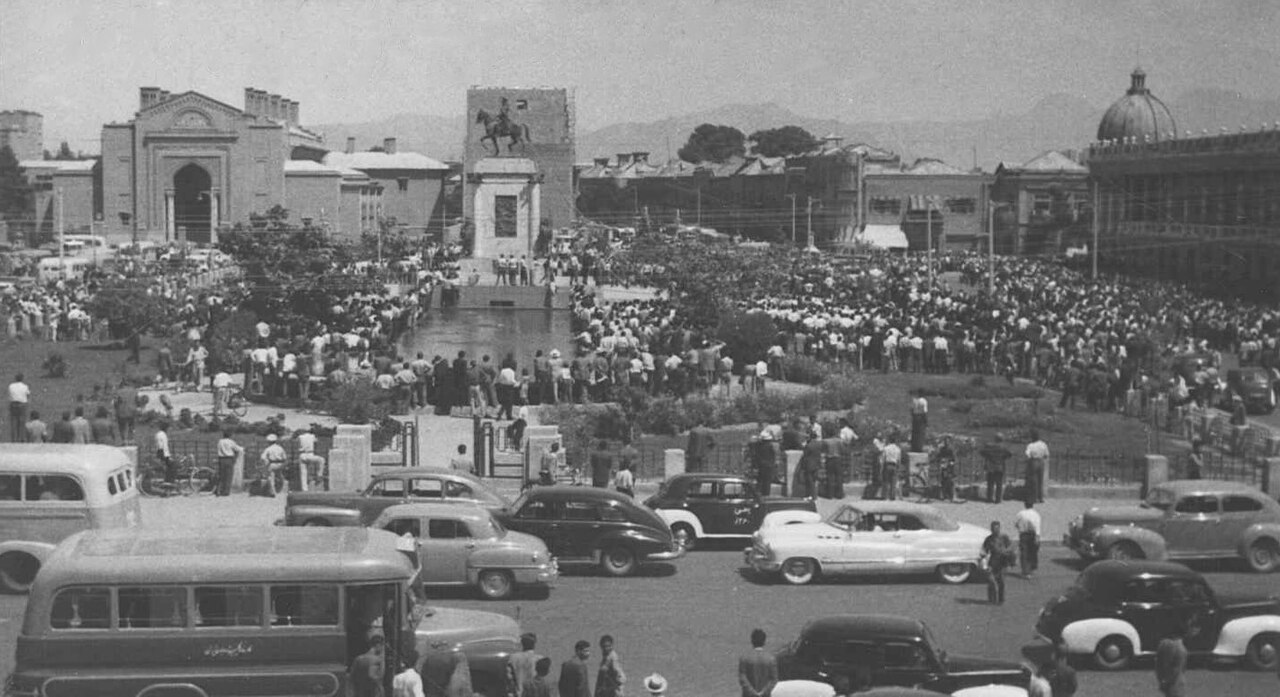
The party’s link to the Soviet Union was its greatest weakness. In 1944, when Moscow demanded an oil concession in northern Iran, the Tudeh, which had attacked foreign concessions, came out in support, and its members demonstrated in Tehran under the protection of Soviet troops. Nationalists such as Mohammad Mosaddegh never forgot it. During the Iran crisis of 1946 the party’s branch in Azerbaijan merged into Ja’far Pishevari’s Soviet-backed Democratic Party.
In August 1946 Prime Minister Ahmad Qavam brought three Tudeh ministers into his cabinet, for education, health and trade. The party’s moment of greatest influence lasted only weeks: a tribal revolt in the south, opposition from the court and Britain, and the collapse of the Azerbaijan government in December left it weakened and divided. In January 1948 a group of reformers led by Khalil Maleki, critical of the leadership’s dependence on Moscow, broke away.
Banned, but not broken, 1949–1953
After the attempt on the shah’s life at the University of Tehran on 4 February 1949, which the government blamed on the communists, the Tudeh was outlawed and its leaders arrested or forced to flee. Several escaped from Qasr prison in December 1950. Underground, the party remained strong: it organised large demonstrations in Tehran, controlled much of the student movement and kept its unions in the oil fields.
Its relationship with Mohammad Mosaddegh’s government was uneasy. At first the party attacked him as a tool of the Americans; later it moved closer, and it took part in the uprising of 30 Tir in July 1952. It also had a secret organisation of officers inside the army, which it did not use. In August 1953 its street demonstrations against the monarchy alarmed many supporters of Mosaddegh and were used by the organisers of the coup to argue that Iran faced a communist takeover, a claim historians including Abrahamian and Mark Gasiorowski consider much exaggerated. The coup itself is covered on the page on the 1953 coup.
Repression after 1953
After the coup the Tudeh was the main target of the new regime. In 1954 the security services uncovered its military network, several hundred officers in all, many of them in sensitive posts; a number were executed and many more imprisoned. Thousands of civilian members were arrested, and many signed public recantations. The leadership went into exile in the Soviet Union and East Germany. In the 1960s and 1970s the party had little presence inside Iran, where a new generation of the left turned to guerrilla groups. The security apparatus built in these years is described on the page on SAVAK.
Return and final suppression
The Tudeh returned openly in 1979 under its new secretary-general, Nureddin Kianuri, and gave its support to Ayatollah Khomeini and the Islamic Republic as an anti-imperialist government. This did not protect it. In February 1983 the authorities arrested Kianuri and other leaders, accused them of spying for the Soviet Union, and broadcast their confessions on television; the party was banned that spring. Many of its imprisoned members were killed in the 1988 executions of political prisoners. The party continues to exist in exile.
- 1937 Arrest of the Fifty-Three
- 1941 Tudeh Party founded
- 1944 Eight deputies in the Majlis; support for a Soviet oil concession
- 1946 Oil strike in Khuzestan; three Tudeh ministers in Qavam’s cabinet
- 1949 Banned after the attempt on the shah’s life
- 1954 Military network uncovered
- 1979 Returns under Kianuri
- 1983 Leaders arrested; party banned again
Assessments
Historians agree on the party’s importance and disagree on its record. Abrahamian, in Iran Between Two Revolutions, shows how it brought the working class and the modern middle class into politics and shaped Iranian intellectual life for decades. Maziar Behrooz, in Rebels with a Cause, stresses how its loyalty to Soviet policy repeatedly cost it support and judgement, from the oil concession of 1944 to its backing of the Islamic Republic. Monarchist writers have seen the party chiefly as a Soviet instrument and a threat that justified repression; many former members later wrote memoirs of disillusionment. Its story ties together the occupation, the oil crisis and the coup of 1953, and the politics of the left after 1979.
Persian words from this page
| حزب | hezb | party |
| توده | tude | the masses |
| کارگر | kârgar | worker |
| اتحادیه | ettehâdiye | union |
| پنجاه و سه نفر | panjâh-o se nafar | “the Fifty-Three” |
| دنیا | Donyâ | “World”, Arani’s journal |
Sources and further reading
- Ervand Abrahamian, Iran Between Two Revolutions (Princeton University Press, 1982), chapters 6–7.
- Maziar Behrooz, Rebels with a Cause: The Failure of the Left in Iran (I.B. Tauris, 1999).
- Sepehr Zabih, The Communist Movement in Iran (University of California Press, 1966).
- Ervand Abrahamian, Tortured Confessions: Prisons and Public Recantations in Modern Iran (University of California Press, 1999).
- Encyclopaedia Iranica, article “Communism ii. In Persia from 1941 to 1953” (iranicaonline.org).
Want to learn Persian? Get the free Starter Pack
Get the 14-page printable Starter Pack (all 32 letters, a 7-day reading plan, 100 core words and 20 survival phrases) and a short 5-email course. Free.
More in The Pahlavi Era (1925–1979)
- Reza Shah Pahlavi
- Reza Shah’s Reforms
- The Trans-Iranian Railway
- Why Persia Became “Iran” in 1935
- The Unveiling Decree of 1936 (Kashf-e Hijab)
- The Anglo-Soviet Invasion of Iran (1941)
- The Persian Corridor and the Tehran Conference
- The Iran Crisis of 1946
- Mohammad Reza Shah’s Early Reign (1941–1953)
- The Tudeh Party
- Mohammad Mosaddegh
- The Nationalisation of Iranian Oil (1951)
- The 1953 Coup in Iran
- Fazlollah Zahedi
- The 1954 Oil Consortium Agreement
- SAVAK: The Shah’s Security Service
- The White Revolution (1963)
- The Uprising of June 1963 and Khomeini’s Exile
- The Hoveyda Years (1965–1977)
- The 2,500-Year Celebration of the Persian Empire (1971)
- The Oil Boom of the 1970s
- Intellectuals and Opposition in the 1960s–70s
- Iran as a Regional Power under the Shah
- Women in Pahlavi Iran
- The Cinema Rex Fire (1978)
- Black Friday (September 1978)
- The Shah Leaves Iran (January 1979)
- Farah Pahlavi
- The Pahlavi Family
- Forough Farrokhzad and Modern Persian Poetry
- Iranian Cinema before 1979