The uprising of 15 Khordad 1342 (5 June 1963) was a wave of riots in Tehran, Qom and other cities that broke out after the arrest of Ayatollah Ruhollah Khomeini, who had attacked the shah in a sermon two days earlier. The army crushed it within days, but it made Khomeini the best-known opponent of the monarchy. In November 1964, after a new speech against American legal immunity, he was sent into exile, where he stayed for fourteen years.
| Date | 5–7 June 1963 (15–17 Khordad 1342) |
|---|---|
| Places | Tehran, Qom, Mashhad, Shiraz, Varamin and other towns |
| Prime minister | Asadollah Alam |
| Trigger | Khomeini’s arrest in Qom before dawn on 5 June |
| Deaths | Disputed: from dozens to hundreds; later claims of thousands |
| Exile | Turkey from November 1964; Najaf, Iraq, from October 1965; Paris, October 1978 |
From the referendum to Feyziyeh
Khomeini, then a senior teacher in the seminaries of Qom in his early sixties, had come forward in late 1962 against a law on local councils that dropped the requirement that candidates be Muslim and swear on the Quran. The government withdrew it. When the shah put the White Revolution to a referendum in January 1963, Khomeini and other clerics urged a boycott. His sermons attacked the shah’s dependence on the United States and his ties with Israel as much as land reform or votes for women.
On 22 March 1963, during the anniversary of the death of the sixth Imam, commandos and plain-clothes agents broke into the Feyziyeh seminary in Qom, beat students and killed at least one. Khomeini’s statements on the attack were copied and spread across the country.
The Ashura sermon and the arrest
Muharram, the month of mourning for Imam Hossein, fell in late May and early June 1963. On the afternoon of Ashura, 3 June, Khomeini spoke at Feyziyeh. He compared the regime to Yazid, the caliph whose army killed Hossein at Karbala, and addressed the shah directly, warning him that he risked the fate of his father. Mourning processions in Tehran the same day carried his picture.
At around three in the morning of 5 June, commandos arrested him at his home in Qom and took him to Tehran. When the news spread, crowds came out in Qom, in the Tehran bazaar and in south Tehran, and later in Mashhad, Shiraz and other towns. Rioters attacked police stations, government buildings and shops. Villagers from Varamin, south of the capital, marched toward Tehran and were stopped by troops at a bridge near Pishva.
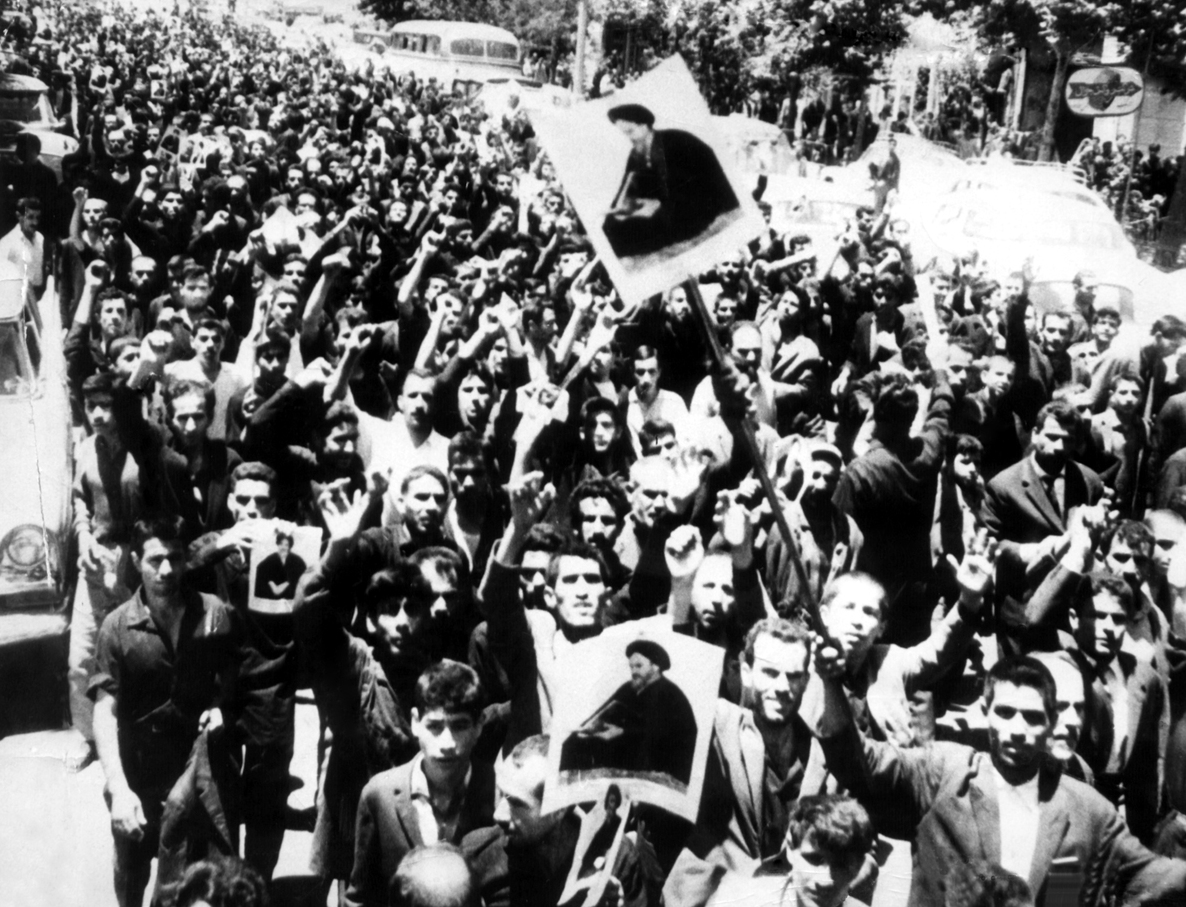

Martial law and the death toll
Prime Minister Asadollah Alam, a close friend of the shah, declared martial law and ordered the army to fire. Within two days the cities were quiet. Hundreds were arrested, among them about thirty leading clerics. Two men seen as leaders of the Tehran crowds, Tayyeb Haj-Rezai and Hajj Esmail Reza’i, were executed that November.
The number of dead has never been settled.
- Baqer Moin, Khomeini’s biographer, found in police files 380 people killed or wounded, a figure that leaves out those who avoided hospitals or were buried by the security forces.
- Most historians speak of dozens to a few hundred deaths and treat the exact figure as unknown.
- Khomeini and opposition sources later spoke of 15,000 dead, a figure repeated in the Islamic Republic but not supported by documentary research.
Release, the capitulation speech and exile
Khomeini was held in Tehran and then under house arrest, and released in April 1964. A widely repeated account holds that senior clerics recognised him as a marja’, a source of emulation, to protect him from trial; how much this mattered is debated. In October 1964 the Majlis passed a bill giving American military personnel and their families immunity from Iranian courts, linked in Iranian minds with a large American loan for arms. On 26 October Khomeini attacked it in a sermon in Qom, calling it a return of the old capitulations granted to foreign powers and an insult to Iran’s independence.
He was arrested again on 4 November 1964 and flown to Turkey. In October 1965 he moved to Najaf in Iraq, the main Shi’a seminary city, where in 1970 he gave the lectures on Islamic government, velayat-e faqih, that later shaped the constitution of the Islamic Republic. In January 1965 Prime Minister Hassan Ali Mansur, whose government had passed the immunity bill, was shot by a member of an Islamist group linked to Khomeini’s followers; he died days later.
A rehearsal for 1979
For the Islamic Republic, 15 Khordad is the true beginning of the revolution and a public holiday. Secular historians are more cautious but agree on its weight. Ervand Abrahamian and Said Amir Arjomand see June 1963 as the moment the clergy re-entered national politics and Khomeini emerged as a leader with his own message. Defenders of the shah describe it as a reactionary riot against land reform and women’s rights, organised by landlords and clerics. Both readings capture part of a movement that mixed bazaar merchants, seminary students, urban poor and nationalists. The full story of Khomeini’s life is told on Ruhollah Khomeini, and his return in 1979 on Khomeini’s return.
- 26 January 1963 Referendum on the White Revolution
- 22 March 1963 Attack on the Feyziyeh seminary, Qom
- 3 June 1963 Khomeini’s Ashura sermon
- 5 June 1963 Arrest; riots in Tehran, Qom and other cities
- April 1964 Khomeini released
- 26 October 1964 Speech against the immunity law
- 4 November 1964 Exile to Turkey
- October 1965 Move to Najaf
Persian words from this page
| پانزده خرداد | Pânzdah-e Khordâd | 15 Khordad (5 June) |
| مدرسه فیضیه | Madrese-ye Feyziye | Feyziyeh seminary |
| عاشورا | Âshurâ | Ashura |
| تبعید | tab’id | exile |
| کاپیتولاسیون | kâpitulâsiyon | capitulation (legal immunity for foreigners) |
| مرجع تقلید | marja’-e taqlid | source of emulation |
| ولایت فقیه | velâyat-e faqih | guardianship of the jurist |
Sources and further reading
- Baqer Moin, Khomeini: Life of the Ayatollah (I.B. Tauris, 1999).
- Ervand Abrahamian, Iran Between Two Revolutions (Princeton University Press, 1982).
- Said Amir Arjomand, The Turban for the Crown: The Islamic Revolution in Iran (Oxford University Press, 1988).
- Hamid Algar, “The Oppositional Role of the Ulama in Twentieth-Century Iran”, in Nikki Keddie (ed.), Scholars, Saints and Sufis (University of California Press, 1972).
- Abbas Amanat, Iran: A Modern History (Yale University Press, 2017).
Want to learn Persian? Get the free Starter Pack
Get the 14-page printable Starter Pack (all 32 letters, a 7-day reading plan, 100 core words and 20 survival phrases) and a short 5-email course. Free.
More in The Pahlavi Era (1925–1979)
- Reza Shah Pahlavi
- Reza Shah’s Reforms
- The Trans-Iranian Railway
- Why Persia Became “Iran” in 1935
- The Unveiling Decree of 1936 (Kashf-e Hijab)
- The Anglo-Soviet Invasion of Iran (1941)
- The Persian Corridor and the Tehran Conference
- The Iran Crisis of 1946
- Mohammad Reza Shah’s Early Reign (1941–1953)
- The Tudeh Party
- Mohammad Mosaddegh
- The Nationalisation of Iranian Oil (1951)
- The 1953 Coup in Iran
- Fazlollah Zahedi
- The 1954 Oil Consortium Agreement
- SAVAK: The Shah’s Security Service
- The White Revolution (1963)
- The Uprising of June 1963 and Khomeini’s Exile
- The Hoveyda Years (1965–1977)
- The 2,500-Year Celebration of the Persian Empire (1971)
- The Oil Boom of the 1970s
- Intellectuals and Opposition in the 1960s–70s
- Iran as a Regional Power under the Shah
- Women in Pahlavi Iran
- The Cinema Rex Fire (1978)
- Black Friday (September 1978)
- The Shah Leaves Iran (January 1979)
- Farah Pahlavi
- The Pahlavi Family
- Forough Farrokhzad and Modern Persian Poetry
- Iranian Cinema before 1979