Forough Farrokhzad (فروغ فرخزاد, 1934–1967) was the most influential woman poet of twentieth-century Iran. In five books written over little more than a decade, she moved from frank love poems that scandalised Tehran to the free verse of Another Birth (1964), and she also directed one of the founding films of Iranian documentary, The House Is Black. She died in a car accident at 32.
| Born | Tehran, end of 1934 (some sources give early January 1935) |
|---|---|
| Died | 13 February 1967, Tehran, in a car accident |
| Buried | Zahir od-Dowleh cemetery, Tehran |
| Poetry | Asir, Divar, Esyan, Tavallodi digar, and a posthumous fifth book |
| Film | The House Is Black (خانه سیاه است), 1962 |
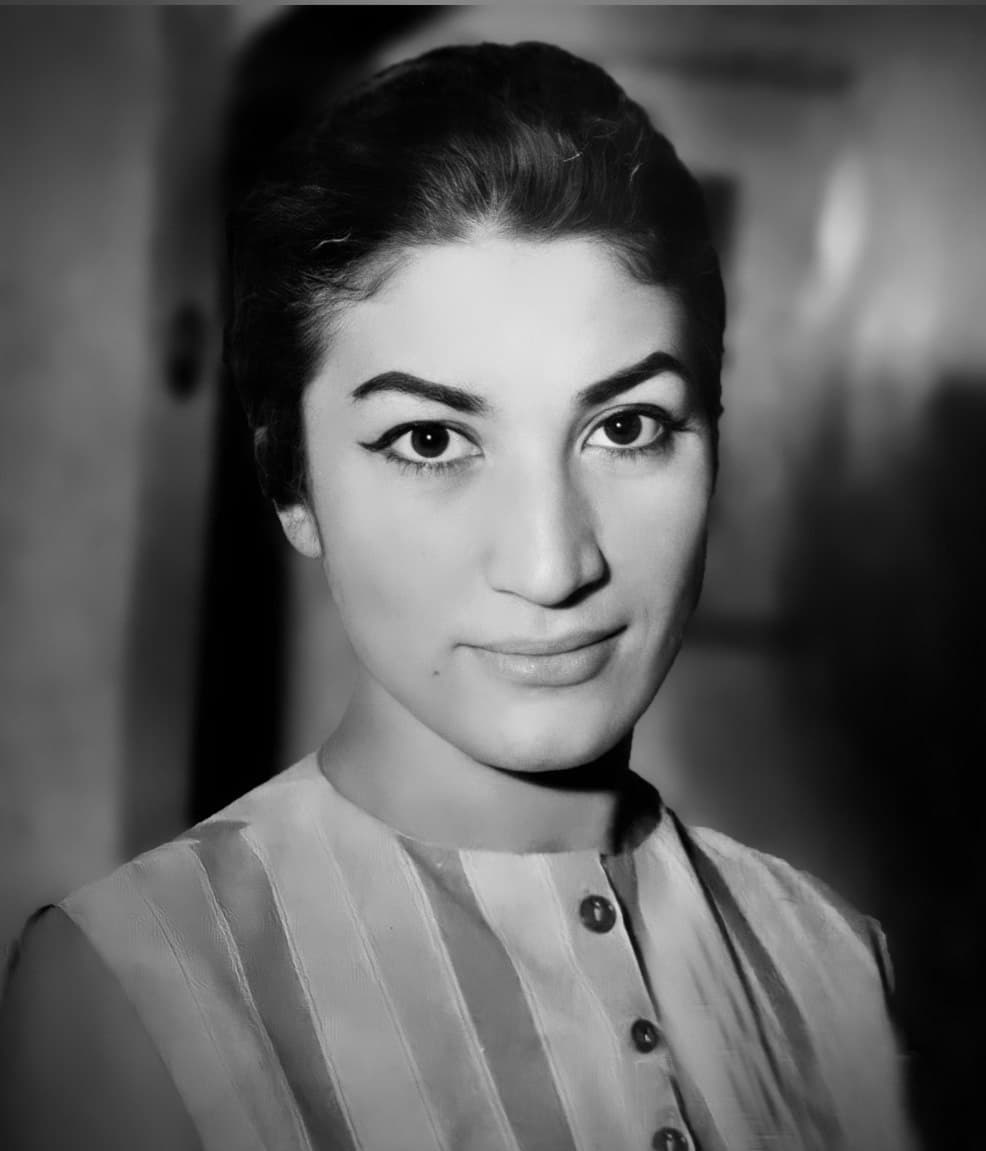

A Tehran childhood and an early marriage
Forough was born in Tehran into the large family of an army officer, Colonel Mohammad Bagher Farrokhzad. Several of her brothers and sisters also became known in the arts. At sixteen she married Parviz Shapour, a satirist and cartoonist, and moved with him to Ahvaz, where their son Kamyar was born. The marriage broke down within a few years, and after the divorce in 1954 the boy stayed with his father’s family. The loss of her son, and the judgement of a society that saw a divorced woman poet as a scandal, run through her early poems.
The first three books
Her first collection, Asir (اسیر, The Captive), appeared in 1955, followed by Divar (دیوار, The Wall) in 1956 and Esyan (عصیان, Rebellion) in 1958. They used the four-line stanzas and rhyme of traditional Persian verse, but their voice was new: a woman speaking in the first person about desire, loneliness and her own wish to be free. A poem titled “Sin” (Gonah), about a love affair, made her notorious. Critics attacked her as immoral; younger readers, many of them women, found in her someone who said what they could not.
She was part of a wider change in Persian poetry. Since the 1920s Nima Yushij had been breaking with the fixed metres and rhyme of the classical tradition, and a generation of “new poetry” (شعر نو, she’r-e now) writers followed him, among them Ahmad Shamlu, Mehdi Akhavan-Sales and Sohrab Sepehri. Farrokhzad began inside the old forms and moved steadily towards this freer style.
Ebrahim Golestan and the cinema
In 1958 she met the writer and filmmaker Ebrahim Golestan and began working at his film studio in Tehran, first as a secretary and then as editor, actor and director. The two had a long relationship, which added to the gossip about her. Golestan’s studio made documentaries for the oil company and other clients, and Farrokhzad learned editing there.
In 1962 she went with a small crew to the leper colony of Bababaghi near Tabriz and spent twelve days filming The House Is Black. The film, about twenty minutes long, shows the daily life of the patients, children at school, people eating, praying and playing, over a soundtrack in which Farrokhzad reads passages from the Old Testament and her own words. It won the main documentary prize at the Oberhausen festival in Germany in 1963 and is now regarded as a forerunner of the Iranian new wave (see Iranian cinema before 1979). During the filming she became attached to a boy from the colony, Hossein Mansouri, whom she later took into her home.
Another Birth
Tavallodi digar (تولدی دیگر, Another Birth), published in 1964, is the book on which her reputation rests. The poems drop regular rhyme and stanza, take their rhythm from speech, and range from intimate love poems to sharp pictures of Tehran’s new middle class, its television sets and its hypocrisy. “Another Birth”, the title poem, and “Earthly Verses” (Ayeh-ha-ye zamini), a dark vision of a world after the light has gone, are among the most quoted Persian poems of the century.
Her last poems, written in 1965–66, were collected after her death as Let Us Believe in the Beginning of the Cold Season (ایمان بیاوریم به آغاز فصل سرد). One of them takes its title from the line تنها صداست که میماند (tanhâ sedâst ke mimânad), “only the voice remains”.
Death and reputation
On 13 February 1967 the jeep she was driving crashed in north Tehran, and she died on the way to hospital. She was buried at the Zahir od-Dowleh cemetery, where her grave became a place of pilgrimage for readers.
Her standing has only grown since. Her poems have been translated into many languages, and her life has been the subject of biographies and films. After 1979 her work was for some years hard to publish in full in Iran, and editions were often cut, yet she remains one of the most widely read modern poets in the country. She is often discussed alongside the changes described on the page about women in Pahlavi Iran, though she wrote as an individual rather than for any movement, and her influence on the writers of the 1960s and 1970s is traced on the page about intellectuals and opposition.
For the classical poetry she grew up with and broke away from, see the site’s introduction to the Shahnameh and the tomb of Hafez.
Persian words from this page
| شعر | she’r | poem, poetry |
| شاعر | shâ’er | poet |
| شعر نو | she’r-e now | new poetry |
| تولدی دیگر | tavallodi digar | another birth |
| صدا | sedâ | voice, sound |
| خانه سیاه است | khâne siâh ast | the house is black |
| عصیان | esyân | rebellion |
Sources and further reading
- Farzaneh Milani, Veils and Words: The Emerging Voices of Iranian Women Writers, Syracuse University Press, 1992.
- Michael C. Hillmann, A Lonely Woman: Forugh Farrokhzad and Her Poetry, Three Continents Press, 1987.
- Sholeh Wolpé (trans.), Sin: Selected Poems of Forugh Farrokhzad, University of Arkansas Press, 2007.
- Encyclopaedia Iranica, article “Farrokzād, Forugh”.
- Hamid Naficy, A Social History of Iranian Cinema, vol. 2, Duke University Press, 2011.
Want to learn Persian? Get the free Starter Pack
Get the 14-page printable Starter Pack (all 32 letters, a 7-day reading plan, 100 core words and 20 survival phrases) and a short 5-email course. Free.
More in The Pahlavi Era (1925–1979)
- Reza Shah Pahlavi
- Reza Shah’s Reforms
- The Trans-Iranian Railway
- Why Persia Became “Iran” in 1935
- The Unveiling Decree of 1936 (Kashf-e Hijab)
- The Anglo-Soviet Invasion of Iran (1941)
- The Persian Corridor and the Tehran Conference
- The Iran Crisis of 1946
- Mohammad Reza Shah’s Early Reign (1941–1953)
- The Tudeh Party
- Mohammad Mosaddegh
- The Nationalisation of Iranian Oil (1951)
- The 1953 Coup in Iran
- Fazlollah Zahedi
- The 1954 Oil Consortium Agreement
- SAVAK: The Shah’s Security Service
- The White Revolution (1963)
- The Uprising of June 1963 and Khomeini’s Exile
- The Hoveyda Years (1965–1977)
- The 2,500-Year Celebration of the Persian Empire (1971)
- The Oil Boom of the 1970s
- Intellectuals and Opposition in the 1960s–70s
- Iran as a Regional Power under the Shah
- Women in Pahlavi Iran
- The Cinema Rex Fire (1978)
- Black Friday (September 1978)
- The Shah Leaves Iran (January 1979)
- Farah Pahlavi
- The Pahlavi Family
- Forough Farrokhzad and Modern Persian Poetry
- Iranian Cinema before 1979