Mohammad Mosaddegh (1882–1967) was an Iranian lawyer and statesman who led the National Front, nationalised the British-owned oil industry in 1951 and served as prime minister from 1951 until he was overthrown in a coup on 19 August 1953. To his admirers he is the symbol of Iranian independence and constitutional government; to his critics an obstinate leader who pushed the country into crisis. He spent his last fourteen years in prison and under house arrest.
| Born | 1882 (usually given as 16 June), Tehran |
|---|---|
| Family | Father a senior finance official; mother a Qajar princess |
| Education | Paris; doctorate in law, University of Neuchâtel, Switzerland (1914) |
| Prime minister | April 1951 – July 1952; July 1952 – 19 August 1953 |
| Died | 5 March 1967, Ahmadabad, under house arrest |
| Persian name | محمد مصدق (Mohammad Mosaddeq); earlier title Mosaddeq al-Saltaneh |
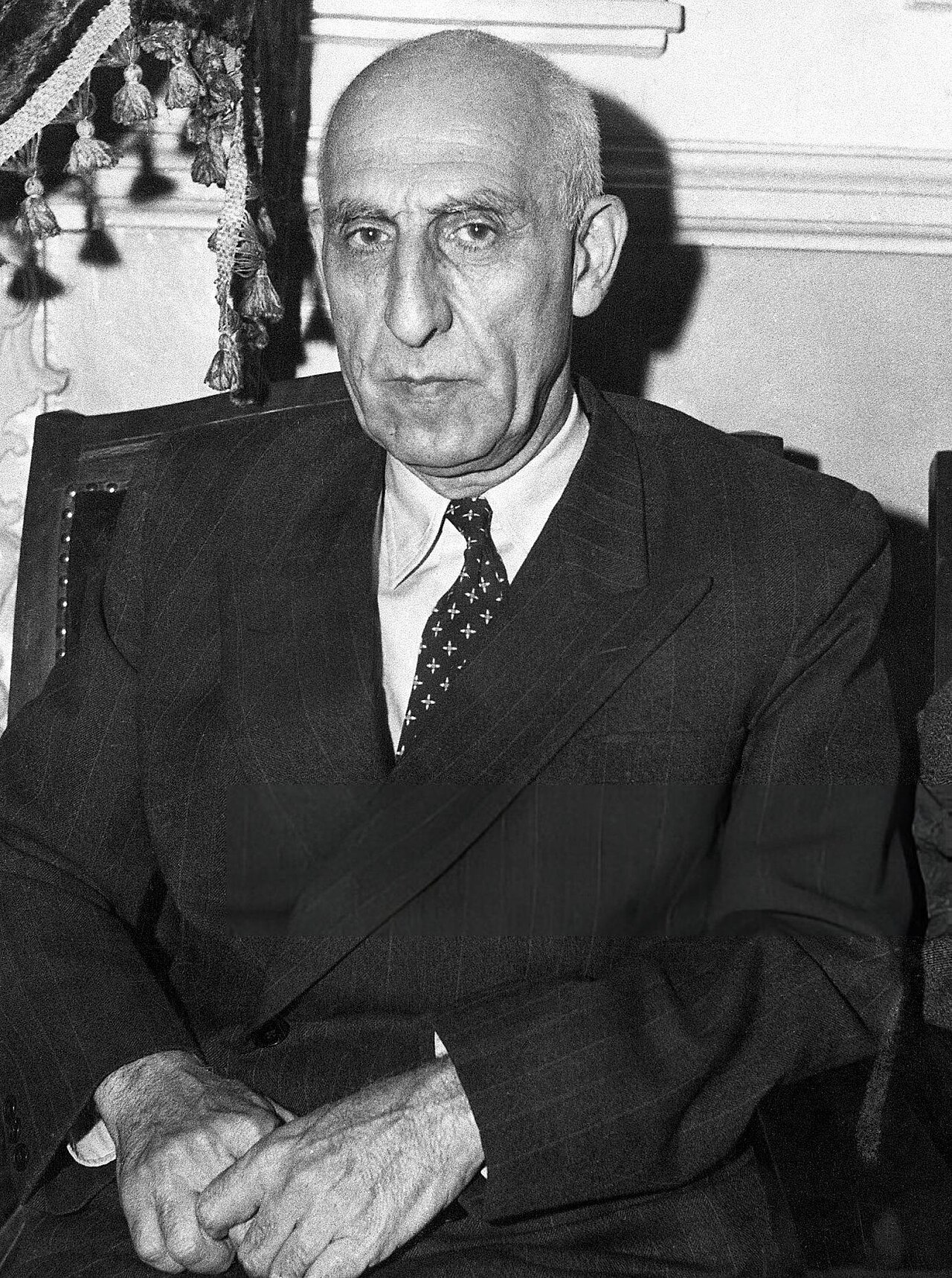

A Qajar aristocrat and constitutionalist
Mosaddegh was born into the Qajar elite. His father served for decades in the finance administration, and his mother was a granddaughter of the crown prince Abbas Mirza. As a teenager he received the post of chief finance officer of Khorasan, and in 1906 he was elected to the first Majlis of the Constitutional Revolution but was too young to take his seat. He studied in Paris and then in Switzerland, where he took a doctorate in law at Neuchâtel in 1914 with a thesis on wills in Shi’a law.
Back in Iran he held a series of high offices: governor of Fars, briefly minister of finance and of foreign affairs, and governor of Azerbaijan. In the Majlis in October 1925 he spoke against the transfer of the crown to Reza Khan, arguing that a strong prime minister should not become an unaccountable shah, as told on the page on the end of the Qajar dynasty. Under Reza Shah he withdrew to his estate at Ahmadabad, west of Tehran. In 1940 he was arrested and held in the remote town of Birjand, and was released after some months.
Deputy and leader of the National Front
After 1941 Mosaddegh returned to politics. In 1944 he topped the poll in Tehran for the fourteenth Majlis, where he built a reputation for honesty, legal argument and dramatic speeches. In December 1944 he sponsored the law that barred ministers from negotiating oil concessions without parliament’s consent, aimed at Soviet demands in the north but in principle at all foreign powers. His position, which he called “negative balance”, was that Iran should give concessions to no foreign power rather than balance one against another.
In October 1949, after protests against rigged elections, he and a group of deputies, journalists and activists founded the National Front, جبهه ملی (Jebhe-ye Melli), a coalition of liberal nationalists, bazaar groups, some clerics led by Ayatollah Abolqasem Kashani, and secular parties. Its central demand was the nationalisation of the Anglo-Iranian Oil Company.
Prime minister, 1951–1953
In March 1951 the Majlis and the Senate passed the nationalisation law, and on 28 April 1951 the Majlis chose Mosaddegh as prime minister. Britain responded with a blockade of Iranian oil, legal action and diplomatic pressure. Mosaddegh defended Iran’s case in person at the UN Security Council in New York in October 1951 and at the International Court of Justice in The Hague, which in July 1952 ruled that it had no jurisdiction. Time magazine named him its Man of the Year for 1951. The oil dispute itself is told on the page on the nationalisation of Iranian oil.
At home the loss of oil revenue caused severe economic strain. In July 1952 he resigned when the shah refused him control of the war ministry; four days of protests culminating in the uprising of 30 Tir (21 July 1952) brought him back with emergency powers. He used them to pass reforms, among them a measure raising peasants’ share of the harvest, and in October 1952 he broke off diplomatic relations with Britain. His coalition began to break apart: Kashani and other former allies turned against him, and the Tudeh Party’s growing street presence worried conservatives and the United States. In August 1953 he dissolved the Majlis after a referendum whose methods even sympathetic historians have criticised.
The coup and its aftermath
On 19 August 1953 (28 Mordad 1332) a coup organised by the American CIA and British intelligence with royalist officers, led by General Fazlollah Zahedi, overthrew him; his house in Tehran was attacked and looted. The events are covered on the page on the 1953 coup.
Mosaddegh was tried by a military court in late 1953, where he defended himself at length and insisted that he remained the lawful prime minister. He was sentenced to three years in solitary confinement and afterwards confined to his estate at Ahmadabad, where he lived under guard until his death on 5 March 1967. He was buried in his own house there, since the authorities refused his wish to be buried beside those killed on 30 Tir.
A contested legacy
Few Iranian figures are remembered so warmly by so many, and the arguments about him have never stopped. Homa Katouzian and Ervand Abrahamian present him as a liberal democrat and nationalist who stood for constitutional rule and Iranian control of Iran’s resources, overthrown by foreign powers and the court. Christopher de Bellaigue’s biography Patriot of Persia (2012) offers a sympathetic but critical portrait that stresses his inflexibility in negotiation. Monarchist writers, and historians such as Ray Takeyh, argue that his rule had become increasingly authoritarian, that he rejected reasonable oil settlements, and that the coup succeeded because much of Iranian society had turned against him. Abbas Milani and Abbas Amanat both stress his integrity while noting that he missed chances for a compromise. In Iran, both the monarchy and the Islamic Republic have at times kept his memory at arm’s length, while for secular nationalists he remains the great might-have-been of modern Iranian history.
Persian words from this page
| مصدق | Mosaddeq | Mosaddegh |
| جبهه ملی | Jebhe-ye Melli | National Front |
| نفت | naft | oil |
| ملی شدن | melli shodan | nationalisation |
| احمدآباد | Ahmadâbâd | his estate, where he died |
| ۲۸ مرداد | bist-o hasht-e Mordâd | 28 Mordad, the day of the coup |
Sources and further reading
- Homa Katouzian, Musaddiq and the Struggle for Power in Iran (I.B. Tauris, 1990).
- Ervand Abrahamian, The Coup: 1953, the CIA, and the Roots of Modern U.S.–Iranian Relations (The New Press, 2013).
- Christopher de Bellaigue, Patriot of Persia: Muhammad Mossadegh and a Very British Coup (Bodley Head, 2012).
- Mark J. Gasiorowski and Malcolm Byrne (eds.), Mohammad Mosaddeq and the 1953 Coup in Iran (Syracuse University Press, 2004).
- Ray Takeyh, The Last Shah: America, Iran, and the Fall of the Pahlavi Dynasty (Yale University Press, 2021).
Want to learn Persian? Get the free Starter Pack
Get the 14-page printable Starter Pack (all 32 letters, a 7-day reading plan, 100 core words and 20 survival phrases) and a short 5-email course. Free.
More in The Pahlavi Era (1925–1979)
- Reza Shah Pahlavi
- Reza Shah’s Reforms
- The Trans-Iranian Railway
- Why Persia Became “Iran” in 1935
- The Unveiling Decree of 1936 (Kashf-e Hijab)
- The Anglo-Soviet Invasion of Iran (1941)
- The Persian Corridor and the Tehran Conference
- The Iran Crisis of 1946
- Mohammad Reza Shah’s Early Reign (1941–1953)
- The Tudeh Party
- Mohammad Mosaddegh
- The Nationalisation of Iranian Oil (1951)
- The 1953 Coup in Iran
- Fazlollah Zahedi
- The 1954 Oil Consortium Agreement
- SAVAK: The Shah’s Security Service
- The White Revolution (1963)
- The Uprising of June 1963 and Khomeini’s Exile
- The Hoveyda Years (1965–1977)
- The 2,500-Year Celebration of the Persian Empire (1971)
- The Oil Boom of the 1970s
- Intellectuals and Opposition in the 1960s–70s
- Iran as a Regional Power under the Shah
- Women in Pahlavi Iran
- The Cinema Rex Fire (1978)
- Black Friday (September 1978)
- The Shah Leaves Iran (January 1979)
- Farah Pahlavi
- The Pahlavi Family
- Forough Farrokhzad and Modern Persian Poetry
- Iranian Cinema before 1979