Under Mohammad Reza Shah (1941–1979) Iranian women won the right to vote and stand for parliament in 1963, gained new rights in marriage and divorce through the Family Protection Laws of 1967 and 1975, and entered universities, the professions and government in growing numbers. The changes were real but came from the state, in a system without free politics, and they were opposed by much of the clergy and doubted by many on the left. Most of the legal reforms were reversed after the revolution of 1979.
| Vote and candidacy | Announced 27 February 1963 (8 Esfand 1341); first exercised in the Majlis elections of September 1963 |
|---|---|
| First women deputies | Six in the Majlis and two appointed senators, 1963 |
| Family Protection Law | 1967; revised and extended 1975 |
| First woman minister | Farrokhroo Parsa, education, from 1968 |
| Main organisation | Women’s Organisation of Iran, founded 1966 |
The inheritance from Reza Shah
The first Pahlavi king had opened Tehran University to women in the 1930s and banned the veil in public in 1936, a measure described on the unveiling decree. When he abdicated in 1941 the ban lapsed, and many women went back to the chador. In the freer years of the 1940s women’s groups multiplied, from the Tudeh party’s women’s organisation to societies of educated professional women. Bills to give women the vote were put forward, including during Mosaddegh’s government, but were dropped in the face of clerical opposition.

The vote, 1963
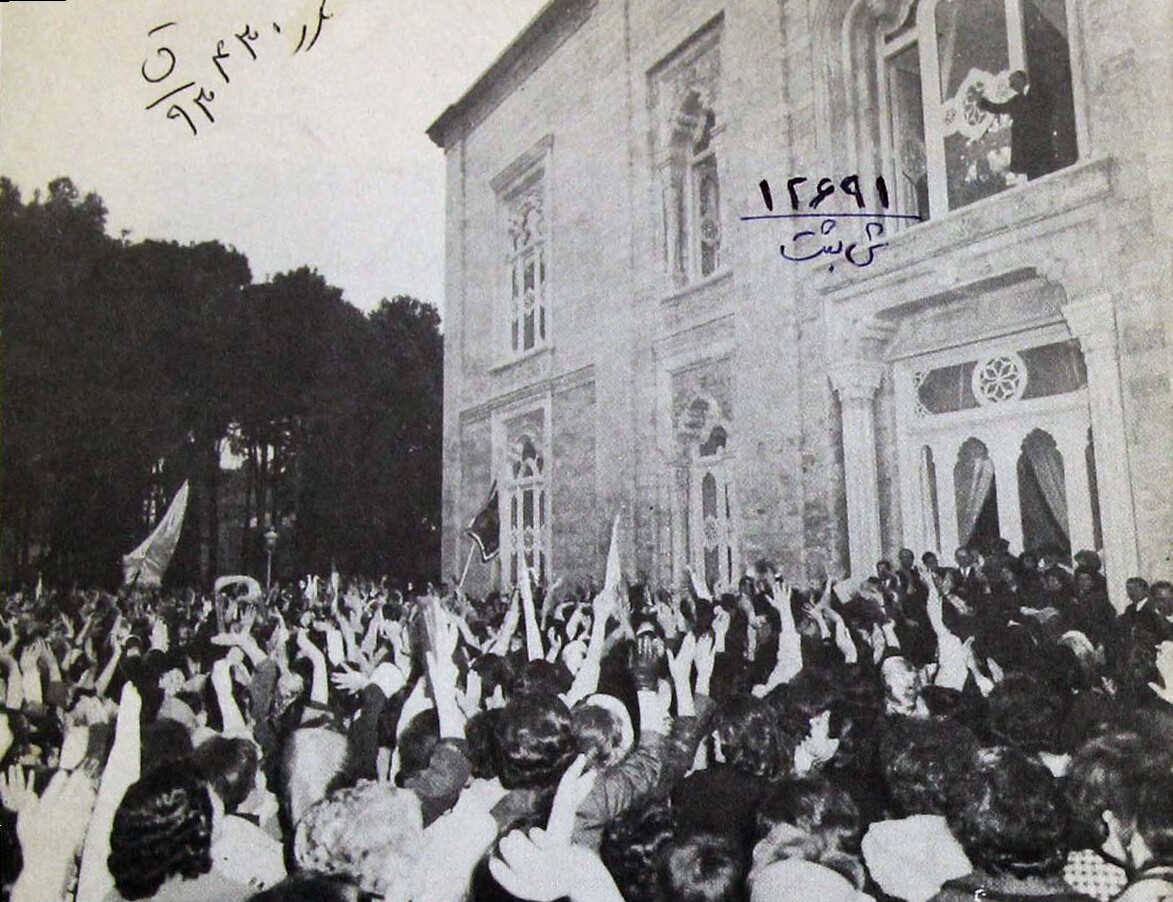
Votes for women were one of the six points of the White Revolution. Women’s groups had campaigned for years, and on 27 February 1963 the shah announced that women would vote and stand in the coming elections. The date, 8 Esfand, was later marked as Women’s Day. In September 1963 six women were elected to the Majlis, among them Farrokhroo Parsa and Mehrangiz Dowlatshahi, and two women, Shams ol-Moluk Mosahab and Mehrangiz Manouchehrian, were appointed to the Senate. Elections in Pahlavi Iran were tightly controlled, so the vote meant entry into the official system rather than a free choice; the same was true for men.
Among the clerics, Ayatollah Khomeini was one of the loudest critics of women’s suffrage in 1962 and 1963, presenting it as part of a programme against Islam. After 1979 the Islamic Republic kept women’s right to vote.
Family law: the 1967 and 1975 reforms
The most far-reaching change was in family law, which until then followed Shi’a jurisprudence closely. The Family Protection Law of 1967, revised in 1975, moved divorce into special family courts. A husband could no longer divorce his wife simply by declaring it; both spouses could petition on grounds set by law. A man needed the court’s permission, and in practice his first wife’s consent, to take a second wife. Courts decided child custody on the child’s interest. The 1975 law raised the minimum age of marriage to 18 for women and 20 for men. Lawyers of the Women’s Organisation helped draft the changes, which were framed carefully as consistent with Islam.
Women in public life
The Women’s Organisation of Iran, founded in 1966 with Princess Ashraf as its honorary head, became the main channel of state policy on women. Under its secretary-general Mahnaz Afkhami it ran literacy classes, vocational training and childcare centres across the country, and in 1975 Afkhami became minister of state for women’s affairs. Farrokhroo Parsa became minister of education in 1968, the first woman in an Iranian cabinet. From 1968 young women served in the Literacy Corps in villages, and from the end of the 1960s women were appointed judges; one of them was Shirin Ebadi, later winner of the Nobel Peace Prize. Women became lawyers, doctors, engineers, diplomats and university teachers in growing numbers, and figures such as the poet Forough Farrokhzad and Empress Farah Pahlavi became public models of very different kinds.
Critics on two sides
The reforms reached mainly urban, middle-class women. In the villages and poorer city districts, illiteracy among women remained high in the 1970s, and many families saw the state’s model of womanhood as foreign. Religious critics argued that the regime promoted Western consumer culture and immodesty. Ali Shariati, in lectures published as Fatemeh is Fatemeh (early 1970s), offered a third model: neither the traditional woman nor the Westernised “painted doll”, but an active, devout woman modelled on the Prophet’s daughter. Many young women who joined the revolution in 1978 wore the headscarf or chador as a political statement.
On the left and among later feminist historians, the criticism was different. Parvin Paidar and others describe the Pahlavi approach as “state feminism”: gains granted from above, with independent women’s organisations absorbed or silenced, so that women’s rights were tied to the fate of the regime. Janet Afary stresses that the laws changed the lives of many women but also that their dependence on the monarchy made them easy to reverse. Mahnaz Afkhami, who worked inside the system, has defended working through the state as the practical route to these rights at the time.
After 1979
Within weeks of the revolution the Family Protection Law was suspended and the legal age of marriage for girls lowered, and the hejab was made compulsory in the early 1980s. Farrokhroo Parsa was tried by a revolutionary court and executed in 1980. Yet women’s education kept expanding under the Islamic Republic, and the questions raised in the Pahlavi years returned in later movements, most visibly in the protests of 2022. For the longer story, see women in Iranian history.
Persian words from this page
| حق رأی | haqq-e ra’y | right to vote |
| قانون حمایت خانواده | Qânun-e Hemâyat-e Khânevâde | Family Protection Law |
| سازمان زنان ایران | Sâzmân-e Zanân-e Irân | Women’s Organisation of Iran |
| چادر | châdor | chador, full-length cloak |
| حجاب | hejâb | hijab, veiling |
| طلاق | talâq | divorce |
Sources and further reading
- Parvin Paidar, Women and the Political Process in Twentieth-Century Iran (Cambridge University Press, 1995).
- Janet Afary, Sexual Politics in Modern Iran (Cambridge University Press, 2009).
- Mahnaz Afkhami and Erika Friedl (eds.), In the Eye of the Storm: Women in Post-Revolutionary Iran (Syracuse University Press, 1994).
- Eliz Sanasarian, The Women’s Rights Movement in Iran (Praeger, 1982).
Want to learn Persian? Get the free Starter Pack
Get the 14-page printable Starter Pack (all 32 letters, a 7-day reading plan, 100 core words and 20 survival phrases) and a short 5-email course. Free.
More in The Pahlavi Era (1925–1979)
- Reza Shah Pahlavi
- Reza Shah’s Reforms
- The Trans-Iranian Railway
- Why Persia Became “Iran” in 1935
- The Unveiling Decree of 1936 (Kashf-e Hijab)
- The Anglo-Soviet Invasion of Iran (1941)
- The Persian Corridor and the Tehran Conference
- The Iran Crisis of 1946
- Mohammad Reza Shah’s Early Reign (1941–1953)
- The Tudeh Party
- Mohammad Mosaddegh
- The Nationalisation of Iranian Oil (1951)
- The 1953 Coup in Iran
- Fazlollah Zahedi
- The 1954 Oil Consortium Agreement
- SAVAK: The Shah’s Security Service
- The White Revolution (1963)
- The Uprising of June 1963 and Khomeini’s Exile
- The Hoveyda Years (1965–1977)
- The 2,500-Year Celebration of the Persian Empire (1971)
- The Oil Boom of the 1970s
- Intellectuals and Opposition in the 1960s–70s
- Iran as a Regional Power under the Shah
- Women in Pahlavi Iran
- The Cinema Rex Fire (1978)
- Black Friday (September 1978)
- The Shah Leaves Iran (January 1979)
- Farah Pahlavi
- The Pahlavi Family
- Forough Farrokhzad and Modern Persian Poetry
- Iranian Cinema before 1979