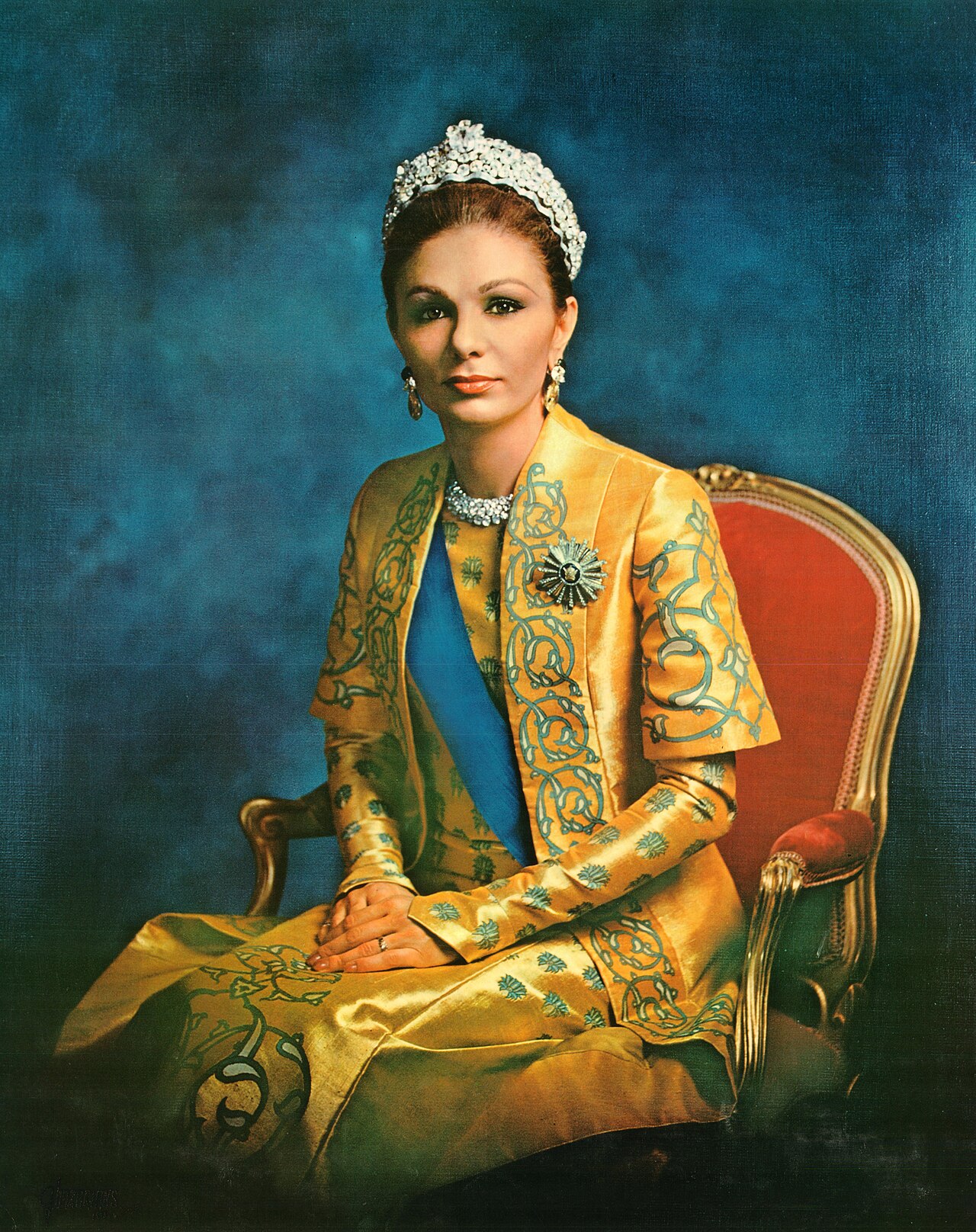
Farah Pahlavi (born Farah Diba in Tehran on 14 October 1938) was the third wife of Mohammad Reza Shah and the last empress of Iran. Crowned shahbanu in 1967 and named regent in case the shah died before their son came of age, she became the most visible patron of the arts, museums and charities in Pahlavi Iran. She left Iran with the shah in January 1979 and has lived in exile since.
| Born | 14 October 1938, Tehran |
|---|---|
| Persian name | فرح پهلوی (née دیبا, Diba) |
| Married | Mohammad Reza Shah, December 1959 |
| Crowned | 26 October 1967, as Shahbanu (empress) |
| Children | Reza (b. 1960), Farahnaz (b. 1963), Ali Reza (1966–2011), Leila (1970–2001) |
| Memoir | An Enduring Love: My Life with the Shah (2004) |

Family and studies
Farah was the only child of Sohrab Diba, an army officer trained in France, and Farideh Ghotbi. In her memoir she writes that her father’s family came from Iranian Azerbaijan and her mother’s from Lahijan in Gilan. Her father died in 1948, when she was nine, and she was brought up by her mother in Tehran, where she went to the Italian and French schools and then the Lycée Razi. In 1957 she went to Paris to study architecture at the École Spéciale d’Architecture.
Marriage and an heir
The shah’s first two marriages, to Princess Fawzia of Egypt and to Soraya Esfandiary-Bakhtiary, had not produced a son, and the succession was a matter of state (see the Pahlavi family). Farah was introduced to him in Paris in 1959 at a reception for Iranian students, and they married in Tehran in December 1959. Their first child, Crown Prince Reza, was born on 31 October 1960. Three more children followed: Farahnaz, Ali Reza and Leila.
Coronation and regency, 1967
At the coronation in the Golestan Palace on 26 October 1967 the shah crowned himself and then crowned Farah, the first coronation of a queen in modern Iranian history. A constitutional change in the same year made her regent if the shah died before the crown prince turned twenty. The title she took, شهبانو (shahbânu), was a revived old Persian word for queen. For the setting of the ceremony see the site’s guide to the Golestan Palace.
Patron of art and culture
Farah used her position mainly in culture, education and welfare, and had a staff and offices of her own at the palace. The best known projects associated with her include:
- The Shiraz Arts Festival (جشن هنر شیراز), held each year from 1967 to 1977 in Shiraz and at Persepolis. It brought Iranian traditional music and taazieh passion plays together with avant-garde composers and theatre directors from abroad, including Peter Brook and Karlheinz Stockhausen. Some productions caused public scandal among religious Iranians.
- The Tehran Museum of Contemporary Art, opened in 1977 in a building designed by her cousin, the architect Kamran Diba. In the 1970s, with oil money, it bought a large collection of Western modern art, including works by Picasso, Pollock, Warhol and Rothko, which remains in Tehran.
- Museums of Iranian heritage, including the Carpet Museum of Iran and the Reza Abbasi Museum, and the buying back of Iranian art and antiquities from abroad.
- Children’s culture, as patron of the Institute for the Intellectual Development of Children and Young Adults (Kanun), which published children’s books and ran a film unit where Abbas Kiarostami made his first films (see Iranian cinema before 1979).
She was also the patron of many charities and health organisations and travelled widely in the provinces, including to leprosy and poverty-stricken areas. Supporters remember her as the most approachable member of the royal family. Critics, from the religious right and the left, saw the festivals and art purchases as an extravagant import of Western culture paid for by a country with deep poverty, and as part of the court’s lavish image alongside events such as the 2,500-year celebration of 1971.
Revolution and exile
Farah left Iran with the shah on 16 January 1979 (see the shah leaves Iran) and stayed with him through his moves between Egypt, Morocco, the Bahamas, Mexico, the United States and Panama until his death in Cairo in July 1980. After his death she lived first in Egypt and later mainly in the United States and Paris.
Exile brought personal losses. Her younger daughter, Leila, died in London in 2001, and her younger son, Ali Reza, died in Boston in 2011; both deaths were widely reported as suicides. She published her memoir, An Enduring Love: My Life with the Shah, in 2004, which gives her own account of the court and the revolution. Her elder son, Reza Pahlavi, lives in the United States and is active in Iranian opposition politics abroad.
A divided memory
In Iran her name remains politically charged. For monarchists and many Iranians of the diaspora she represents the dignity of the old court and a period of cultural openness. For supporters of the Islamic Republic she is a symbol of the monarchy it overthrew. Historians tend to give her credit for the cultural institutions she founded, several of which still operate in Tehran, while noting that she had no formal political power and little influence on the shah’s decisions about security or government.
Persian words from this page
| شهبانو | shahbânu | empress |
| فرح | Farah | Farah (the name means joy) |
| نایبالسلطنه | nâyeb-ol-saltane | regent |
| تاجگذاری | tâj-gozâri | coronation |
| جشن هنر | jashn-e honar | arts festival |
| موزه | muze | museum |
Sources and further reading
- Farah Pahlavi, An Enduring Love: My Life with the Shah, Miramax Books, 2004.
- Abbas Milani, The Shah, Palgrave Macmillan, 2011.
- Robert Gluck, “The Shiraz Arts Festival: Western Avant-Garde Arts in 1970s Iran”, Leonardo 40:1 (2007).
- Abbas Amanat, Iran: A Modern History, Yale University Press, 2017.
Want to learn Persian? Get the free Starter Pack
Get the 14-page printable Starter Pack (all 32 letters, a 7-day reading plan, 100 core words and 20 survival phrases) and a short 5-email course. Free.
More in The Pahlavi Era (1925–1979)
- Reza Shah Pahlavi
- Reza Shah’s Reforms
- The Trans-Iranian Railway
- Why Persia Became “Iran” in 1935
- The Unveiling Decree of 1936 (Kashf-e Hijab)
- The Anglo-Soviet Invasion of Iran (1941)
- The Persian Corridor and the Tehran Conference
- The Iran Crisis of 1946
- Mohammad Reza Shah’s Early Reign (1941–1953)
- The Tudeh Party
- Mohammad Mosaddegh
- The Nationalisation of Iranian Oil (1951)
- The 1953 Coup in Iran
- Fazlollah Zahedi
- The 1954 Oil Consortium Agreement
- SAVAK: The Shah’s Security Service
- The White Revolution (1963)
- The Uprising of June 1963 and Khomeini’s Exile
- The Hoveyda Years (1965–1977)
- The 2,500-Year Celebration of the Persian Empire (1971)
- The Oil Boom of the 1970s
- Intellectuals and Opposition in the 1960s–70s
- Iran as a Regional Power under the Shah
- Women in Pahlavi Iran
- The Cinema Rex Fire (1978)
- Black Friday (September 1978)
- The Shah Leaves Iran (January 1979)
- Farah Pahlavi
- The Pahlavi Family
- Forough Farrokhzad and Modern Persian Poetry
- Iranian Cinema before 1979