In the decade before the revolution Mohammad Reza Shah turned Iran into the strongest military power in the Persian Gulf. With oil money and American backing he bought advanced weapons on a vast scale, took control of three disputed islands when Britain left the Gulf in 1971, forced Iraq to accept a new border on the Shatt al-Arab in 1975 and sent troops to defeat a rebellion in Oman. Supporters saw a country recovering its historic weight; critics saw an overstretched ally serving American aims.
| Period | About 1968–1978 |
|---|---|
| Doctrine | Nixon Doctrine (1969): regional allies to police their own regions; the “twin pillars” of Iran and Saudi Arabia |
| Key events | Bahrain claim dropped 1970; Abu Musa and the Tunbs 30 November 1971; Dhofar 1973–76; Algiers Agreement 6 March 1975 |
| Main suppliers | United States and Britain |
Britain leaves, the shah steps in
In January 1968 the British government announced that it would withdraw its forces from east of Suez, including the Persian Gulf, by the end of 1971. For a century and a half Britain had protected the Gulf sheikhdoms and controlled the waterway. The shah meant Iran to inherit that role. The Nixon Doctrine of 1969, which asked American allies to take charge of their own regions, gave him what he wanted: Washington would rely on Iran and, to a lesser degree, Saudi Arabia, to keep the Gulf stable and the Soviet Union out.
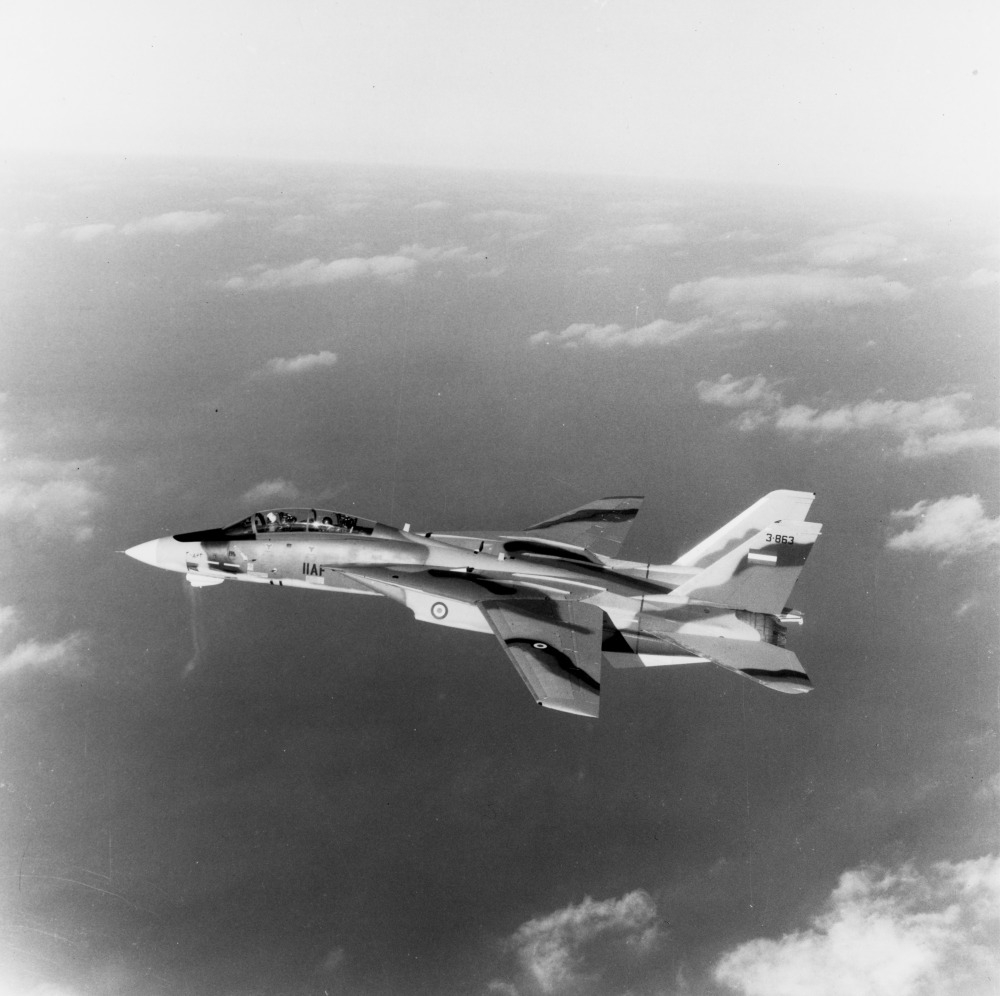
When President Nixon and Henry Kissinger visited Tehran in May 1972, they agreed that Iran could buy almost any American conventional weapon it wished. After the oil price rises of 1973 the shah could pay for them. Iran ordered F-14 Tomcat fighters (it was the only foreign customer), destroyers, helicopters by the hundred and, from Britain, hundreds of Chieftain tanks and the world’s largest military hovercraft fleet. Defence spending rose several-fold in the 1970s, and thousands of American advisers and technicians came to Iran to help run the new equipment.

Bahrain and the islands
Iran had long claimed Bahrain. In 1970, after a UN mission reported that most Bahrainis wanted independence, the shah dropped the claim, and the Majlis approved the decision. He was firmer about three small islands near the Strait of Hormuz. On 30 November 1971, a day before British protection of the sheikhdoms ended, Iranian forces landed on Abu Musa under an agreement with the ruler of Sharjah that allowed Sharjah to keep a police post and share oil revenue. They took the Greater and Lesser Tunbs, claimed by Ras al-Khaimah, by force, in a clash in which several local policemen and Iranian servicemen were killed.
Arab states protested at the United Nations, and Libya nationalised British oil assets partly in response. The United Arab Emirates, founded on 2 December 1971, still claims the islands, which Iran administers as part of Hormozgan province.
The Shatt al-Arab and the Kurds
Relations with Iraq’s Ba’athist government were hostile. In April 1969 Iran rejected the 1937 treaty that gave Iraq control of almost all the Shatt al-Arab (Arvand Rud), the river border at the head of the Persian Gulf, and sent ships through it under naval escort. Iran also armed the Iraqi Kurdish rebellion of Mustafa Barzani, with help from the United States and Israel.
At an OPEC summit in Algiers on 6 March 1975, the shah and Iraq’s vice-president Saddam Hussein reached a deal. Iraq accepted a border along the deepest channel of the river, and Iran ended its support for the Kurds, whose revolt collapsed within weeks. Saddam tore up the agreement in September 1980, days before he invaded Iran; see the causes of the Iran–Iraq War.
War in Dhofar
In southern Oman a Marxist-led insurgency had held much of the Dhofar region since the 1960s, supported by South Yemen. At the request of Sultan Qaboos, the shah sent a brigade of about 1,200 men with helicopters in late 1973, growing in 1974 to a task force of about 4,000. Iranian troops cleared the road from Salalah to Thumrait, attempted to cut rebel supply lines toward the Yemeni border and took the rebel-held town of Rakhyut. The rebellion was declared defeated in January 1976. For Iranian officers it was valuable combat experience; for the shah, proof that Iran could act as a regional guardian.
Friends, rivals and critics
The shah kept working ties with Israel, which bought Iranian oil, as described on Iran and Israel, and he balanced relations with the Soviet Union through trade and a gas pipeline. Saudi Arabia was a partner in the “twin pillars” but also a rival in OPEC and in the Gulf. Plans for a large naval base at Chabahar on the Gulf of Oman showed ambitions reaching into the Indian Ocean.
Historians judge the policy in different ways. Roham Alvandi argues that the shah was not a mere client but used the Nixon administration to pursue Iranian goals of his own. Critics then and since, including many in the US Congress in the mid-1970s, warned that Iran was buying more weapons than it could operate. In Iran the opposition attacked the arms spending and the foreign advisers as signs of dependence. When the monarchy fell, much of the equipment passed to the Islamic Republic and was used in the war with Iraq. For the Gulf coast today, see Bandar Abbas.
Persian words from this page
| خلیج فارس | Khalij-e Fârs | Persian Gulf |
| ابوموسی | Abumusâ | Abu Musa |
| تنب بزرگ | Tonb-e Bozorg | Greater Tunb |
| اروندرود | Arvandrud | Shatt al-Arab |
| ارتش | artesh | army |
| تنگه هرمز | Tange-ye Hormoz | Strait of Hormuz |
Sources and further reading
- Roham Alvandi, Nixon, Kissinger, and the Shah: The United States and Iran in the Cold War (Oxford University Press, 2014).
- Rouhollah K. Ramazani, Iran’s Foreign Policy, 1941–1973 (University Press of Virginia, 1975).
- Shahram Chubin and Sepehr Zabih, The Foreign Relations of Iran (University of California Press, 1974).
- Abbas Amanat, Iran: A Modern History (Yale University Press, 2017).
- John Peterson, Oman’s Insurgencies: The Sultanate’s Struggle for Supremacy (Saqi, 2007).
Want to learn Persian? Get the free Starter Pack
Get the 14-page printable Starter Pack (all 32 letters, a 7-day reading plan, 100 core words and 20 survival phrases) and a short 5-email course. Free.
More in The Pahlavi Era (1925–1979)
- Reza Shah Pahlavi
- Reza Shah’s Reforms
- The Trans-Iranian Railway
- Why Persia Became “Iran” in 1935
- The Unveiling Decree of 1936 (Kashf-e Hijab)
- The Anglo-Soviet Invasion of Iran (1941)
- The Persian Corridor and the Tehran Conference
- The Iran Crisis of 1946
- Mohammad Reza Shah’s Early Reign (1941–1953)
- The Tudeh Party
- Mohammad Mosaddegh
- The Nationalisation of Iranian Oil (1951)
- The 1953 Coup in Iran
- Fazlollah Zahedi
- The 1954 Oil Consortium Agreement
- SAVAK: The Shah’s Security Service
- The White Revolution (1963)
- The Uprising of June 1963 and Khomeini’s Exile
- The Hoveyda Years (1965–1977)
- The 2,500-Year Celebration of the Persian Empire (1971)
- The Oil Boom of the 1970s
- Intellectuals and Opposition in the 1960s–70s
- Iran as a Regional Power under the Shah
- Women in Pahlavi Iran
- The Cinema Rex Fire (1978)
- Black Friday (September 1978)
- The Shah Leaves Iran (January 1979)
- Farah Pahlavi
- The Pahlavi Family
- Forough Farrokhzad and Modern Persian Poetry
- Iranian Cinema before 1979