The 2,500-year celebration of the Persian Empire was a series of ceremonies held from 12 to 16 October 1971, mainly at Persepolis, to mark 2,500 years since Cyrus the Great founded the Achaemenid monarchy. Mohammad Reza Shah hosted kings, presidents and other dignitaries from about sixty countries in a tent city built for the occasion. Meant to present Iran as an ancient nation reborn, it became for many Iranians, then and since, a symbol of the distance between the court and the country.
| Dates | 12–16 October 1971 |
|---|---|
| Places | Pasargadae, Persepolis and Tehran |
| Official emblem | The Cyrus Cylinder |
| Tent city | Designed by Maison Jansen of Paris |
| Catering | Maxim’s of Paris |
| Cost | Disputed: US$17 million (court figure) to over $100 million (critics) |
Why 2,500 years
The idea of a great anniversary had circulated at the court since the late 1950s. It suited the shah’s view of himself as heir to an unbroken line of Iranian kingship, and it offered an answer to the clergy and the left: an identity rooted in pre-Islamic Iran and in the monarchy itself. The founding of Cyrus’s empire was dated, by a deliberately round reckoning, to about 550 BCE, so 1971 was chosen. The Cyrus Cylinder, presented by the regime as the first charter of human rights, became the official emblem, and a replica was given to the United Nations. For the king himself, see Cyrus the Great.
Five days in October
On 12 October the shah and Empress Farah stood before the tomb of Cyrus at Pasargadae, where the shah gave a short address that ended with the words, still widely quoted in Iran, کوروش، آسوده بخواب، که ما بیداریم: “Cyrus, rest in peace, for we are awake.”
The main events took place below the terraces of Persepolis. The Paris decorators Maison Jansen had laid out a tent city on the plain, with fifty luxury tents for the guests arranged around a central fountain, and a great banqueting tent. On the evening of 14 October some 600 guests sat down to a banquet prepared by Maxim’s of Paris, which went on for more than five hours. Among those present were Emperor Haile Selassie of Ethiopia, King Hussein of Jordan, President Tito of Yugoslavia, Prince Rainier and Princess Grace of Monaco, the Duke of Edinburgh and Princess Anne for Britain, and US Vice-President Spiro Agnew. President Nixon and President Pompidou of France stayed away.
The next day 1,724 soldiers in costumes and false beards marched past the guests in a parade of Iranian armies from the Medes and Achaemenids to the Pahlavi army. On 16 October the shah inaugurated the Shahyad monument in Tehran, now the Azadi Tower, and paid homage at his father’s mausoleum.

The argument about the cost
The cost is still disputed. The Ministry of Court gave a figure of about US$17 million, and the chief organiser later gave about $22 million. Critics at the time and after the revolution spoke of $100 million or more; a much-cited estimate of about $120 million in a later BBC documentary has been challenged as unsupported. The court argued that most of the money went on permanent works: roads, hotels, improvements to Shiraz airport and the Shahyad monument. Opponents replied that champagne, foie gras and French chefs for foreign royalty were an insult in a country where many villages still lacked clean water.
Criticism and its echo
Ayatollah Khomeini, in exile in Najaf, condemned the celebration and monarchy itself. Students and leftist groups in Iran and abroad protested; SAVAK detained people it suspected of planning trouble before the event. Western press coverage mixed admiration with mockery of the luxury. The festival also showed a gap between the guest list and Iranians: few ordinary people took part, and much of what the guests saw was foreign-made.
Historians differ in how much it mattered. Critical accounts, such as Ervand Abrahamian’s, present it as a moment when the shah’s grandeur began to look like isolation from his own people. Robert Steele, author of the most detailed study, argues that many stories of its excess were inflated after 1979, while accepting that it hurt the shah’s image; former officials stress that it promoted Iran’s ancient heritage and tourism. Its ideological sequel came in 1976, when the regime replaced the Islamic solar calendar with an “imperial” calendar counted from Cyrus, a change many religious Iranians found offensive and which was reversed in 1978. See the history of the Iranian calendar.
What is left
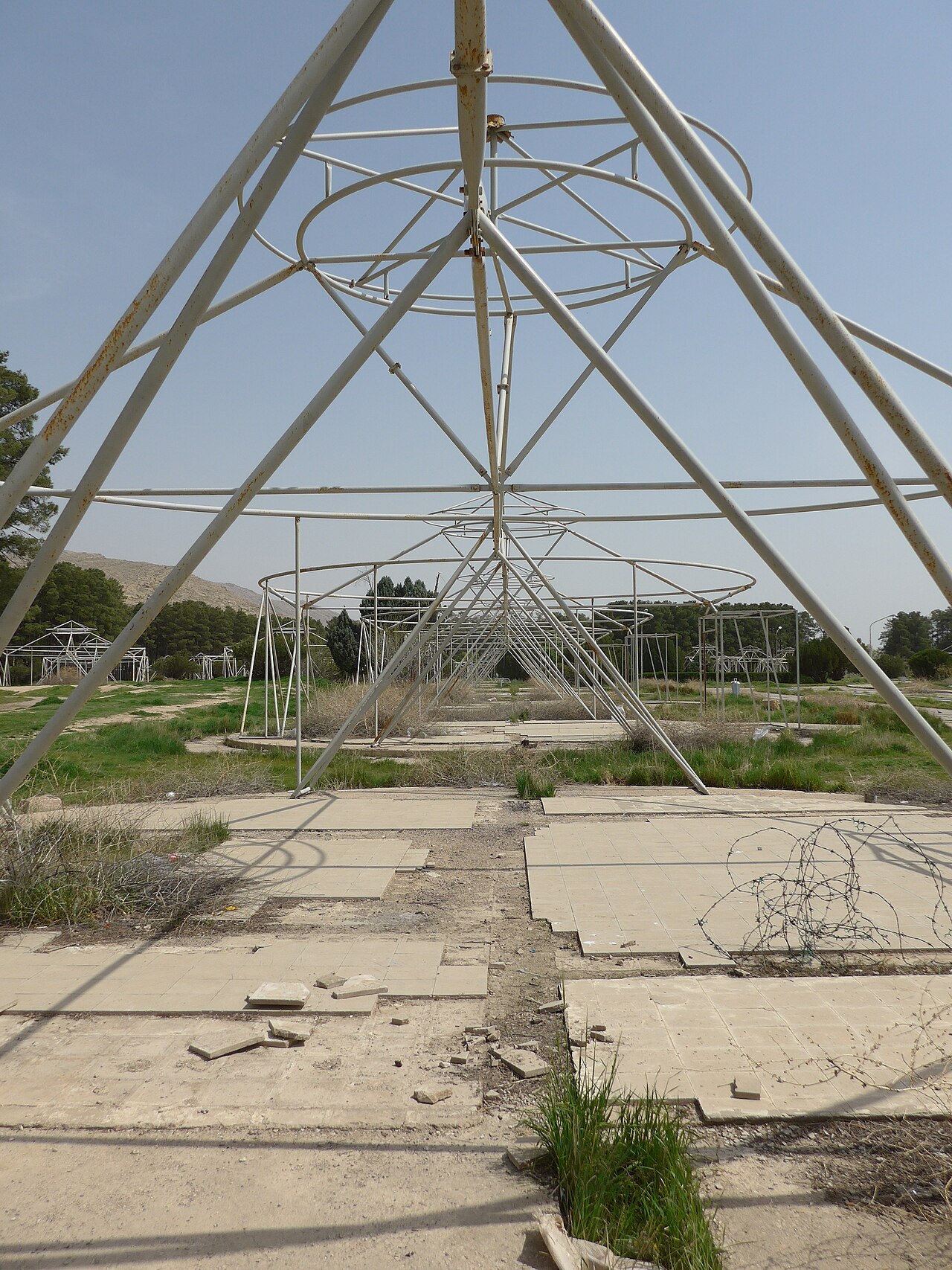
The tent city was looted after the revolution and left to decay. Steel frames and the paved avenues of the camp still stand on the plain beside Persepolis, unlabelled, between the car park and the Achaemenid ruins. Visitors who walk past them are seeing the remains of one of the twentieth century’s most famous parties, a few hundred metres from the palaces of the kings it was meant to honour. The Pahlavi family’s own story is told on Farah Pahlavi.
Persian words from this page
| جشنهای ۲۵۰۰ ساله | jashn-hâ-ye do-hezâr-o-pânsad sâle | 2,500-year celebrations |
| تخت جمشید | Takht-e Jamshid | Persepolis |
| پاسارگاد | Pâsârgâd | Pasargadae |
| کوروش | Kurosh | Cyrus |
| آسوده بخواب | âsude bekhâb | rest in peace (literally “sleep calmly”) |
| شهیاد | Shahyâd | Shahyad (“memorial of the shahs”), now Azadi |
Sources and further reading
- Ervand Abrahamian, A History of Modern Iran (Cambridge University Press, 2008).
- Robert Steele, The Shah’s Imperial Celebrations of 1971: Nationalism, Culture and Politics in Late Pahlavi Iran (I.B. Tauris, 2020).
- Abbas Amanat, Iran: A Modern History (Yale University Press, 2017).
- Abbas Milani, The Shah (Palgrave Macmillan, 2011).
- Talinn Grigor, Building Iran: Modernism, Architecture, and National Heritage under the Pahlavi Monarchs (Periscope, 2009).
Want to learn Persian? Get the free Starter Pack
Get the 14-page printable Starter Pack (all 32 letters, a 7-day reading plan, 100 core words and 20 survival phrases) and a short 5-email course. Free.
More in The Pahlavi Era (1925–1979)
- Reza Shah Pahlavi
- Reza Shah’s Reforms
- The Trans-Iranian Railway
- Why Persia Became “Iran” in 1935
- The Unveiling Decree of 1936 (Kashf-e Hijab)
- The Anglo-Soviet Invasion of Iran (1941)
- The Persian Corridor and the Tehran Conference
- The Iran Crisis of 1946
- Mohammad Reza Shah’s Early Reign (1941–1953)
- The Tudeh Party
- Mohammad Mosaddegh
- The Nationalisation of Iranian Oil (1951)
- The 1953 Coup in Iran
- Fazlollah Zahedi
- The 1954 Oil Consortium Agreement
- SAVAK: The Shah’s Security Service
- The White Revolution (1963)
- The Uprising of June 1963 and Khomeini’s Exile
- The Hoveyda Years (1965–1977)
- The 2,500-Year Celebration of the Persian Empire (1971)
- The Oil Boom of the 1970s
- Intellectuals and Opposition in the 1960s–70s
- Iran as a Regional Power under the Shah
- Women in Pahlavi Iran
- The Cinema Rex Fire (1978)
- Black Friday (September 1978)
- The Shah Leaves Iran (January 1979)
- Farah Pahlavi
- The Pahlavi Family
- Forough Farrokhzad and Modern Persian Poetry
- Iranian Cinema before 1979