The 1953 coup overthrew Iran’s prime minister Mohammad Mosaddegh on 19 August 1953 (28 Mordad 1332) and restored Mohammad Reza Shah to full power. It was planned by the American CIA and British MI6, which the United States has acknowledged in declassified documents, and carried out by Iranian army officers, royalist politicians, clerics and street crowds. Historians still argue about how far the outcome was decided in Washington and London and how far in Tehran.
| Date | First attempt 15–16 August 1953; coup 19 August 1953 (28 Mordad 1332) |
|---|---|
| Code names | TPAJAX (CIA), Operation Boot (MI6) |
| Key Iranian figure | General Fazlollah Zahedi, appointed prime minister |
| CIA field officer | Kermit Roosevelt Jr. |
| Deaths | Estimates of about 200 to 300 in Tehran |
| Result | Mosaddegh arrested and tried; shah returned 22 August |
Why London and Washington wanted Mosaddegh gone
After the oil nationalisation of 1951, Britain wanted a government in Tehran that would settle on terms it could accept. MI6 had networks in Iran, notably the Rashidian brothers, but lost its base when Iran closed the British embassy in October 1952. British officers, among them C.M. Woodhouse, then pressed the Americans to act. President Truman had refused; the Eisenhower administration, in office from January 1953, agreed. In American eyes the main issue was the Cold War: officials feared that a weakened Mosaddegh would be pushed aside by the communist Tudeh party. Mark Gasiorowski argues that this fear, more than oil, drove the US decision; Ervand Abrahamian puts oil and the control of it at the centre.
Inside Iran the coalition behind Mosaddegh had split. Ayatollah Abol-Qasem Kashani and other former allies had turned against him, the army officer corps was resentful, and in early August 1953 Mosaddegh dissolved the Majlis after a referendum that critics called rigged. CIA money and propaganda worked on all these divisions in the months before the coup.
The failed first attempt, 15–16 August
The plan relied on the shah, who signed two decrees (farman): one dismissing Mosaddegh and one naming Zahedi prime minister. On the night of 15–16 August Colonel Nematollah Nasiri of the Imperial Guard took the dismissal order to Mosaddegh’s house. Mosaddegh, warned in advance, had him arrested. Officers loyal to the government rounded up plotters, Zahedi went into hiding, and the shah flew to Baghdad and then to Rome. Crowds pulled down statues of the Pahlavi kings, and Tudeh supporters filled the streets.
The CIA’s headquarters thought the operation had failed. The 2017 State Department documents include messages from Washington on 18 August telling the station to stop. Roosevelt and his Iranian contacts carried on.

19 August: 28 Mordad
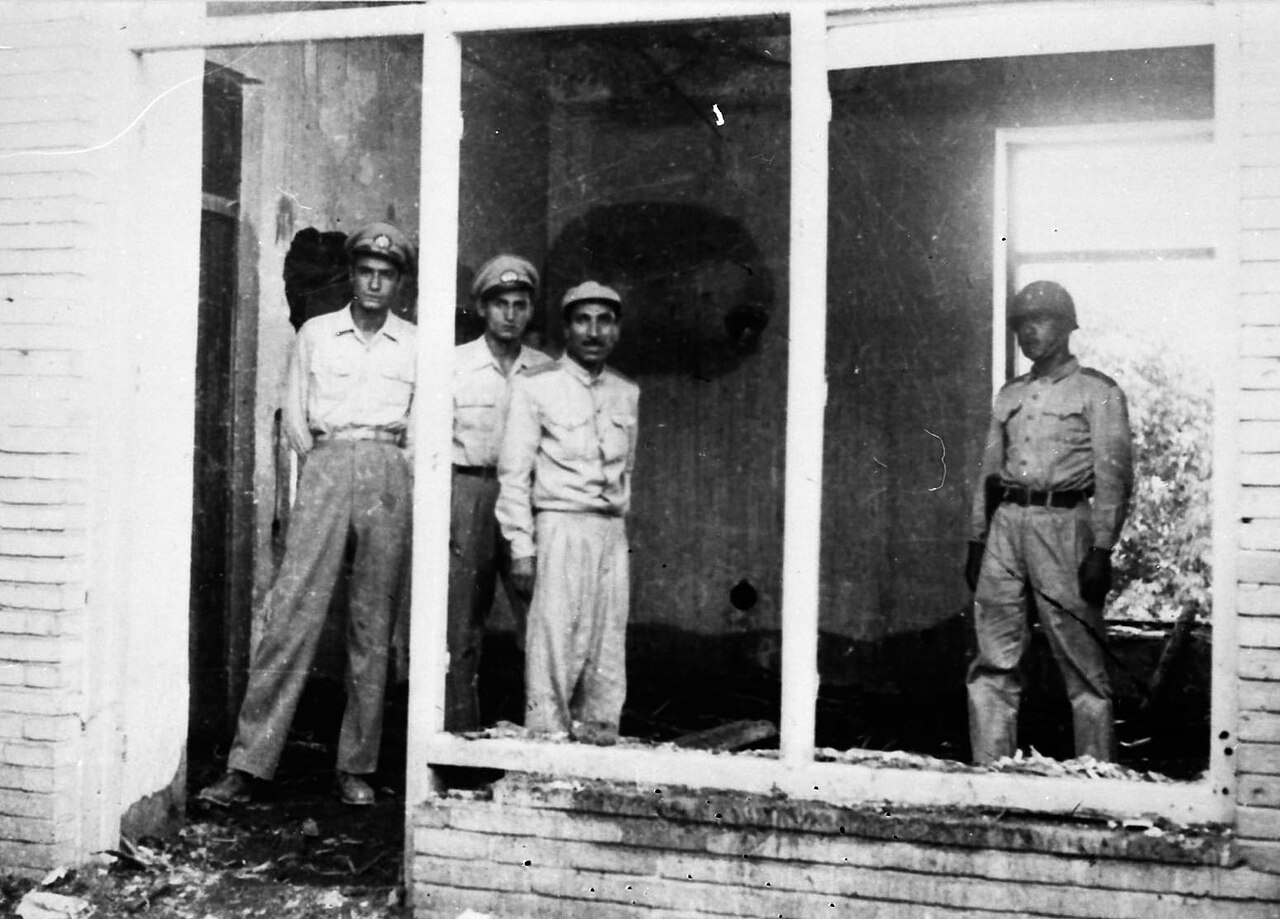
On the morning of 19 August crowds from south Tehran, including bazaar toughs and men from the zurkhaneh gyms, marched toward the centre shouting for the shah. Many had been paid; how many, and by whom, is disputed. Army and police units joined them, the radio station was seized and the decree naming Zahedi was broadcast. Mosaddegh had ordered his supporters, and the Tudeh, to keep off the streets the day before, so little resistance formed. Tanks attacked Mosaddegh’s house in the afternoon; after several hours of fighting he escaped over a wall and surrendered the next day. The shah returned on 22 August.
Estimates of the dead range from about 200 to about 300. Mosaddegh was tried by a military court in late 1953 and sentenced to three years in prison, followed by house arrest at Ahmadabad until his death in 1967. His foreign minister Hossein Fatemi was executed in 1954, and thousands of Tudeh members were arrested in the following years.
The declassified record
The American role was an open secret for decades, but the documents came out slowly. In 2000 the New York Times published much of an internal CIA history written by Donald Wilber in 1954. In 2013 the National Security Archive obtained the release of a CIA internal history, The Battle for Iran, which states that the coup was carried out “under CIA direction as an act of U.S. foreign policy”. In June 2017 the State Department published a long-delayed volume of Foreign Relations of the United States on Iran 1951–1954, with hundreds of documents on the planning, the payments and the near-abandonment of the operation. British files remain only partly released.
How decisive was the foreign role
Historians agree that the CIA and MI6 planned the coup, funded opposition politicians and the press, and that the CIA paid for at least part of the crowds. They disagree about weight.
- Foreign role decisive. Gasiorowski, Abrahamian and the journalist Stephen Kinzer (All the Shah’s Men, 2003) argue that without American planning, money and Roosevelt’s refusal to give up after 16 August, Mosaddegh would have stayed in office. Ali Rahnema’s close study of the networks of agents and paid crowds (2015) supports a strong foreign role while stressing the Iranians who did the work.
- Iranian forces decisive. Ray Takeyh (Foreign Affairs, 2014, and The Last Shah, 2021) and the former diplomat Darioush Bayandor (Iran and the CIA, 2010) argue that the CIA plot had collapsed by 17 August and that 19 August was driven mainly by Iranian actors: the clergy around Kashani and Ayatollah Behbahani, army officers and a public tired of crisis. Gasiorowski and Roham Alvandi have called this reading of the evidence highly selective.
The disagreement is also political. For the Islamic Republic, and for many Iranian nationalists, 28 Mordad is the founding grievance of hostility to the United States; for some monarchists it was a national uprising for the shah. The 2017 documents gave material to both sides: they show how close Washington came to giving up, and how much it had invested before it nearly did. For the deal that followed, see the 1954 oil consortium; for Mosaddegh himself, see his biography; for the general who replaced him, see Fazlollah Zahedi.
Persian words from this page
| کودتا | kudetâ | coup |
| ۲۸ مرداد | bist-o-hasht-e Mordâd | 28 Mordad (19 August 1953) |
| فرمان | farmân | royal decree |
| مصدق | Mosaddeq | Mosaddegh |
| زاهدی | Zâhedi | Zahedi |
| زورخانه | zurkhâne | traditional gym (“house of strength”) |
Sources and further reading
- US Department of State, Foreign Relations of the United States, 1952–1954, Iran, 1951–1954 (Office of the Historian, 2017).
- CIA, The Battle for Iran (internal history, released 2013 via the National Security Archive).
- Mark J. Gasiorowski and Malcolm Byrne (eds.), Mohammad Mosaddeq and the 1953 Coup in Iran (Syracuse University Press, 2004).
- Ervand Abrahamian, The Coup: 1953, the CIA, and the Roots of Modern U.S.–Iranian Relations (The New Press, 2013).
- Ray Takeyh, “What Really Happened in Iran”, Foreign Affairs (July/August 2014); Darioush Bayandor, Iran and the CIA: The Fall of Mosaddeq Revisited (Palgrave Macmillan, 2010).
- Stephen Kinzer, All the Shah’s Men (Wiley, 2003); Ali Rahnema, Behind the 1953 Coup in Iran (Cambridge University Press, 2015).
Want to learn Persian? Get the free Starter Pack
Get the 14-page printable Starter Pack (all 32 letters, a 7-day reading plan, 100 core words and 20 survival phrases) and a short 5-email course. Free.
More in The Pahlavi Era (1925–1979)
- Reza Shah Pahlavi
- Reza Shah’s Reforms
- The Trans-Iranian Railway
- Why Persia Became “Iran” in 1935
- The Unveiling Decree of 1936 (Kashf-e Hijab)
- The Anglo-Soviet Invasion of Iran (1941)
- The Persian Corridor and the Tehran Conference
- The Iran Crisis of 1946
- Mohammad Reza Shah’s Early Reign (1941–1953)
- The Tudeh Party
- Mohammad Mosaddegh
- The Nationalisation of Iranian Oil (1951)
- The 1953 Coup in Iran
- Fazlollah Zahedi
- The 1954 Oil Consortium Agreement
- SAVAK: The Shah’s Security Service
- The White Revolution (1963)
- The Uprising of June 1963 and Khomeini’s Exile
- The Hoveyda Years (1965–1977)
- The 2,500-Year Celebration of the Persian Empire (1971)
- The Oil Boom of the 1970s
- Intellectuals and Opposition in the 1960s–70s
- Iran as a Regional Power under the Shah
- Women in Pahlavi Iran
- The Cinema Rex Fire (1978)
- Black Friday (September 1978)
- The Shah Leaves Iran (January 1979)
- Farah Pahlavi
- The Pahlavi Family
- Forough Farrokhzad and Modern Persian Poetry
- Iranian Cinema before 1979