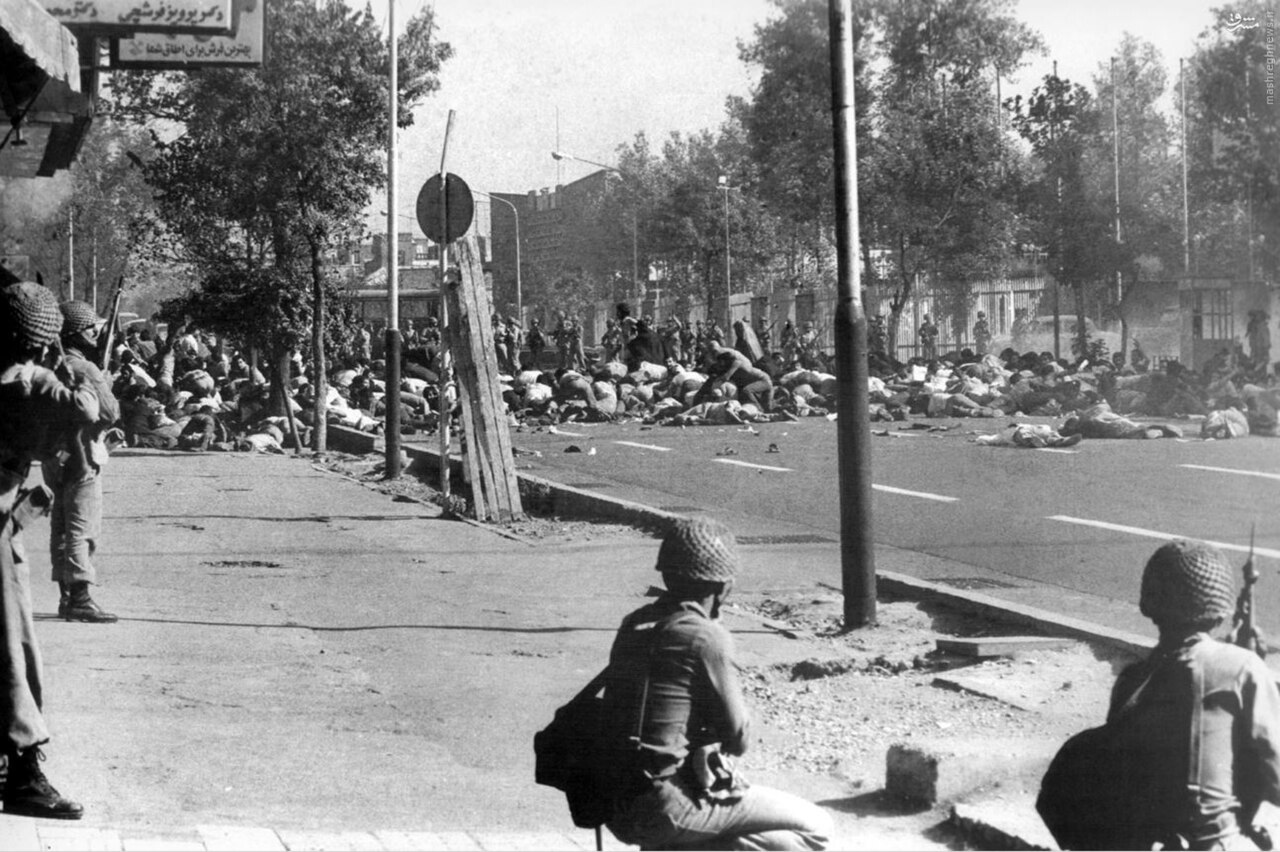
Black Friday (جمعه سیاه, Jom’e-ye siâh) was the shooting of demonstrators by the army in Jaleh Square, eastern Tehran, on Friday 8 September 1978, hours after martial law had been declared. The government reported 86 dead and the opposition spoke of thousands; later research based on Iranian records counted 64 dead in the square and 88 across Tehran that day. The killings ended hopes of compromise between the shah and the protest movement.
| Date | Friday 8 September 1978 (17 Shahrivar 1357) |
|---|---|
| Place | Jaleh Square (میدان ژاله), Tehran, now Shohada (Martyrs) Square |
| Prime minister | Jafar Sharif-Emami |
| Martial law commander, Tehran | General Gholam-Ali Oveisi |
| Deaths | Disputed: 86 (government, 1978); thousands (opposition claims); 64 in the square and 88 in Tehran that day (Emadeddin Baghi) |

Reconciliation, then martial law
After the Cinema Rex fire in Abadan, the shah dismissed his prime minister and on 27 August 1978 appointed Jafar Sharif-Emami, a veteran politician with ties to religious families, to head a “government of national reconciliation”. Sharif-Emami closed casinos, restored the Islamic calendar in place of the imperial one introduced in 1976, released some prisoners and allowed the press more freedom.
The concessions did not stop the protests. On 4 September, the festival of Eid al-Fitr at the end of Ramadan, a huge crowd prayed in the open on the hills of Qeytariyeh in north Tehran and then marched through the city. More marches followed on 7 September, with demonstrators handing flowers to soldiers and calling for the return of Khomeini and an end to the monarchy. That night the government declared martial law in Tehran and eleven other cities, banning gatherings. The announcement was broadcast early on the morning of Friday 8 September, and many people heading to a planned rally had not heard it.
The morning in Jaleh Square
A crowd gathered in Jaleh Square, in a mainly working-class and lower middle-class part of east Tehran. Troops blocked the square and ordered the demonstrators to disperse. When they did not, soldiers opened fire, including, according to many witnesses, from helicopters overhead, though the use of helicopter fire is disputed. Shooting also broke out in other parts of south and east Tehran during the day.
Accounts of the exact sequence differ. Officials said soldiers had been attacked and that armed militants were in the crowd. Opposition accounts described an unarmed crowd fired on without warning. What is clear is that the army used live fire on a large crowd in a residential area, and that many of the dead were young men from the surrounding streets.
How many died
The death toll became a political weapon almost at once, and the figures still vary widely:
- The government reported 86 dead on the day.
- The opposition spoke of thousands of dead. Figures of 3,000 to 4,000 circulated, and some reports spoke of 15,000 dead and wounded. The French philosopher Michel Foucault, then writing about Iran for an Italian newspaper, repeated figures in the thousands.
- Later research. In the 2000s Emadeddin Baghi, a researcher who had worked on the records of the Foundation of Martyrs, the Islamic Republic’s body that compensates the families of those killed in the revolution, counted 64 dead in Jaleh Square, including a woman and a girl, and 24 more in other parts of Tehran, for a total of 88 that day.
Most historians now accept a toll of under a hundred dead, with many more wounded. Charles Kurzman and others have noted that the much larger figures believed at the time were themselves part of the story: people acted on what they thought had happened.
Consequences
Black Friday did not stop the movement. Strikes spread through the autumn, including in the oil industry, and the protests grew larger. The killings made it almost impossible for moderate opposition leaders to negotiate with the shah, and they strengthened the hand of Khomeini, who refused any compromise with the monarchy.
Abroad, the reaction was mixed. US President Jimmy Carter, then at the Camp David talks with Egypt and Israel, telephoned the shah two days later and publicly reaffirmed American support, which many Iranians read as approval. Accounts of the shah’s own reaction describe him as shaken by the bloodshed, and he did not again order a crackdown on this scale. Martial law remained, but the army increasingly hesitated to fire on large crowds.
Sharif-Emami’s government fell in early November 1978 and was replaced by a military government under General Gholam-Reza Azhari. In January 1979 the shah left Iran. After the revolution Jaleh Square was renamed Shohada (Martyrs) Square, and 17 Shahrivar, the Persian date, was given to a major street in Tehran and others across the country.
For the longer background, see the causes of the 1979 revolution and SAVAK.
Persian words from this page
| جمعه سیاه | jom’e-ye siâh | Black Friday |
| میدان ژاله | meydân-e Zhâle | Jaleh Square |
| شهدا | shohadâ | martyrs |
| حکومت نظامی | hokumat-e nezâmi | martial law |
| شهریور | Shahrivar | sixth month of the Iranian calendar |
| تظاهرات | tazâhorât | demonstrations |
Sources and further reading
- Charles Kurzman, The Unthinkable Revolution in Iran, Harvard University Press, 2004.
- Emadeddin Baghi, research on the casualties of the revolution based on Foundation of Martyrs records (published in Persian, early 2000s); discussed in Kurzman (2004).
- Ervand Abrahamian, A History of Modern Iran, Cambridge University Press, 2008.
- Michael Axworthy, Revolutionary Iran, Oxford University Press, 2013.
- Janet Afary and Kevin B. Anderson, Foucault and the Iranian Revolution, University of Chicago Press, 2005.
Want to learn Persian? Get the free Starter Pack
Get the 14-page printable Starter Pack (all 32 letters, a 7-day reading plan, 100 core words and 20 survival phrases) and a short 5-email course. Free.
More in The Pahlavi Era (1925–1979)
- Reza Shah Pahlavi
- Reza Shah’s Reforms
- The Trans-Iranian Railway
- Why Persia Became “Iran” in 1935
- The Unveiling Decree of 1936 (Kashf-e Hijab)
- The Anglo-Soviet Invasion of Iran (1941)
- The Persian Corridor and the Tehran Conference
- The Iran Crisis of 1946
- Mohammad Reza Shah’s Early Reign (1941–1953)
- The Tudeh Party
- Mohammad Mosaddegh
- The Nationalisation of Iranian Oil (1951)
- The 1953 Coup in Iran
- Fazlollah Zahedi
- The 1954 Oil Consortium Agreement
- SAVAK: The Shah’s Security Service
- The White Revolution (1963)
- The Uprising of June 1963 and Khomeini’s Exile
- The Hoveyda Years (1965–1977)
- The 2,500-Year Celebration of the Persian Empire (1971)
- The Oil Boom of the 1970s
- Intellectuals and Opposition in the 1960s–70s
- Iran as a Regional Power under the Shah
- Women in Pahlavi Iran
- The Cinema Rex Fire (1978)
- Black Friday (September 1978)
- The Shah Leaves Iran (January 1979)
- Farah Pahlavi
- The Pahlavi Family
- Forough Farrokhzad and Modern Persian Poetry
- Iranian Cinema before 1979