On 25 August 1941 British and Soviet forces invaded neutral Iran from the south, west and north. Iranian resistance collapsed within days, and on 16 September Reza Shah abdicated in favour of his 21-year-old son, Mohammad Reza. The Allies wanted Iran’s oil and its railway to supply the Soviet Union after Germany’s invasion of the USSR, and they stayed until 1946.
| Date | 25 August – 17 September 1941 (3–26 Shahrivar 1320) |
|---|---|
| Invaders | United Kingdom (with British Indian and Commonwealth forces) and the Soviet Union |
| British code name | Operation Countenance |
| Iranian ceasefire | Ordered 29 August 1941 under Prime Minister Mohammad Ali Foroughi |
| Result | Abdication of Reza Shah (16 September); Allied occupation until 1946; Tripartite Treaty of January 1942 |
| Persian name | شهریور ۱۳۲۰ (Shahrivar-e 1320), or اشغال ایران (eshghâl-e Irân) |
Why the Allies invaded
When war broke out in 1939 Iran declared itself neutral. The situation changed on 22 June 1941, when Germany invaded the Soviet Union. Britain and the USSR became allies overnight, and both looked at Iran. It had the large British-run refinery at Abadan, a land route between British India, Iraq and the Soviet Caucasus, and the newly completed Trans-Iranian Railway, the best way to carry Western supplies from the Persian Gulf to the Soviet Union.
The public reason given was the presence of German nationals in Iran, engineers, technicians and businessmen who had come in the 1930s as Germany became Iran’s largest trading partner. Britain and the Soviet Union claimed they were a fifth column and demanded their expulsion in notes of July and August 1941. The Iranian government reduced their number but refused to expel them all, insisting on its neutrality. Historians generally agree that the German presence was a pretext; the Allies needed control of Iran’s communications whatever Tehran did.
The invasion
Before dawn on 25 August 1941 British naval forces attacked Abadan and Khorramshahr at the head of the Persian Gulf. Iranian sloops and gunboats were sunk at their moorings, and the commander of the small navy, Admiral Gholamali Bayandor, was killed at Khorramshahr. British and Indian troops took the oil installations and the port of Bandar Shahpur, while another column advanced from Iraq through the Zagros passes towards Kermanshah. At the same time Soviet armies crossed the border from the Caucasus into Azerbaijan and Gilan, and later from Central Asia into Khorasan. Soviet aircraft bombed Tabriz, Qazvin and other towns.
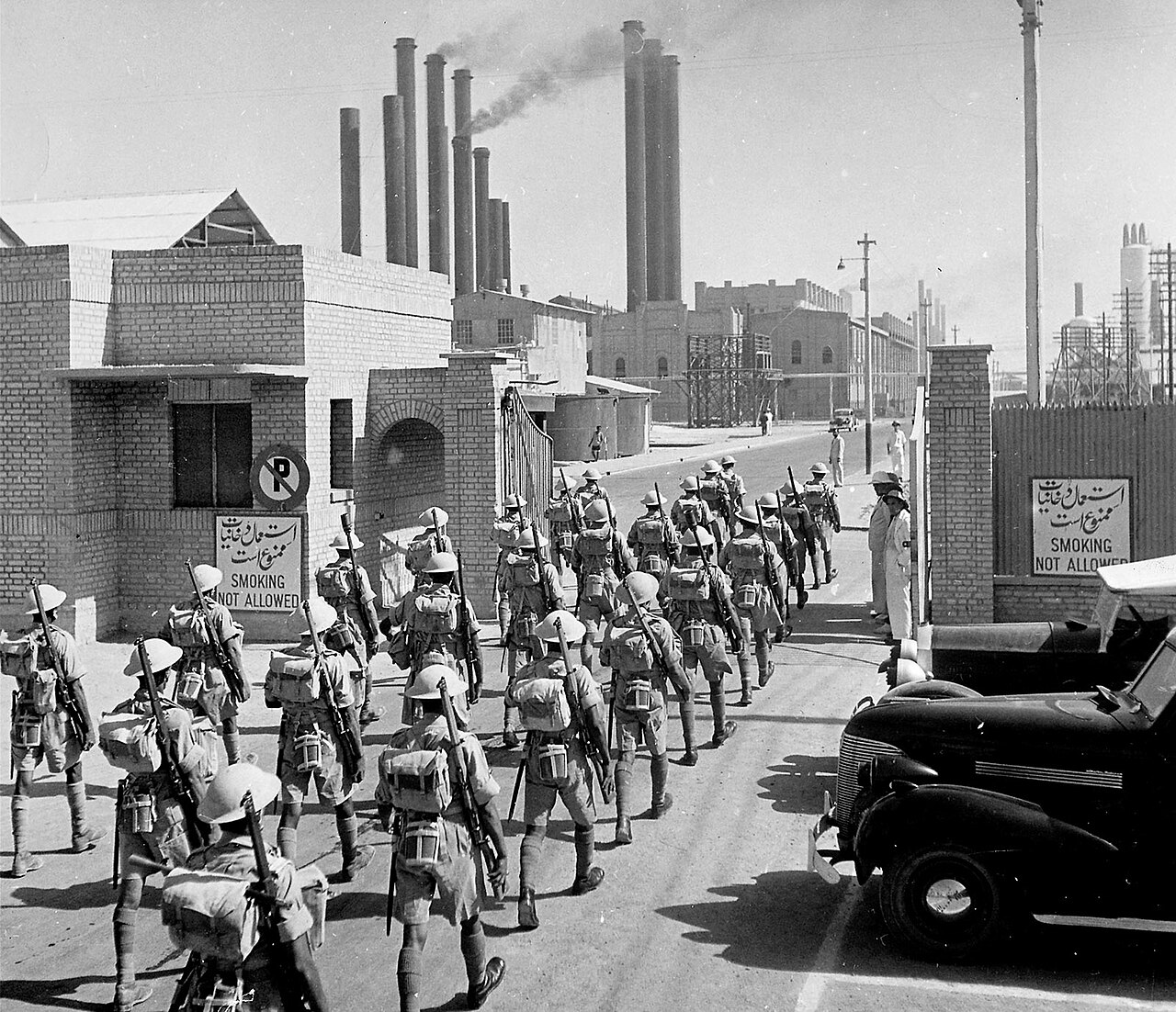

The army Reza Shah had built over twenty years was designed to control the provinces, not to fight two great powers. Some units fought, notably at the Paitak pass and on the Persian Gulf coast; many dissolved as conscripts went home and officers lost contact with Tehran. Several hundred Iranian soldiers and sailors were killed; exact figures are uncertain. Allied losses were light.
On 27 August the cabinet of Ali Mansur resigned. The new prime minister, the elderly statesman Mohammad Ali Foroughi, ordered a ceasefire on 29 August and opened negotiations. Iran agreed to expel or hand over most Germans and to allow Allied use of its roads and railway.
The abdication of Reza Shah
The fighting had stopped, but the Allies did not trust Reza Shah. British radio, including the Persian broadcasts of the BBC, attacked his rule, his seizure of land and his treatment of opponents, and found a ready audience. Soviet and British columns began moving towards Tehran in mid-September. Foroughi, who had served and suffered under the shah, advised him that the dynasty could survive only if he stepped down.
On 16 September 1941 Reza Shah signed a short letter of abdication, drafted by Foroughi, in favour of his son and left Tehran for Isfahan. The next day Allied troops entered the capital and Mohammad Reza took the oath before the Majlis. The British carried the former shah from Bandar Abbas to Mauritius, and later to Johannesburg, where he died in 1944. His life is covered on the page on Reza Shah.
Whether Britain had a choice of successor is debated. Some British officials considered restoring the Qajars, possibly through a son of the last crown prince, but the idea was dropped. Abbas Milani and Ervand Abrahamian both describe the succession of the young crown prince as a compromise accepted by the British because it kept the state working.
- 22 June 1941 Germany invades the Soviet Union
- July–August 1941 British and Soviet notes demand expulsion of Germans
- 25 August 1941 Invasion begins; Iranian navy sunk at Abadan and Khorramshahr
- 29 August 1941 Foroughi orders a ceasefire
- 16 September 1941 Reza Shah abdicates
- 17 September 1941 Allied troops enter Tehran; Mohammad Reza Shah takes the oath
- 29 January 1942 Tripartite Treaty of Alliance signed
The Tripartite Treaty and occupation
In January 1942 Iran, Britain and the Soviet Union signed a Treaty of Alliance. The Allies promised to respect Iran’s sovereignty and territorial integrity and to withdraw their forces within six months of the end of the war with Germany and its allies. In return Iran gave them the use of its communications. The country was in effect divided again: Soviet forces in the north, British in the south, and from late 1942 American troops running the supply route. That story is told on the page on the Persian Corridor, and the Soviet failure to leave on time on the page on the Iran crisis of 1946.
What the invasion meant for Iran
For many Iranians the invasion was a humiliation that echoed the occupations of the First World War, described on our page on Iran in the First World War. Occupation brought inflation, shortages of bread and, in 1942–1943, hunger in many towns, as armies bought up food and transport was given over to Allied supplies.
It also ended a dictatorship. The fall of Reza Shah released political prisoners, revived the press and parliament and allowed parties to form, among them the communist Tudeh Party. Ervand Abrahamian and Homa Katouzian both describe 1941–1953 as an unusually open period in Iranian politics, a time of real competition among the court, the Majlis, the old notables, nationalists and the left. Mohammad Reza Shah’s early reign, and the rise of Mohammad Mosaddegh, belong to this period.
Persian words from this page
| شهریور | Shahrivar | sixth month of the Iranian calendar |
| اشغال | eshghâl | occupation |
| متفقین | motafeqin | the Allies |
| استعفا | este’fâ | resignation, abdication |
| بیطرفی | bi-tarafi | neutrality |
| فروغی | Forughi | Foroughi, prime minister in 1941 |
Sources and further reading
- Ervand Abrahamian, Iran Between Two Revolutions (Princeton University Press, 1982), chapters 3–4.
- Richard A. Stewart, Sunrise at Abadan: The British and Soviet Invasion of Iran, 1941 (Praeger, 1988).
- Abbas Milani, The Shah (Palgrave Macmillan, 2011).
- Homa Katouzian, The Persians: Ancient, Mediaeval and Modern Iran (Yale University Press, 2009).
- Encyclopaedia Iranica, article “Anglo-Iranian Relations” (iranicaonline.org).
Want to learn Persian? Get the free Starter Pack
Get the 14-page printable Starter Pack (all 32 letters, a 7-day reading plan, 100 core words and 20 survival phrases) and a short 5-email course. Free.
More in The Pahlavi Era (1925–1979)
- Reza Shah Pahlavi
- Reza Shah’s Reforms
- The Trans-Iranian Railway
- Why Persia Became “Iran” in 1935
- The Unveiling Decree of 1936 (Kashf-e Hijab)
- The Anglo-Soviet Invasion of Iran (1941)
- The Persian Corridor and the Tehran Conference
- The Iran Crisis of 1946
- Mohammad Reza Shah’s Early Reign (1941–1953)
- The Tudeh Party
- Mohammad Mosaddegh
- The Nationalisation of Iranian Oil (1951)
- The 1953 Coup in Iran
- Fazlollah Zahedi
- The 1954 Oil Consortium Agreement
- SAVAK: The Shah’s Security Service
- The White Revolution (1963)
- The Uprising of June 1963 and Khomeini’s Exile
- The Hoveyda Years (1965–1977)
- The 2,500-Year Celebration of the Persian Empire (1971)
- The Oil Boom of the 1970s
- Intellectuals and Opposition in the 1960s–70s
- Iran as a Regional Power under the Shah
- Women in Pahlavi Iran
- The Cinema Rex Fire (1978)
- Black Friday (September 1978)
- The Shah Leaves Iran (January 1979)
- Farah Pahlavi
- The Pahlavi Family
- Forough Farrokhzad and Modern Persian Poetry
- Iranian Cinema before 1979