Khosrow II, called Parviz (“the Victorious”), ruled the Sasanian Empire from 590 to 628 CE, with a break in 590–591 when the rebel Bahram Chobin held the throne. Restored with Byzantine help, he later led Iran’s greatest war of conquest, taking Syria, Jerusalem and Egypt, and his court became a byword for luxury. The war ended in defeat, and in 628 Khosrow was overthrown and executed by his own son, leaving the empire exhausted a few years before the Arab conquest.
| Reign | 590 and 591–628 CE |
|---|---|
| Father | Hormizd IV |
| Epithet | Parviz, Middle Persian Abarwēz, “victorious” |
| Main residences | Ctesiphon and Dastagerd (Dastgerd) in Mesopotamia |
| Wives in the sources | Shirin; Maria, said in later tradition to be a daughter of the emperor Maurice |
| Death | Executed February 628, after a coup by his son Kavad II (Shiroe) |
| Monuments | The large grotto at Taq-e Bostan, near Kermanshah, is usually attributed to him |

A throne won twice
Khosrow became king in 590 when a court faction led by his maternal uncles Vistahm and Vindoe deposed his father, Hormizd IV. Within months the general Bahram Chobin, already in revolt, drove him out of Ctesiphon. Khosrow fled across the Syrian desert to the Byzantine frontier and asked the emperor Maurice for help, an extraordinary step for a king of kings. Maurice agreed, in return for most of Persian Armenia, part of Iberia and the fortresses of Dara and Martyropolis. In 591 a Byzantine-Persian army defeated Bahram at Blarathon in Azerbaijan, and Khosrow returned to his capital. The story is told on the Bahram Chobin page.
Once secure, Khosrow turned on the men who had put him on the throne. Vindoe was executed. Vistahm, who governed the north-east, rebelled and ruled much of Khorasan and Media for several years, striking coins in his own name, until he was killed around 600. The restored king trusted few of the great nobles, and he had reason not to.
The friend of Maurice
For a decade the two empires were at peace, with the Byzantine emperor treated as the Persian king’s adoptive father. This friendship shaped Khosrow’s reputation among Christians. Byzantine sources record that he sent rich gifts to the shrine of Saint Sergius at Rusafa in Syria, with letters thanking the saint for his victory and later praying that his Christian wife Shirin would bear him a son. Later tradition, Persian and Byzantine, gave him a second Christian wife, Maria, called a daughter of Maurice; most historians doubt that she existed in that form. Both women are discussed on the Shirin page.
Khosrow was not a Christian, and he could be hard on the churches. After the death of the catholicos (head) of the Church of the East in 609 he did not allow a successor to be chosen, and the office stayed vacant until after his fall. At court, the Miaphysite physician Gabriel of Sinjar and Shirin’s circle had strong influence on church affairs. See Christians in the Sasanian Empire.
The end of the Lakhmids
Around 602 Khosrow deposed and killed al-Nu’man III, king of the Lakhmid Arabs at al-Hira, whose dynasty had guarded the desert frontier of Mesopotamia for Iran for three centuries. Arabic tradition gives personal reasons; the result was that Persia lost its buffer state. A few years later, at a place called Dhu Qar, Arab tribes defeated a Persian and Arab force. The battle was small, but Arab memory treated it as the first victory of the Arabs over the Persians, and it showed what the frontier had become without the Lakhmids.
The great war
In 602 Maurice was murdered by the usurper Phocas. Khosrow declared war, claiming to avenge his benefactor, and presented a man said to be Maurice’s son Theodosius as the rightful emperor. The war lasted until 628. Persian armies under generals such as Shahrbaraz and Shahin took Dara, Edessa, Antioch and Damascus, captured Jerusalem in 614 and carried off the relic of the True Cross, and conquered Egypt between 618 and 621. In 626 a Persian army stood on the Bosporus opposite Constantinople while the Avars besieged the city.
The war and the Byzantine recovery are told in two pages: the last great war, 602–628, and Heraclius strikes back.
The splendour of Khosrow’s court
Later Persian and Arabic writers remembered Khosrow above all for his magnificence. Al-Tabari, al-Tha’alibi and Ferdowsi list his treasures and his marvels. Among the most famous are:
- the throne Taqdis, decorated with the signs of the zodiac;
- Shabdiz, his black horse, whose death no one dared to report to him;
- Barbad, the court musician, credited in later tradition with composing a melody for every day of the year;
- a vast carpet for the palace of Ctesiphon, later called the “Spring of Khosrow”, which showed a garden in jewels and gold thread;
- harems, elephants and treasuries described in numbers that are plainly exaggerated.
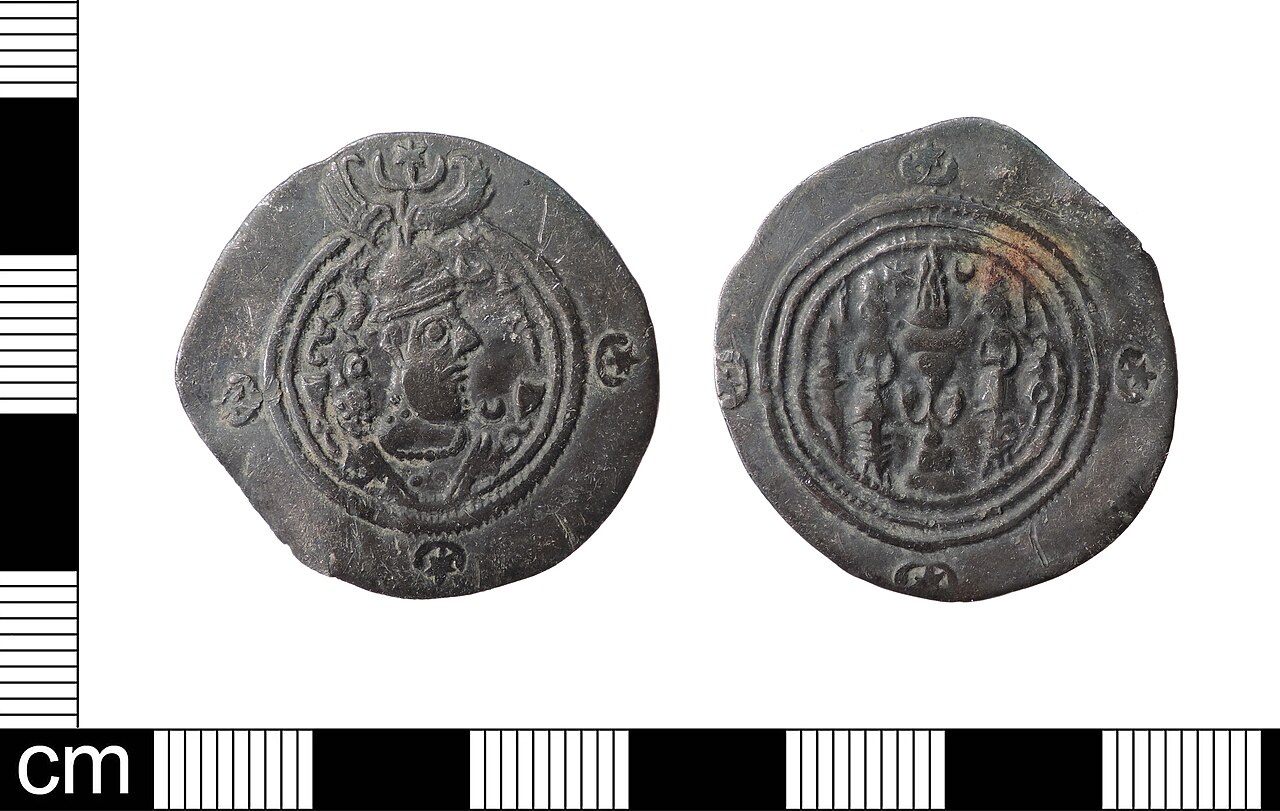
Much of this is legend, but it rests on a real court culture. Khosrow’s coins introduced a new crown with wings and a crescent, and his legend on them reads that the king has “increased in glory”. The great rock-cut grotto at Taq-e Bostan, with its royal hunting scenes and an armoured horseman, is the finest visual record of his court. Visit it through the Taq-e Bostan site guide or read about the monument in Taq-e Bostan.
The fall of 628
By 627 Heraclius was in Mesopotamia and had sacked Khosrow’s palace at Dastagerd. The king retreated to Ctesiphon and, according to the sources, punished generals he blamed for the defeats and refused to make peace. In February 628 a group of nobles freed his son Shiroe, who had been held under guard, and proclaimed him king as Kavad II. Khosrow was arrested, held for a few days in a building the sources call the “House of Darkness”, and put to death. Tabari preserves a list of charges brought against him, including the killing of his father, the hoarding of treasure and the long imprisonment of soldiers on distant fronts.
Islamic tradition adds that Khosrow received a letter from the Prophet Muhammad inviting him to Islam and tore it up, and that the Prophet foretold the tearing apart of his kingdom. Within four years, the empire had gone through more than half a dozen rulers. See civil war and the queens Boran and Azarmidokht.
A double reputation
Khosrow II is remembered in two ways. For Persian poets he is the lover of Shirin in the romance of Nizami Ganjavi and the most splendid of kings. For historians he is the ruler who staked everything on a war of conquest, won almost all of the eastern Roman provinces and lost them in three years, leaving both empires open to the Arab armies of the 630s.
Persian words from this page
| خسرو پرویز | Khosrow Parviz | Khosrow the Victorious |
| شیرین | Shirin | Shirin; also “sweet” |
| شبدیز | Shabdiz | Khosrow’s horse; “night-coloured” |
| باربد | Bârbad | Barbad, the court musician |
| تاق بستان | Tâq-e Bostân | Taq-e Bostan |
| شیرویه | Shiruye | Shiroe, Kavad II |
Sources and further reading
- al-Tabari, The History of al-Tabari, vol. 5, trans. C. E. Bosworth (SUNY Press, 1999).
- Theophylact Simocatta, History, trans. Michael and Mary Whitby (Oxford, 1986).
- “Khosrow II”, Encyclopaedia Iranica, iranicaonline.org.
- James Howard-Johnston, The Last Great War of Antiquity (Oxford University Press, 2021).
- Touraj Daryaee, Sasanian Persia: The Rise and Fall of an Empire (I.B. Tauris, 2009).
Want to learn Persian? Get the free Starter Pack
Get the 14-page printable Starter Pack (all 32 letters, a 7-day reading plan, 100 core words and 20 survival phrases) and a short 5-email course. Free.
More in The Sasanian Empire (224–651 CE)
- The Origins of the Sasanian Family
- Ardashir I, Founder of the Sasanian Empire
- Firuzabad: Ardashir’s Round City
- Shapur I, King of Kings of Iran and Non-Iran
- Bishapur: Shapur’s City
- The Battle of Edessa and the Capture of Valerian
- The Ka’ba-ye Zartosht Inscription of Shapur I
- Mani and Manichaeism
- Hormizd I and Bahram I
- Kartir and the Zoroastrian Church
- Bahram II
- Narseh and the Peace of Nisibis
- Shapur II the Great
- Julian’s Invasion of Persia (363)
- Christians in the Sasanian Empire
- Shapur III and the Partition of Armenia
- Yazdegerd I
- Bahram V Gur
- Yazdegerd II
- The Battle of Avarayr (451)
- The Hephthalites and Iran’s Eastern Frontier
- Peroz I and the Hephthalite Disaster
- Kavad I
- Zamasp and Kavad’s Return
- Mazdak and the Mazdakite Movement
- Khosrow I Anushirvan the Just
- The Sasanian–Byzantine Wars of the 6th Century
- The Battle of Dara (530)
- Khosrow I Sacks Antioch (540)
- The Lazic War (541–562)
- The Reforms of Khosrow I
- The Academy of Gondishapur: History and Legend
- Borzuya, Chess and Kalila wa Dimna
- Taq Kasra: The Arch of Ctesiphon
- The Sasanian Conquest of Yemen
- The Sasanians and the Western Turks
- Hormizd IV
- Bahram Chobin’s Rebellion
- Khosrow II Parviz
- The Last Great War: Byzantium and Persia, 602–628
- The Siege of Constantinople (626)
- Heraclius Strikes Back
- Shirin: Queen and Legend
- Shahrbaraz, the General Who Became King
- Civil War and the Queens Boran and Azarmidokht
- Yazdegerd III, the Last Sasanian King
- The Sasanian Army
- Sasanian Society and the Class System
- Zoroastrianism under the Sasanians
- Sasanian Art: Silver, Reliefs and Silk
- The Sasanian Reliefs of Naqsh-e Rostam
- Taq-e Bostan
- Sasanian Cities, Palaces and Bridges
- Middle Persian (Pahlavi) Language and Literature
- Sasanian Coins and Silverwork
- Women in the Sasanian Empire
- Polo, Hunting and Games at the Sasanian Court
- The Sasanian Legacy