Bahram V, known as Bahram Gur, was king of Sasanian Iran from 420 to 438 CE. Raised at the Arab court of al-Hira, he won the throne against the will of the nobles, fought Rome to a quick peace and drove off invaders from Central Asia. Later Persian poets made him the great hunter-king of legend, and his name is still one of the most familiar in Persian literature.
| Reign | 420–438 CE (some reckonings give 421–439) |
|---|---|
| Father | Yazdegerd I |
| Middle Persian name | Wahram |
| Nickname | Gur, “onager” (wild ass), his favourite quarry |
| Wars | Rome, 421–422; Central Asian invaders in the northeast |
| Successor | His son Yazdegerd II |
A prince brought up among the Arabs
According to al-Tabari, Yazdegerd I sent his young son Bahram to be raised by the Lakhmid kings of al-Hira, the Arab client state on the edge of the Iraqi desert that guarded the empire’s southwestern frontier. There he learned riding, archery and, the sources add, Arabic and the manners of the desert. Arab tradition says the Lakhmid king built the palace of al-Khawarnaq near al-Hira for the prince, and tells that its architect was thrown from the roof so that he could never build a finer one. Like many details of Bahram’s youth, that story belongs to legend.
Taking the crown from between two lions
When Yazdegerd died in 420, the nobles were determined that none of his sons should rule. They killed one, Shapur, and crowned a distant relative named Khosrow. Bahram marched from al-Hira with an Arab army led by the Lakhmid al-Mundhir and camped near Ctesiphon.
Al-Tabari and Ferdowsi tell how the deadlock was broken. Bahram proposed that the royal crown be placed between two hungry lions: whoever took it would be king. Khosrow declined to try. Bahram killed the lions and put on the crown. The tale is a legend of royal legitimacy, but behind it lies a real compromise. The nobles accepted Bahram, and he in turn ruled with more regard for them and for the priests than his father had shown.

War and peace with Rome
The new reign began with conflict. The persecution of Christians that had started at the end of Yazdegerd’s reign continued, refugees fled to Roman territory, and Bahram demanded their return. War broke out in 421. Roman forces besieged Nisibis and Persian troops attacked Theodosiopolis in Armenia, but neither side gained much. A peace was made in 422. Roman sources report that each empire agreed to tolerate the other’s religious minorities, Christians in Persia and Zoroastrians in Rome, and not to accept the other’s Arab allies if they changed sides.
In Armenia, Bahram ended the long line of Arsacid kings. In 428, at the request of Armenian nobles who had turned against their own king Artashes, he deposed him and placed Persian Armenia under a governor, a marzban. This set the stage for the Armenian revolt of 451 under his son (see The Battle of Avarayr).
The victory in the east
The most celebrated event of the reign took place in the northeast. Invaders from beyond the Oxus, whom the Persian and Arabic sources call “Turks” and their ruler the “khaqan”, crossed into Khorasan. Bahram, the story goes, pretended to go hunting in Azerbaijan, let rumours spread that he had abandoned the east, and then marched fast with a small force and surprised the enemy near Merv. The khaqan was killed and his crown taken. Bahram’s brother Narseh was made governor of Khorasan.
The invaders cannot have been Turks, who appear only a century later. Modern historians think they were one of the Hunnic peoples then moving into Bactria, most likely the Kidarites or the Chionites. The Hephthalites, who would become the empire’s great eastern enemy, came to power somewhat later. Historians do agree that Bahram held the frontier, which his successors would not always manage to do.
Bahram the hunter in Persian poetry
Bahram’s real achievements were modest beside his fame in literature. In the Shahnameh of Ferdowsi he is the model of a pleasure-loving but generous king who hunts, drinks, travels in disguise and marries the daughters of farmers and kings. Ferdowsi has him visit India incognito and bring back thousands of musicians, said to be the ancestors of the Luris, the travelling entertainers of later Iran.
Azadeh and the deer
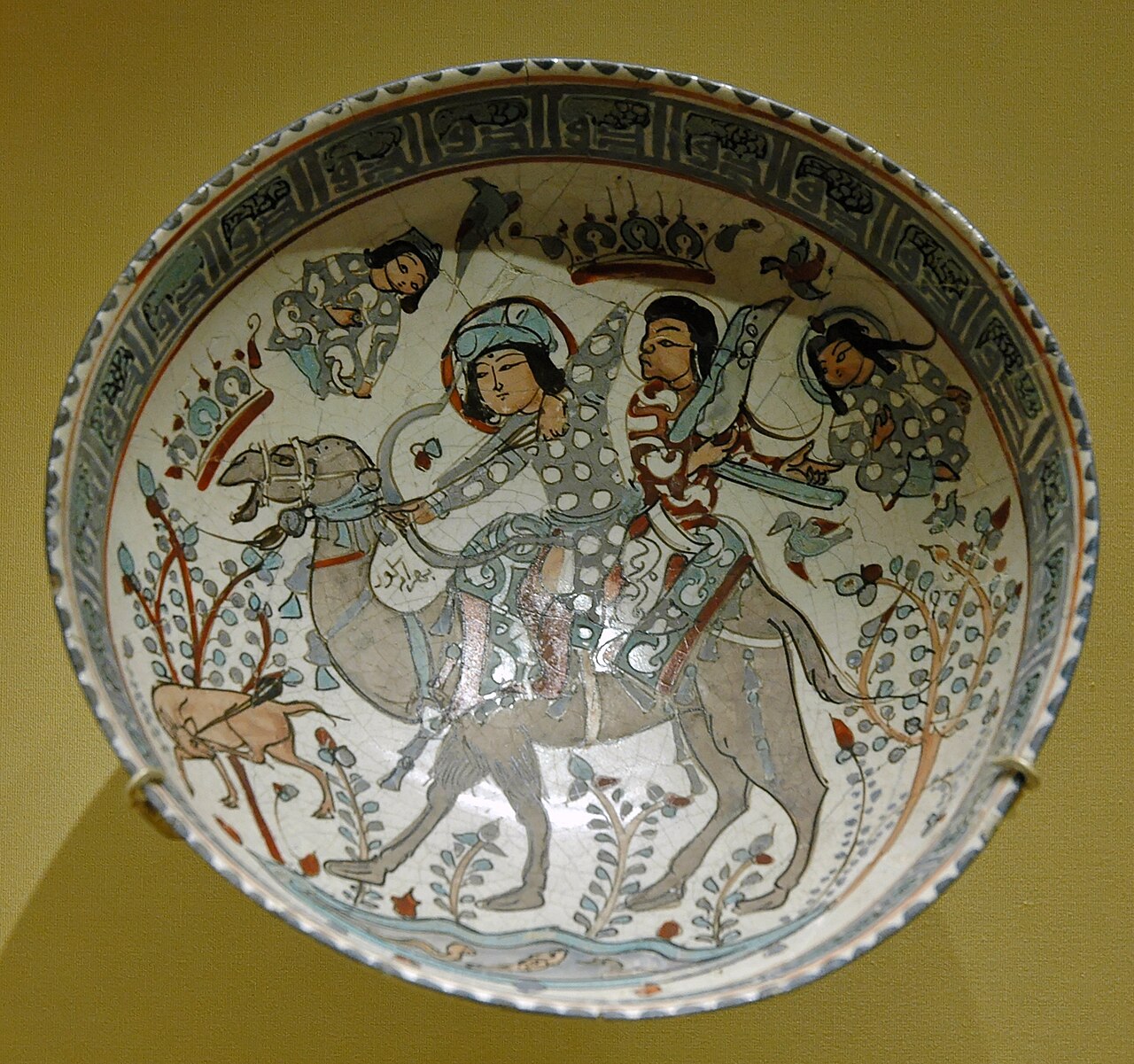
The best-known episode tells of the harpist Azadeh, who rode behind Bahram on a camel during a hunt. She challenged him to turn a male deer into a female and a female into a male, and to pin a deer’s hoof to its ear. He shot away the stag’s antlers, put two arrows into the doe’s head as horns, and grazed the ear of a third deer with a pellet so that, when it raised its hoof to scratch, an arrow pinned the two together. Azadeh called the feat devilish rather than skilful, and in his anger Bahram threw her down and rode over her. The scene was painted again and again on later Iranian pottery and in manuscripts.
The Seven Beauties
In 1197 the poet Nizami Ganjavi made Bahram the hero of Haft Paykar, “The Seven Beauties”. Nizami rewrote the Azadeh story with a gentler ending: the slave girl, named Fitna, is spared and later wins back the king’s respect. The heart of the poem is a palace of seven domes, each of a different colour, where seven princesses from the seven regions of the world tell Bahram a story on each day of the week.
His nickname also gave poets an easy pun, since gur means both “onager” and “grave”. A well-known quatrain attributed to Omar Khayyam observes that Bahram, who spent his life catching the gur, was in the end caught by the gur himself. Persian tradition even names him as the first person to compose verse in Persian, a claim with no historical basis.
The end of the reign
Bahram died in 438 or 439. Al-Tabari and Ferdowsi tell that he vanished while hunting, swallowed by a marsh or a pit, and that his body was never found. Whatever the truth, the succession passed peacefully to his son Yazdegerd II. To later Iranians the reign looked like a golden age of peace, plenty and royal pleasures, and the image of Bahram on horseback with his bow became a lasting emblem of the Persian king. His love of the hunt fits the world described on the page on Polo, Hunting and Games at the Sasanian Court.
Persian words from this page
| بهرام گور | Bahrâm-e Gur | Bahram Gur |
| گور | gur | onager; also grave |
| آزاده | Âzâdeh | Azadeh (the harpist); “free, noble” |
| هفت پیکر | Haft Peykar | The Seven Beauties |
| شکار | shekâr | hunt |
| مرزبان | marzbân | frontier governor |
Sources and further reading
- Al-Tabari, The History of al-Tabari, vol. V, trans. C. E. Bosworth (SUNY Press, 1999).
- Ferdowsi, Shahnameh, the reign of Bahram Gur; English translation by Dick Davis (Penguin, 2006).
- Nizami Ganjavi, Haft Paykar, trans. Julie Scott Meisami (Oxford University Press, 1995).
- “Bahrām V Gōr”, Encyclopaedia Iranica, iranicaonline.org.
- Touraj Daryaee, Sasanian Persia: The Rise and Fall of an Empire (I.B. Tauris, 2009).
Want to learn Persian? Get the free Starter Pack
Get the 14-page printable Starter Pack (all 32 letters, a 7-day reading plan, 100 core words and 20 survival phrases) and a short 5-email course. Free.
More in The Sasanian Empire (224–651 CE)
- The Origins of the Sasanian Family
- Ardashir I, Founder of the Sasanian Empire
- Firuzabad: Ardashir’s Round City
- Shapur I, King of Kings of Iran and Non-Iran
- Bishapur: Shapur’s City
- The Battle of Edessa and the Capture of Valerian
- The Ka’ba-ye Zartosht Inscription of Shapur I
- Mani and Manichaeism
- Hormizd I and Bahram I
- Kartir and the Zoroastrian Church
- Bahram II
- Narseh and the Peace of Nisibis
- Shapur II the Great
- Julian’s Invasion of Persia (363)
- Christians in the Sasanian Empire
- Shapur III and the Partition of Armenia
- Yazdegerd I
- Bahram V Gur
- Yazdegerd II
- The Battle of Avarayr (451)
- The Hephthalites and Iran’s Eastern Frontier
- Peroz I and the Hephthalite Disaster
- Kavad I
- Zamasp and Kavad’s Return
- Mazdak and the Mazdakite Movement
- Khosrow I Anushirvan the Just
- The Sasanian–Byzantine Wars of the 6th Century
- The Battle of Dara (530)
- Khosrow I Sacks Antioch (540)
- The Lazic War (541–562)
- The Reforms of Khosrow I
- The Academy of Gondishapur: History and Legend
- Borzuya, Chess and Kalila wa Dimna
- Taq Kasra: The Arch of Ctesiphon
- The Sasanian Conquest of Yemen
- The Sasanians and the Western Turks
- Hormizd IV
- Bahram Chobin’s Rebellion
- Khosrow II Parviz
- The Last Great War: Byzantium and Persia, 602–628
- The Siege of Constantinople (626)
- Heraclius Strikes Back
- Shirin: Queen and Legend
- Shahrbaraz, the General Who Became King
- Civil War and the Queens Boran and Azarmidokht
- Yazdegerd III, the Last Sasanian King
- The Sasanian Army
- Sasanian Society and the Class System
- Zoroastrianism under the Sasanians
- Sasanian Art: Silver, Reliefs and Silk
- The Sasanian Reliefs of Naqsh-e Rostam
- Taq-e Bostan
- Sasanian Cities, Palaces and Bridges
- Middle Persian (Pahlavi) Language and Literature
- Sasanian Coins and Silverwork
- Women in the Sasanian Empire
- Polo, Hunting and Games at the Sasanian Court
- The Sasanian Legacy