Iran declared itself neutral in November 1914, but it had no army able to defend that neutrality. From 1914 to 1918 Ottoman, Russian and British troops fought across its western and northern provinces, German agents raised tribes in the south, and the country’s own politicians split between the two sides. The war wrecked the economy, emptied the government’s treasury and opened the way to the famine of 1917–1919.
| Iran’s status | Neutral, declared 1 November 1914 |
|---|---|
| Shah | Ahmad Shah (crowned July 1914) |
| Foreign forces | Russian army in the north; Ottoman army in Azerbaijan and the west; British forces in the south and, from 1918, the north-west; German missions |
| Main fronts | Azerbaijan and Urmia; Kermanshah and Hamadan; Fars and the Persian Gulf coast |
| Aftermath | Famine and epidemics; British dominance; Iran excluded from the Paris Peace Conference |
A weak state in 1914
When the war began Iran had been without a working parliament for most of the years since Russia’s ultimatum closed the Majlis in 1911 (see Morgan Shuster and the Russian ultimatum). Russian troops were already garrisoned in Tabriz, Qazvin, Rasht and Mashhad. The only effective force of the central government was the gendarmerie, officered by Swedes since 1911, and the Cossack Brigade, still under Russian command. Ahmad Shah came of age and was crowned in July 1914, weeks before the war, and the third Majlis was elected that year.
Iran’s declaration of neutrality was ignored by all sides. Russia would not withdraw its troops; the Ottoman Empire, which entered the war in November 1914, regarded Russian troops on Iranian soil as a reason to send its own; Britain needed to protect the oil works at Abadan and the pipeline from Masjed Soleyman (see the D’Arcy concession), and the route to India.
The north-west: Ottomans and Russians
The first fighting came in Azerbaijan. Ottoman troops and Kurdish irregulars crossed the border late in 1914 and took Tabriz in January 1915, holding it for some weeks until the Russians returned. In April 1915 Russian forces defeated an Ottoman army at Dilman near Salmas. The region around Lake Urmia, with its mixed population of Azerbaijani Turks, Kurds, Assyrian and Armenian Christians, became a scene of repeated massacres and flight as armies came and went. In 1918, after the Russian army had dissolved, Assyrian and Armenian forces tried to hold Urmia; the Assyrian patriarch Mar Shimun Benyamin was murdered by the Kurdish chief Simko in March 1918, and that summer tens of thousands of Christians fled south towards Hamadan, many dying on the way. The story of these communities is followed on the pages on Christians of Iran and the Armenians of Iran.

The “emigration” of 1915 and a rival government
Many Iranian nationalists saw Germany and the Ottoman Empire as the enemies of the two powers that had crushed the constitution. German agents worked to turn that feeling into an alliance. In November 1915, as Russian troops advanced from Qazvin towards Tehran, a large group of Democrat and pro-German deputies, officials and gendarmerie officers left the capital for Qom. The shah was nearly persuaded to go with them, but stayed after the Russian and British envoys pressed him. This departure is known as the Mohajerat (مهاجرت, emigration). The third Majlis ceased to function.
The emigrants moved on to Kermanshah, where in 1916 Reza-Qoli Khan Nezam al-Saltaneh formed a provisional “national government” with Ottoman and German backing. Its fortunes followed those of the armies: a Russian army under General Baratov pushed through Hamadan and Kermanshah, the Ottomans drove it back in the summer of 1916, and when Britain captured Baghdad in March 1917 the Ottomans withdrew and the provisional government broke up.
The south: Wassmuss and the tribes
In the south the war was fought by small numbers of men and large amounts of money. The German consul Wilhelm Wassmuss, who spoke Persian and knew the tribes, encouraged the Tangestani and Dashti tribesmen of the Bushehr hinterland to attack the British. Their leader Rais Ali Delvari was killed in 1915 and is remembered in Iran as a national hero. In Shiraz, pro-German gendarmerie officers arrested the British consul and other British subjects in November 1915. Other German missions crossed the country towards Afghanistan, hoping to bring the emir into the war.
Britain answered by occupying Bushehr in 1915 and creating the South Persia Rifles in 1916, an Iranian force under British officers commanded by Sir Percy Sykes. The Qashqai tribe under Soulat al-Dowleh fought it in 1918.
1917–1918: Russia collapses, Britain moves north
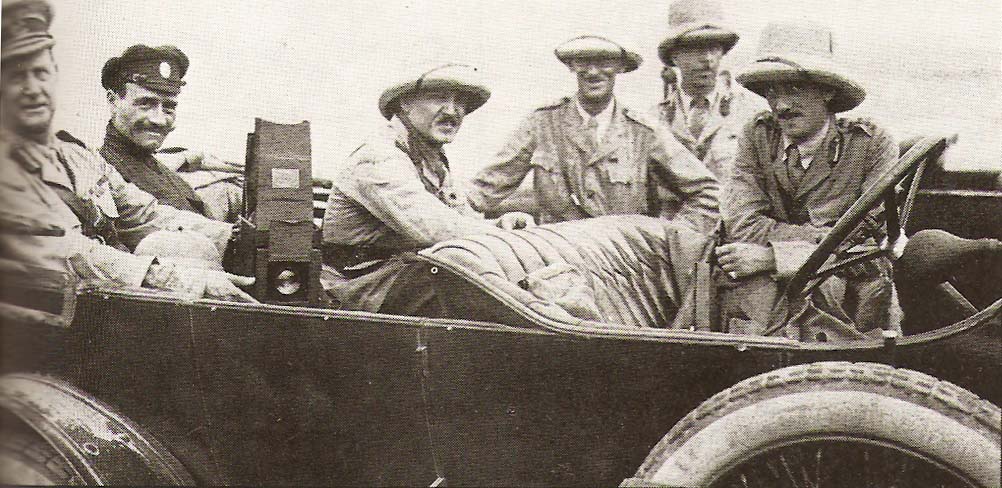
The Russian revolution of 1917 changed the war in Iran. The Russian army melted away and the Bolsheviks renounced the tsar’s claims. Britain filled the gap. In early 1918 a small force under General Lionel Dunsterville, known as Dunsterforce, moved from Baghdad across Kermanshah and Hamadan to the Caspian port of Anzali, fighting the Jangali forces of Gilan on the way (see the Jangali movement), and went on to defend Baku against the Ottomans in August and September 1918. Ottoman troops meanwhile reoccupied Tabriz in June 1918.
Dunsterville’s own memoir describes the hunger he saw in Hamadan and the roads of the west. Armies on all sides had taken grain, animals and labour from a country with poor harvests, and the result was catastrophe, described on the page on the Persian famine of 1917–1919.
- Jul 1914 Ahmad Shah crowned
- 1 Nov 1914 Iran declares neutrality
- Jan 1915 Ottoman troops take Tabriz
- Nov 1915 Mohajerat: deputies leave Tehran for Qom
- 1916 Provisional government at Kermanshah; South Persia Rifles formed
- Mar 1917 British take Baghdad; Ottomans withdraw from western Iran
- 1918 Dunsterforce crosses to the Caspian; Ottomans reoccupy Tabriz
- 1919 Iran’s delegation refused a seat at the Paris Peace Conference
After the armistice
When the war ended in November 1918, British forces were the only foreign army left in most of Iran. Iran sent a delegation to the Paris Peace Conference with claims for compensation and for territory, but the delegation was not admitted, largely because Britain opposed it. Instead the British foreign secretary Lord Curzon pressed for a treaty that would put Iran’s army and finances under British advisers (see the Anglo-Persian Agreement of 1919).
Historians of the period, notably the contributors to Touraj Atabaki’s collection Iran and the First World War, stress how deeply the war shaped what followed: the loss of faith in parliamentary politics, the demand for a strong central army and the regional revolts in Gilan, Azerbaijan and Khorasan that the coup of 1921 set out to end.
Persian words from this page
| جنگ جهانی اول | jang-e jahâni-ye avval | the First World War |
| بیطرفی | bi-tarafi | neutrality |
| مهاجرت | mohâjerat | emigration |
| عثمانی | Osmâni | Ottoman |
| کرمانشاه | Kermânshâh | Kermanshah |
| رئیسعلی دلواری | Ra’is-Ali Delvâri | Rais Ali Delvari |
Sources and further reading
- Touraj Atabaki (ed.), Iran and the First World War: Battleground of the Great Powers (I.B. Tauris, 2006).
- L. C. Dunsterville, The Adventures of Dunsterforce (London, 1920).
- Encyclopaedia Iranica, “Germany i. German-Persian diplomatic relations”.
- Percy Sykes, A History of Persia, 3rd ed. (Macmillan, 1930), vol. 2.
- Abbas Amanat, Iran: A Modern History (Yale University Press, 2017).
Want to learn Persian? Get the free Starter Pack
Get the 14-page printable Starter Pack (all 32 letters, a 7-day reading plan, 100 core words and 20 survival phrases) and a short 5-email course. Free.
More in The Qajar Dynasty (1789–1925)
- Agha Mohammad Khan Qajar
- The Battle of Krtsanisi and Sack of Tiflis (1795)
- Fath-Ali Shah Qajar
- The Qajar Court and Harem
- The Russo-Persian War of 1804–1813
- The Battle of Aslanduz (1812)
- The Treaty of Golestan (1813)
- Abbas Mirza and the First Reforms
- The Russo-Persian War of 1826–1828
- The Treaty of Turkmenchay (1828)
- The Death of Griboyedov (1829)
- Mohammad Shah and the Siege of Herat
- The Bab and the Babi Movement
- Tahirih (Qurrat al-Ayn)
- Naser al-Din Shah Qajar
- Amir Kabir
- Dar al-Funun: Iran’s First Modern School
- The Anglo-Persian War (1856–1857)
- How Iran Lost Herat
- The Great Persian Famine of 1870–1872
- The Reuter Concession (1872)
- Naser al-Din Shah’s Journeys to Europe
- The Tobacco Protest (1891–1892)
- Mirza Malkam Khan and Early Reformers
- The Assassination of Naser al-Din Shah (1896)
- Photography in Qajar Iran
- Mozaffar ad-Din Shah
- Taj al-Saltaneh
- The D’Arcy Concession and the Discovery of Oil (1908)
- The Persian Constitutional Revolution (1905–1911)
- The First Majlis and the Constitution of 1906
- The Anglo-Russian Convention of 1907
- Mohammad Ali Shah and the Bombardment of the Majlis
- The Siege of Tabriz and Sattar Khan
- The Constitutionalists Take Tehran (1909)
- The Bakhtiari and the Revolution
- Morgan Shuster and the Russian Ultimatum (1911)
- Women in the Constitutional Revolution
- Iran in the First World War
- The Persian Famine of 1917–1919
- Mirza Kuchik Khan and the Jangali Movement
- The Anglo-Persian Agreement of 1919
- The 1921 Coup: Reza Khan and Seyyed Zia
- The End of the Qajar Dynasty (1925)
- Qajar Art, Photography and Society