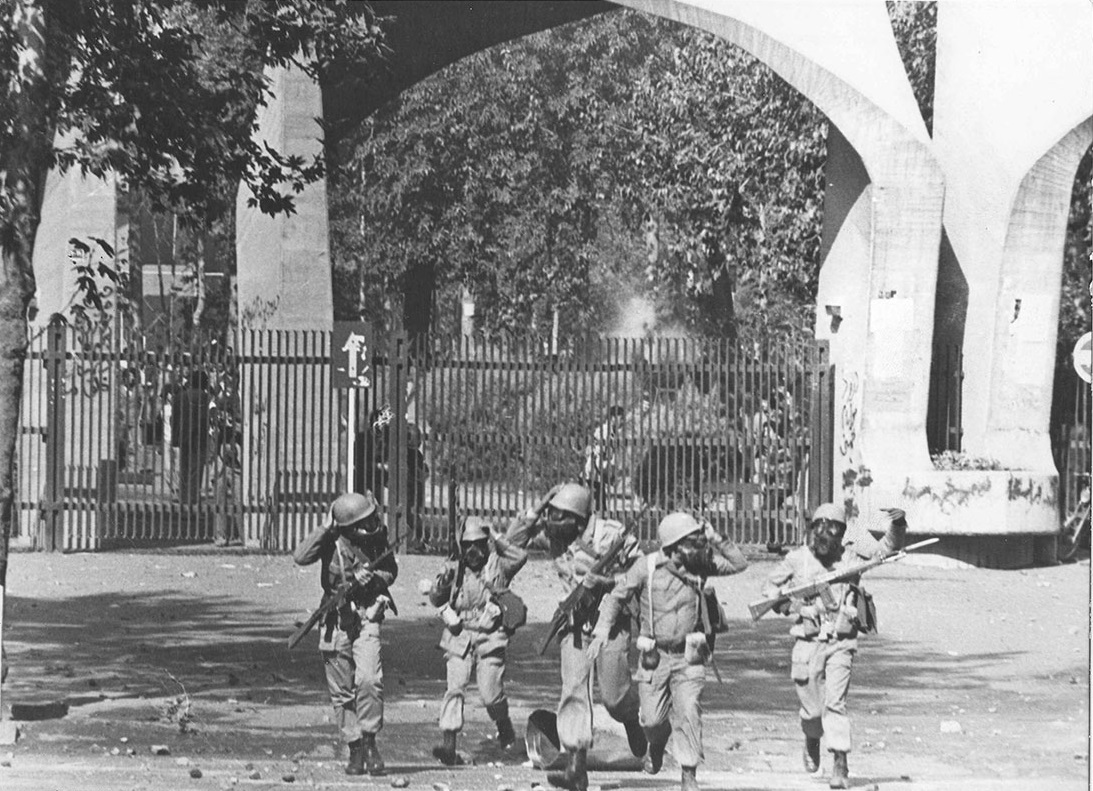
The Iranian Revolution of 1978–79 overthrew Mohammad Reza Shah Pahlavi and ended some 2,500 years of monarchy in Iran. It grew out of a mix of causes: an authoritarian state with no room for opposition, an oil boom that brought inflation and inequality, the alienation of the clergy and the bazaar, and a revolutionary reading of Shi’a Islam that gave millions of people a shared language of protest. Historians still argue about which of these mattered most.
| Period | January 1978 to February 1979 |
|---|---|
| Main actors | Clergy led by Ayatollah Ruhollah Khomeini, bazaar merchants, students, liberal nationalists (National Front, Freedom Movement), left-wing groups, industrial and oil workers |
| Result | Shah leaves Iran (16 January 1979); monarchy falls (11 February 1979); Islamic Republic declared (1 April 1979) |
| Deaths | Disputed: about 2,800 according to Emadeddin Baghi’s study of Martyrs Foundation records; revolutionary leaders claimed 60,000 |

A state that modernised the economy but not politics
After the 1953 coup restored his power, Mohammad Reza Shah ruled with growing personal authority. Parliament was managed, the press censored and the secret police, SAVAK, watched students, writers and clerics. In March 1975 he abolished the two tolerated parties and created a single party, Rastakhiz (Resurgence), telling Iranians who did not wish to join that they could leave the country.
At the same time the state pushed rapid change from above. The White Revolution of 1963 brought land reform, votes for women and literacy campaigns. Cities, universities and a modern middle class grew fast. Ervand Abrahamian, in Iran Between Two Revolutions (1982), argues that this was the central contradiction: the shah developed Iran socially and economically but refused to let the new classes he had created take part in politics, so their discontent had nowhere to go except the street.
Oil money, inflation and the 1977 slowdown
When world oil prices quadrupled in 1973–74, Iran’s oil income rose several times over and the shah announced plans to make Iran one of the world’s leading economies. The oil boom overheated the economy. Ports jammed, rents in Tehran soared, and inflation ate into wages. Villagers poured into shanty towns on the southern edge of the capital, where they lived near the new wealth without sharing it.
In 1975 the government blamed merchants for rising prices and launched an “anti-profiteering” campaign in which students and party inspectors fined, arrested or exiled thousands of shopkeepers. This hit the bazaar, the traditional commercial heart of Iranian cities, which had long-standing ties to the clergy through religious taxes, mosques and family links. When the boom ended and Prime Minister Jamshid Amouzegar cut spending in 1977, unemployment rose among the very migrants and young graduates the boom had drawn in. Political scientists often describe this pattern, a sharp rise in expectations followed by a sudden downturn, as a classic setting for revolt.
The clergy, the bazaar and a new religious politics
Many senior clerics had opposed land reform and votes for women in the early 1960s, and the uprising of June 1963 sent Ayatollah Ruhollah Khomeini into exile. From Najaf in Iraq he lectured on Islamic government and sent recorded sermons into Iran on cassette tapes, which were copied and passed through mosques and bazaars beyond the reach of censorship.
Meanwhile lay intellectuals reshaped religion as a language of protest. Jalal Al-e Ahmad’s essay Gharbzadegi (“Westoxication”, 1962) attacked blind imitation of the West. Ali Shariati, who died in England in June 1977, lectured to packed halls at the Hosseiniyeh Ershad in Tehran on Shi’ism as a faith of martyrdom and resistance rather than quiet piety. His ideas drew in young people who might otherwise have joined secular left-wing groups. The page on intellectuals and opposition in the 1960s and 70s traces these currents in detail.
Said Amir Arjomand, in The Turban for the Crown (1988), stresses this religious side: the Shi’a clergy had an independent organisation, income and network of mosques that no secular opposition could match, and Khomeini turned it into a revolutionary movement. Nikki Keddie, in Roots of Revolution (1981), places the alliance of clergy and bazaar in a longer story that runs back to the Tobacco Protest of 1891 and the Constitutional Revolution of 1905–11.
The international setting
Many Iranians saw the shah as dependent on the United States, which had backed the 1953 coup and supplied his army. A 1964 law granting legal immunity to American military personnel had been the target of Khomeini’s sharpest speech before his exile. When President Jimmy Carter spoke about human rights in 1977, the shah eased some controls: political prisoners were released, and writers and lawyers began to publish open letters. Supporters of the monarchy, and the shah himself in his memoir Answer to History (1980), later argued that American pressure and foreign plotting undermined him. Most historians see outside pressure as a minor factor that opened a door rather than a cause in itself.
A further factor was hidden at the time: the shah had been diagnosed with cancer in the mid-1970s and kept it secret. Several historians, including Abbas Milani in his biography of the shah, suggest that illness contributed to his hesitation in 1978.
From grievances to revolution: the events of 1978
The spark came on 7 January 1978, when the newspaper Ettela’at published an article, written under a pseudonym and placed by the government, that insulted Khomeini. Seminary students in Qom protested on 9 January and police fired on them. Shi’a custom holds memorial gatherings forty days after a death, and these became a cycle of protest: mourning for the Qom dead led to riots in Tabriz in February, which led to further memorials and further deaths in other cities.
- 9 January 1978 Seminary students killed in Qom; the number is disputed
- 18 February 1978 Fortieth-day protests turn into riots in Tabriz
- 19 August 1978 Hundreds die in the Cinema Rex fire in Abadan; most Iranians blamed SAVAK
- 8 September 1978 Troops fire on crowds in Jaleh Square on Black Friday, the day martial law was declared
- October–November 1978 Strikes by oil workers, civil servants and bazaar merchants paralyse the economy
- 10–11 December 1978 Huge marches in Tehran on Tasua and Ashura
- 16 January 1979 The shah leaves Iran
The strikes were decisive. When oil workers stopped production in the autumn of 1978, the state lost its main source of income and its ability to buy off discontent. The movement brought together people with very different aims: clerics who wanted an Islamic state, liberals who wanted the 1906 constitution respected, Marxists who wanted a socialist republic. Khomeini’s refusal to compromise, and his vague promises of freedom and justice, held this coalition together until the monarchy fell.
How many people died
Figures for the revolution’s dead vary widely. Khomeini and the new government spoke of 60,000 “martyrs”. Emadeddin Baghi, a researcher who studied the records of the Martyrs Foundation in the 1990s, counted about 2,781 people killed in 1978–79. Charles Kurzman, who cites Baghi’s work in The Unthinkable Revolution in Iran (2004), notes that the lower figures are far better documented. Compared with many revolutions, the death toll was modest for an uprising of this scale, a point several historians use to argue that the army was never fully turned against the population.
Where historians disagree
Explanations fall into broad schools. Structural accounts, such as Abrahamian’s, stress the gap between economic change and political repression. Theda Skocpol, writing in 1982, pointed to the “rentier” character of a state that lived on oil income rather than taxes and so had few ties to society. Religious and cultural accounts, such as Arjomand’s, put the clergy and Shi’a symbolism at the centre. The official view of the Islamic Republic presents the revolution as a religious uprising of the whole nation under Khomeini’s leadership against a tyrannical ruler serving foreign powers. Kurzman argues that none of these causes made revolution inevitable: Iranians joined in large numbers only once they came to believe that the movement could win.
The story continues with Khomeini’s return and the fall of the monarchy in February 1979, and the life of the man who led it, Ruhollah Khomeini.
Persian words from this page
| انقلاب | enqelâb | revolution |
| بازار | bâzâr | bazaar, market |
| اعتصاب | e’tesâb | strike |
| چهلم | chehelom | fortieth-day memorial |
| غربزدگی | gharbzadegi | “Westoxication” |
| رستاخیز | Rastâkhiz | Resurgence (the shah’s single party) |
Sources and further reading
- Ervand Abrahamian, Iran Between Two Revolutions (Princeton University Press, 1982)
- Nikki R. Keddie, Roots of Revolution: An Interpretive History of Modern Iran (Yale University Press, 1981)
- Said Amir Arjomand, The Turban for the Crown: The Islamic Revolution in Iran (Oxford University Press, 1988)
- Charles Kurzman, The Unthinkable Revolution in Iran (Harvard University Press, 2004)
- Theda Skocpol, “Rentier State and Shi’a Islam in the Iranian Revolution”, Theory and Society 11 (1982)
- Michael Axworthy, Revolutionary Iran: A History of the Islamic Republic (Allen Lane, 2013)
Want to learn Persian? Get the free Starter Pack
Get the 14-page printable Starter Pack (all 32 letters, a 7-day reading plan, 100 core words and 20 survival phrases) and a short 5-email course. Free.
More in The Islamic Revolution and the Islamic Republic (1979–present)
- Causes of the 1979 Revolution
- Khomeini’s Return and the Fall of the Monarchy
- Ruhollah Khomeini
- The 1979 Referendum and the New Constitution
- The Iran Hostage Crisis (1979–1981)
- Power Struggles after the Revolution
- The Cultural Revolution and University Closures
- The Iran–Iraq War: Causes and Iraqi Invasion
- Khorramshahr: Fall and Liberation
- The Iran–Iraq War, 1982–1986
- The Basij and Child Soldiers in the Iran–Iraq War
- Chemical Weapons in the Iran–Iraq War
- The Tanker War and Iran Air Flight 655
- The Iran–Contra Affair
- The End of the Iran–Iraq War (1988)
- The 1988 Executions of Political Prisoners
- The Death of Khomeini and the Succession of Khamenei (1989)
- Ali Khamenei
- Rafsanjani and Post-War Reconstruction (1989–1997)
- Khatami and the Reform Era (1997–2005)
- The 1999 Student Protests (18 Tir)
- The Ahmadinejad Presidency (2005–2013)
- The 2009 Election and the Green Movement
- Iran’s Nuclear Program
- Sanctions on Iran
- Rouhani and the Nuclear Deal (JCPOA)
- The Protests of 2017–2018 and November 2019
- The Killing of Soleimani and Flight 752 (January 2020)
- Iran and the COVID-19 Pandemic
- The Raisi Presidency and His Death (2021–2024)
- The 2022 Mahsa Amini Protests: “Woman, Life, Freedom”
- Iran and Israel: From Allies to Open Conflict
- The Pezeshkian Presidency
- The Twelve-Day War of June 2025
- The Protests of Late 2025 and January 2026
- The 2026 War with the United States and Israel
- The Killing of Ali Khamenei (28 February 2026)
- Mojtaba Khamenei and the 2026 Succession
- The Iranian Diaspora
- Iran and Hezbollah
- Major Earthquakes in Modern Iran
- Iranian Cinema after 1979