The Kurds, an Iranian-speaking people of the Zagros mountains, have lived in what is now western Iran for as long as written records describe the region, and they make up an estimated tenth of Iran’s population today. Their history in Iran runs from medieval Kurdish dynasties and the semi-independent principality of Ardalan to twentieth-century revolts, the short-lived Republic of Mahabad in 1946, armed conflict after the 1979 revolution, and the protests of 2022 that began with the death of a young Kurdish woman.
| Main provinces | Kurdistan, Kermanshah, West Azerbaijan (south), Ilam; communities in North Khorasan |
|---|---|
| Languages | Kurdish (Sorani, Kurmanji, Southern Kurdish); Gorani/Hawrami |
| Religion | Mostly Sunni Muslim; Shi’a in Kermanshah and Ilam; Yarsan (Ahl-e Haqq) |
| Share of population | commonly estimated around 10%; Iran’s census does not record ethnicity |
| Persian name | کرد (kord), کردستان (Kordestân) |
Origins and the medieval Kurdish dynasties
Kurdish nationalists often claim the Medes as ancestors. Kurdish is indeed a north-western Iranian language like Median probably was, but there is no direct evidence linking the two, and most historians treat the Kurds’ origins as a mixing of many Zagros peoples over centuries (see the rise of the Medes). The name “Kurd” appears in Middle Persian texts and in early Arabic sources, where it often meant pastoral nomads of the western mountains in general.
In the tenth and eleventh centuries, during the age of Iranian dynasties between Arab and Turkic rule, Kurdish families such as the Hasanwayhids and Annazids ruled the region around Kermanshah and Dinavar. Further west, the Kurdish Ayyubid dynasty of Saladin rose in Egypt and Syria. Most Kurdish lands, though, were governed by tribal chiefs and local emirs under whichever empire was strongest.

Between Safavids and Ottomans
The Kurdish homeland became the frontier between the Shi’a Safavids and the Sunni Ottomans. After the Battle of Chaldiran in 1514, many Kurdish emirs went over to the Ottomans, and the border fixed by the Treaty of Zuhab in 1639 left most Kurds on the Ottoman side, a division that roughly survives in today’s Iran–Turkey and Iran–Iraq borders. Shah Abbas I besieged the Kurdish fortress of Dimdim near Urmia in 1609–1610, an episode remembered in Kurdish epic song, and moved Kurdish tribes to Khorasan to guard the north-eastern frontier against Uzbeks and Turkmens; their descendants still live around Quchan and Bojnurd.
The most important Kurdish principality on the Iranian side was Ardalan, whose rulers, the Vali of Ardalan, governed from Sanandaj as hereditary vassals of the shahs. Their court supported Kurdish and Persian literature; Mastoureh Ardalan (1805–1848) wrote poetry and a history of the dynasty, rare work by a woman of her time. The Qajars ended Ardalan autonomy in the 1860s and appointed governors from Tehran.
Revolts and the Republic of Mahabad
Modern Kurdish nationalism took shape from the late nineteenth century, often across borders. In 1880 the Ottoman Kurdish leader Sheikh Ubeydullah invaded north-western Iran. During and after the First World War the chief Ismail Agha Simko built a power base around Lake Urmia, involved in the killings of Assyrians in 1918, and resisted the central government until his defeat in 1922; he was killed in 1930. Reza Shah disarmed and settled tribes by force and promoted Persian as the single national language.
When Soviet and British troops occupied Iran in 1941, central control in the north-west collapsed. With Soviet backing, the Kurdish Democratic Party of Iran, founded in 1945, proclaimed the Republic of Mahabad in January 1946 under Qazi Muhammad. It opened Kurdish schools and printed Kurdish newspapers, but fell in December 1946 after the Soviets withdrew, and Qazi Muhammad was hanged in March 1947. The episode is told with the parallel Azerbaijan crisis on the Iran crisis of 1946.
After the 1979 revolution
Kurdish parties supported the revolution but demanded autonomy, which the new government refused. Fighting broke out in 1979, and in August Khomeini called on the armed forces to suppress the uprising. The KDPI and the leftist Komala held parts of Kurdistan for several years, and fighting continued during the Iran–Iraq war, when the town of Sardasht was struck with Iraqi chemical weapons in 1987 (see chemical weapons in the Iran–Iraq War). KDPI leader Abdul Rahman Ghassemlou was shot dead in Vienna in 1989 while meeting Iranian envoys, and his successor Sadegh Sharafkandi was killed at the Mykonos restaurant in Berlin in 1992; a German court ruled in 1997 that Iran’s leadership had ordered the Berlin killings, which Iran denied.
In later decades Kurdish regions saw high unemployment, a cross-border porter trade by the kolbar, and frequent arrests of activists. Human rights groups have reported that Kurds make up a disproportionate share of political prisoners and of those executed on security charges; the government says it is fighting armed separatist groups based in Iraq. In September 2022 the death in police custody of Mahsa (Jina) Amini, a young Kurdish woman from Saqqez, set off nationwide protests that began in Kurdish towns (see the “Woman, Life, Freedom” protests).
Culture and place
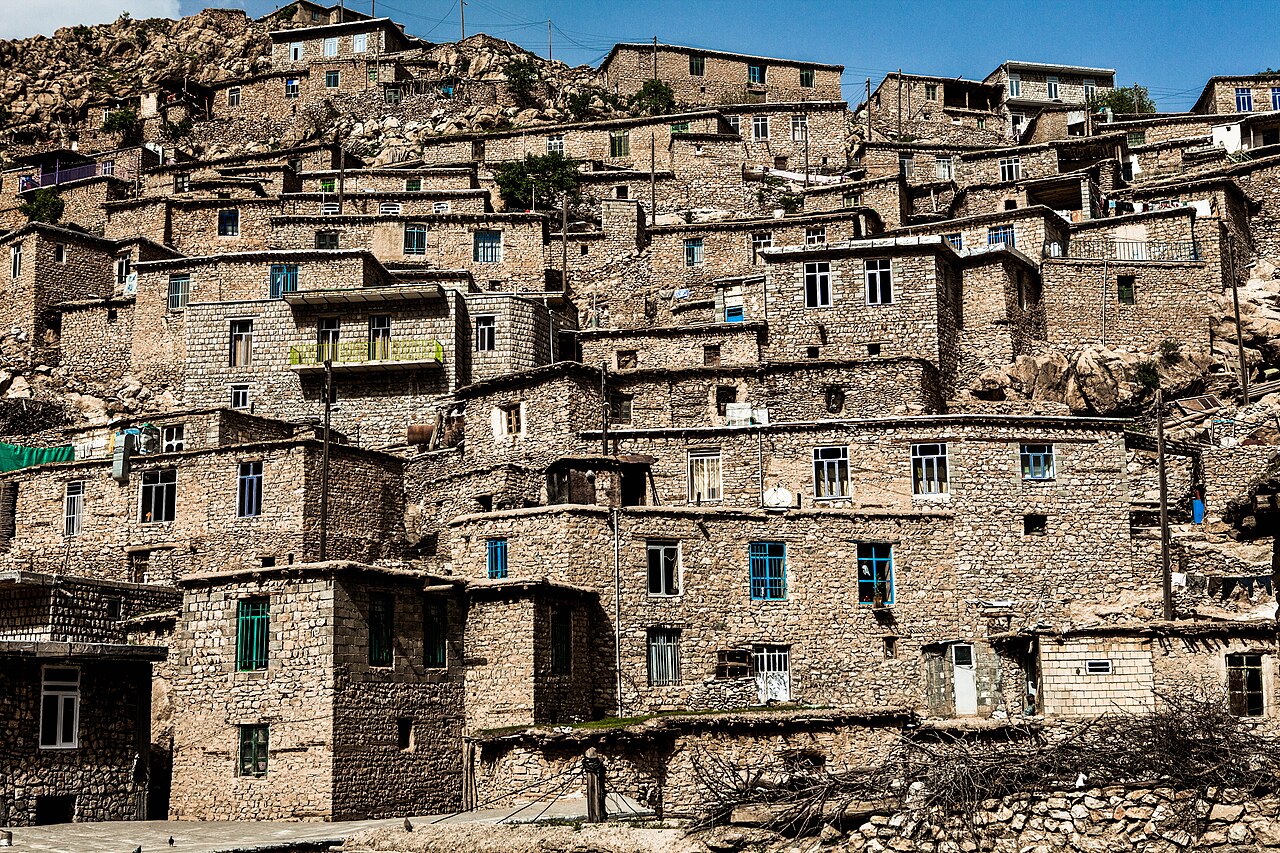
Kurdish culture in Iran is as varied as the terrain. Kermanshah is mostly Shi’a and speaks Southern Kurdish; Sanandaj and Mahabad speak Sorani; the terraced villages of Hawraman, listed by UNESCO in 2021, keep the Hawrami language and the music of the daf frame drum. Read more on the cities of Sanandaj and Kermanshah, and on Iran’s peoples and languages on the people of Iran and languages spoken in Iran.
Persian words from this page
| کرد | kord | Kurd |
| کردی | kordi | Kurdish (language) |
| سنندج | Sanandaj | Sanandaj |
| مهاباد | Mahâbâd | Mahabad |
| اورامان | Owrâmân | Hawraman |
| کولبر | kolbar | cross-border porter |
| دف | daf | frame drum |
Sources and further reading
- David McDowall, A Modern History of the Kurds (3rd ed., 2004).
- Abbas Vali, Kurds and the State in Iran: The Making of Kurdish Identity (2011).
- William Eagleton Jr., The Kurdish Republic of 1946 (1963).
- Martin van Bruinessen, Agha, Shaikh and State: The Social and Political Structures of Kurdistan (1992).
- Encyclopaedia Iranica, “Kurds” and “Ardalan”.
- UNESCO World Heritage Centre, Cultural Landscape of Hawraman/Uramanat (2021).
Want to learn Persian? Get the free Starter Pack
Get the 14-page printable Starter Pack (all 32 letters, a 7-day reading plan, 100 core words and 20 survival phrases) and a short 5-email course. Free.
More in Themes Across Iranian History (3000 BCE–today)
- A History of the Persian Language
- Zoroastrianism through the Ages
- Shi’a Islam in Iranian History
- The Jews of Iran
- The Armenians of Iran
- Christians of Iran
- The Baha’i Faith in Iran
- The Kurds in Iranian History
- Azerbaijanis in Iranian History
- The History of the Iranian Calendar
- Nowruz through History
- The Persian Garden (Pardis) through History
- Qanats: Iran’s Ancient Water Tunnels
- A History of Persian Carpets
- A History of Persian Architecture
- A History of Persian Painting
- A History of Persian Music
- Science in Iranian History
- Women in Iranian History
- Iran and the Silk Road
- Iran and China through History
- Iran and India through History
- Iran and Greece: Perceptions and Exchanges
- Persia and Rome: Seven Centuries of Rivalry
- Iran and the Ottoman Empire
- Iran and Russia through History
- Iran and Britain through History
- Iran and the United States
- How Iran’s Borders Changed
- The Capitals of Iran through History
- Coins of Iran through History: From the Daric to the Rial
- Flags and Symbols of Iran through History
- Myth and History in the Shahnameh: The Epic’s Kings and the Real Past
- Timeline of Iranian History: Key Dates from Elam to Today
- A History of Persian Cuisine: From Royal Banquets to Chelow Kabab
- A History of Persian Poetry: From Rudaki to Forough
- Wine in Iranian History: From Hajji Firuz to Hafez and Prohibition
- Sports in Iranian History: Polo, the Zurkhaneh and Wrestling
- List of Iranian Dynasties and Rulers