Azerbaijanis are Iran’s largest ethnic minority and its largest Turkic-speaking group, usually estimated at between a sixth and a quarter of the population. Living mainly in the north-west around Tabriz, Ardabil, Zanjan and Urmia, and in large numbers in Tehran, they have been at the centre of Iranian history rather than at its edge: the Safavid dynasty rose among them, Tabriz was the seat of Qajar crown princes, and the city led the Constitutional Revolution.
| Region | East and West Azerbaijan, Ardabil, Zanjan; large communities in Tehran, Qazvin, Hamadan |
|---|---|
| Language | Azerbaijani Turkish (Oghuz Turkic), written in Perso-Arabic script in Iran |
| Religion | Overwhelmingly Twelver Shi’a |
| Share of population | commonly estimated at 16–24%; Iran’s census does not record ethnicity |
| Persian names | آذربایجان (Âzarbâyjân), ترکی آذربایجانی (Torki-ye Âzarbâyjâni) |
A land with an ancient Iranian name
The name Azerbaijan goes back to Atropates, a Persian general who held the region after Alexander’s conquest; Greek writers called it Atropatene, and in Middle Persian it was Adurbadagan. Long before that, the area around Lake Urmia was home to the Mannaeans and bordered the kingdom of Urartu (see the Mannaeans and Urartu). Under the Sasanians the province held one of the three great fire temples of Iran, Adur Gushnasp, at what is now Takht-e Soleyman. In the ninth century the mountains of Azerbaijan were the base of Babak Khorramdin’s revolt against the Abbasids.
At that time the people of the region spoke an Iranian language, which medieval writers called Azari. The historian Ahmad Kasravi argued in 1925 that this “old Azari” was the ancestor of the Iranian dialects still spoken in a few villages, and the term is still used in that sense by linguists.

The Turkic transformation
Turkic speech came with the Oghuz Turkmen tribes who followed the Seljuks into Iran in the eleventh century. Azerbaijan’s pastures attracted nomads, and under the Mongols, when Tabriz was the Ilkhanid capital, and the Turkmen dynasties of the Qara Qoyunlu and Aq Qoyunlu, the region became mostly Turkic-speaking. The change was gradual, a language shift rather than the replacement of a population, and by the sixteenth century Turkish was the everyday language of most of the province. Persian remained the language of writing and government, as it was across the region.
Safavids and Qajars
The Safavid dynasty grew from a Sufi order at Ardabil, and its Turkmen followers, the Qizilbash, carried Shah Ismail I to power in Tabriz in 1501. Ismail wrote poetry in Turkish under the pen name Khata’i, and Turkish was spoken at the Safavid court alongside Persian. Tabriz, close to the Ottoman frontier, was the first Safavid capital until Ottoman attacks after Chaldiran pushed the capital to Qazvin.
The Qajars were also a Turkic tribe, and under them Tabriz became the residence of the crown prince and the gateway to Russia and Europe. Crown prince Abbas Mirza launched Iran’s first military and educational reforms from Tabriz. The wars with Russia ended with the Treaty of Turkmenchay in 1828, which fixed the border on the Aras river. The Turkic-speaking lands north of the river became part of the Russian empire and, in 1918 and again in 1991, gave their name to the Republic of Azerbaijan; those south of it remained Iranian.
Tabriz and the Constitutional Revolution
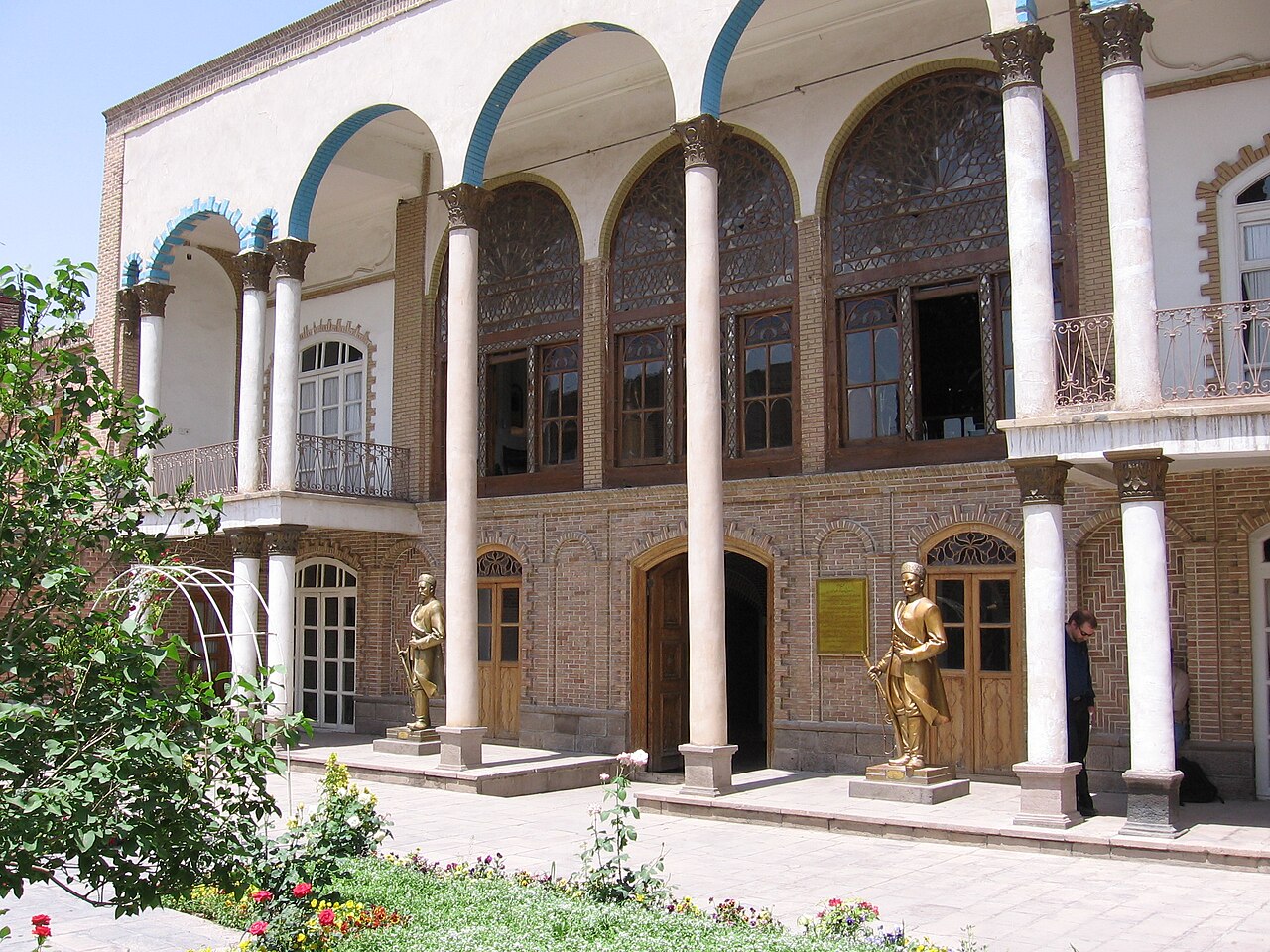
Through its trade with the Caucasus and Istanbul, Tabriz received newspapers, ideas and political networks early, and it became the most radical centre of the Constitutional Revolution. When Mohammad Ali Shah shut down the Majlis in 1908, Tabriz resisted a months-long siege under the popular commanders Sattar Khan and Baqer Khan, a story told on the siege of Tabriz. Azerbaijanis are remembered as defenders of Iranian constitutional government, not as separatists, and Sattar Khan was hailed as Sardâr-e Melli, “national commander”. In 1920 Sheikh Mohammad Khiabani led a short-lived reformist movement in Tabriz, which was crushed by the central government.
Language, the state and the 1946 crisis
From the 1920s the Pahlavi state promoted Persian as the single national language, and Azerbaijani was kept out of schools and official life. During the Soviet occupation of the north after 1941, the Azerbaijan Democratic Party of Ja’far Pishevari set up an autonomous Azerbaijan People’s Government in late 1945, with Azerbaijani as its official language. It collapsed in December 1946 after Soviet troops withdrew, and Iranian forces retook Tabriz; see the Iran crisis of 1946. Views of the episode still divide: some see it as a Soviet puppet, others as an expression of genuine local grievances.
Azerbaijani literature continued regardless. The poet Mohammad-Hossein Shahriar (1906–1988), who wrote mostly in Persian, also wrote Heydar Babaya Salam (“Greetings to Heydar Baba”), the most loved poem in Iranian Azerbaijani Turkish.
Since 1979
Azerbaijanis are deeply integrated in Iranian life: they are prominent in the bazaar, the clergy, the army and politics, and Supreme Leader Ali Khamenei’s paternal family came from Khameneh near Tabriz. Article 15 of the 1979 constitution permits regional languages in the press and in teaching their literature alongside Persian, and activists have pressed for fuller education in Azerbaijani. Issues such as the shrinking of Lake Urmia and the fortunes of the Tabriz football club Tractor have become focal points of regional identity. Explore the cities of Tabriz, Ardabil and Zanjan, and see the people of Iran for today’s ethnic map.
Persian words from this page
| آذربایجان | Âzarbâyjân | Azerbaijan |
| آذری | âzari | Azari, Azerbaijani |
| ترکی | torki | Turkish (language) |
| تبریز | Tabriz | Tabriz |
| سردار ملی | Sardâr-e Melli | national commander |
| ارس | Aras | the Aras river |
| مشروطه | mashrute | constitutional (government) |
Sources and further reading
- Brenda Shaffer, Borders and Brethren: Iran and the Challenge of Azerbaijani Identity (2002).
- Touraj Atabaki, Azerbaijan: Ethnicity and the Struggle for Power in Iran (2000).
- Ervand Abrahamian, Iran Between Two Revolutions (1982).
- Encyclopaedia Iranica, “Azerbaijan” (multi-part article, including “Azeri Turkish” and “The Iranian language of Azerbaijan”).
- Ahmad Kasravi, Âzari yâ zabân-e bâstân-e Âzarbâyjân (1925).
Want to learn Persian? Get the free Starter Pack
Get the 14-page printable Starter Pack (all 32 letters, a 7-day reading plan, 100 core words and 20 survival phrases) and a short 5-email course. Free.
More in Themes Across Iranian History (3000 BCE–today)
- A History of the Persian Language
- Zoroastrianism through the Ages
- Shi’a Islam in Iranian History
- The Jews of Iran
- The Armenians of Iran
- Christians of Iran
- The Baha’i Faith in Iran
- The Kurds in Iranian History
- Azerbaijanis in Iranian History
- The History of the Iranian Calendar
- Nowruz through History
- The Persian Garden (Pardis) through History
- Qanats: Iran’s Ancient Water Tunnels
- A History of Persian Carpets
- A History of Persian Architecture
- A History of Persian Painting
- A History of Persian Music
- Science in Iranian History
- Women in Iranian History
- Iran and the Silk Road
- Iran and China through History
- Iran and India through History
- Iran and Greece: Perceptions and Exchanges
- Persia and Rome: Seven Centuries of Rivalry
- Iran and the Ottoman Empire
- Iran and Russia through History
- Iran and Britain through History
- Iran and the United States
- How Iran’s Borders Changed
- The Capitals of Iran through History
- Coins of Iran through History: From the Daric to the Rial
- Flags and Symbols of Iran through History
- Myth and History in the Shahnameh: The Epic’s Kings and the Real Past
- Timeline of Iranian History: Key Dates from Elam to Today
- A History of Persian Cuisine: From Royal Banquets to Chelow Kabab
- A History of Persian Poetry: From Rudaki to Forough
- Wine in Iranian History: From Hajji Firuz to Hafez and Prohibition
- Sports in Iranian History: Polo, the Zurkhaneh and Wrestling
- List of Iranian Dynasties and Rulers