Ayatollah Ruhollah Khomeini flew back to Tehran from exile in France on 1 February 1979, two weeks after the shah had left the country. Ten days later, on 11 February, the army’s high command declared itself neutral, the last royal government collapsed and the Pahlavi monarchy came to an end. Iran still marks this period as the “Ten Days of Dawn”, and 11 February (22 Bahman) is a national holiday.
| Khomeini lands | 1 February 1979 (12 Bahman 1357), Mehrabad Airport, Tehran |
|---|---|
| Rival prime ministers | Shapour Bakhtiar (appointed by the shah) and Mehdi Bazargan (named by Khomeini on 5 February) |
| Decisive fighting | 9–11 February, beginning at the Doshan Tappeh air base |
| End of the monarchy | 11 February 1979 (22 Bahman), army declares neutrality |
A country with two governments in waiting
When the shah left Iran on 16 January 1979, he handed power to Shapour Bakhtiar, a veteran of Mosaddegh’s National Front who had broken with his colleagues to accept the post. Bakhtiar freed political prisoners, lifted press censorship and announced that SAVAK would be dissolved. He hoped to keep the constitution of 1906 alive, with the monarchy in the background. But to most of the movement he was the shah’s man, and his own party expelled him.
Khomeini had spent the previous four months at Neauphle-le-Château outside Paris, where he gave hundreds of interviews to the world’s press. From France he declared Bakhtiar’s government illegal. For a few days in late January Bakhtiar closed the airports to keep him out, but the protests that followed made the ban impossible to hold.
The flight from Paris
Khomeini travelled on a chartered Air France Boeing 747, with aides, supporters and about a hundred journalists on board. Some feared the plane might be shot down. When a reporter asked him during the flight what he felt about returning after nearly fifteen years in exile, his reply, translated by his aide Sadegh Ghotbzadeh, was hichi, “nothing”. Supporters read the answer as the detachment of a man of God; critics saw in it indifference to the homeland. It has been quoted ever since.
The aircraft landed at Mehrabad Airport on the morning of 1 February. Crowds lined the route into the city in numbers that contemporary reports put in the millions, though no reliable count exists. Khomeini went first to the Behesht-e Zahra cemetery in south Tehran, where many of those killed in the previous year’s protests were buried. There he denounced Bakhtiar’s government and the parliament as illegitimate and announced that he would appoint a government of his own.

Dual power: Bakhtiar against Bazargan
On 5 February Khomeini named Mehdi Bazargan, a devout engineer who led the Freedom Movement of Iran, as prime minister of a provisional government. Iran now had two prime ministers. Bakhtiar refused to resign and said he would not allow an “Islamic republic” to be imposed. Khomeini, for his part, described obedience to Bazargan as a religious duty.
Everything depended on the armed forces. The army was large and well equipped, but its conscripts came from the same families who filled the streets, and desertions had been rising for months. A senior American officer, General Robert Huyser, had been sent to Tehran in January to keep the military united behind Bakhtiar. On 8 February a group of air force technicians, the homafaran, appeared in uniform before Khomeini to salute him. A photograph of the scene in the newspapers showed the military divided.
The fighting of 9–11 February
- 1 February Khomeini lands in Tehran and speaks at Behesht-e Zahra
- 5 February Mehdi Bazargan named head of a provisional government
- 8 February Air force technicians publicly salute Khomeini
- 9 February Fighting breaks out at Doshan Tappeh air base between technicians and units of the Imperial Guard
- 10 February Armouries are seized; guerrilla groups join the fighting; Khomeini tells people to ignore the curfew
- 11 February The Supreme Military Council declares neutrality; Bakhtiar goes into hiding
On the night of 9 February men of the Imperial Guard attacked the technicians at Doshan Tappeh air base in eastern Tehran. Residents and armed members of left-wing and Islamist guerrilla groups, the Fadaiyan-e Khalq and the Mojahedin-e Khalq, came to their aid. Over the next day police stations and barracks fell one after another, and rifles from captured armouries were handed out in the streets. The military government ordered a curfew from the afternoon of 10 February, and Khomeini told his followers to disregard it.
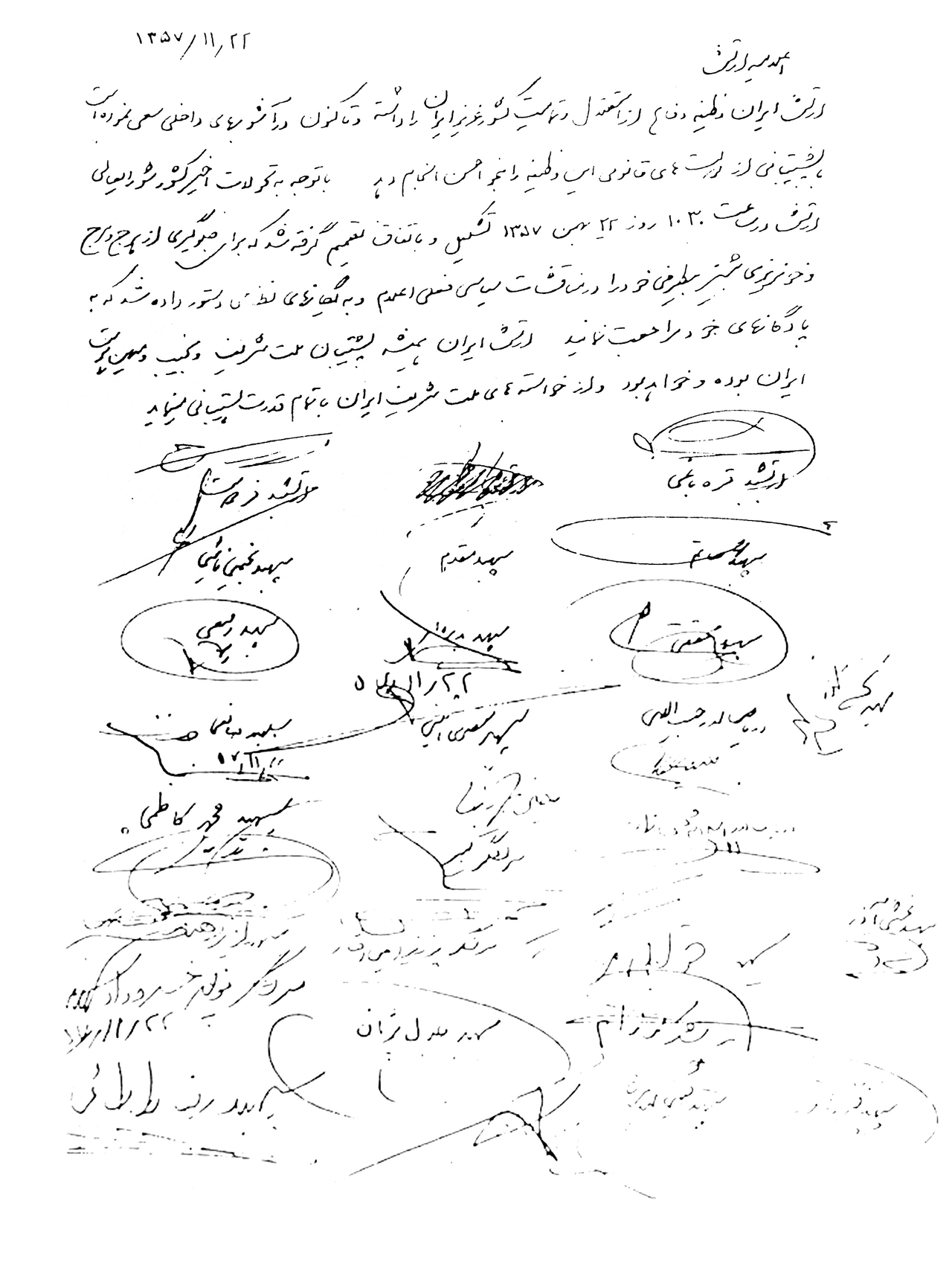
On the morning of 11 February the army’s senior commanders met under the chief of staff, General Abbas Gharabaghi. They issued a statement that the armed forces would remain neutral in the political dispute and withdrew troops to their barracks. In practice it meant the end of the monarchy. Bakhtiar fled the prime minister’s office and later escaped to France, where he was assassinated in 1991. That evening state radio broadcast the words “This is the voice of the revolution”. Gharabaghi always maintained that the declaration was meant to avoid civil war; monarchists accused him of betrayal.
The first days of the new order
Revolutionary committees (komiteh) sprang up across the cities, often based in mosques, and took over policing. Khomeini’s headquarters at the Refah and Alavi schools in Tehran became the real centre of power. Hasty revolutionary courts tried senior officers of the old regime, and on the night of 15 February four generals, including the former SAVAK chief Nematollah Nassiri, were executed on the roof of the Refah school. Hundreds more executions followed in the months ahead, among them that of the long-serving prime minister Amir-Abbas Hoveyda in April 1979.
The coalition that had toppled the shah began to divide almost at once. Liberals in Bazargan’s cabinet wanted orderly government and courts, while the committees and courts answered to clerics close to Khomeini. Bazargan later complained that he had been given a knife without a blade. That struggle, and the vote that founded the new state, are covered in the 1979 referendum and the new constitution and power struggles after the revolution.
How the days are remembered
The Islamic Republic celebrates the period from 12 to 22 Bahman each year as Daheh-ye Fajr, the Ten Days of Dawn, with ceremonies that begin at the hour Khomeini’s plane landed and a mass rally on 22 Bahman in Tehran’s Azadi Square. In the official account the revolution was the victory of a united Muslim nation under its leader. Historians such as Shaul Bakhash and Michael Axworthy stress how uncertain the outcome looked until the last day, and how much depended on the army’s decision not to fight. Supporters of the old regime, and many secular Iranians in exile, remember the same days as the beginning of a dictatorship of a different kind. For the background, see the causes of the 1979 revolution and the life of Ruhollah Khomeini.
Persian words from this page
| دهه فجر | daheh-ye fajr | Ten Days of Dawn |
| بهشت زهرا | Behesht-e Zahrâ | Tehran’s main cemetery |
| همافر | homâfar | air force technician |
| کمیته | komiteh | revolutionary committee |
| بیطرفی | bitarafi | neutrality |
| هیچی | hichi | nothing |
Sources and further reading
- Shaul Bakhash, The Reign of the Ayatollahs: Iran and the Islamic Revolution (Basic Books, 1984)
- Baqer Moin, Khomeini: Life of the Ayatollah (I.B. Tauris, 1999)
- Michael Axworthy, Revolutionary Iran: A History of the Islamic Republic (Allen Lane, 2013)
- Ervand Abrahamian, A History of Modern Iran (Cambridge University Press, 2008)
- Charles Kurzman, The Unthinkable Revolution in Iran (Harvard University Press, 2004)
Want to learn Persian? Get the free Starter Pack
Get the 14-page printable Starter Pack (all 32 letters, a 7-day reading plan, 100 core words and 20 survival phrases) and a short 5-email course. Free.
More in The Islamic Revolution and the Islamic Republic (1979–present)
- Causes of the 1979 Revolution
- Khomeini’s Return and the Fall of the Monarchy
- Ruhollah Khomeini
- The 1979 Referendum and the New Constitution
- The Iran Hostage Crisis (1979–1981)
- Power Struggles after the Revolution
- The Cultural Revolution and University Closures
- The Iran–Iraq War: Causes and Iraqi Invasion
- Khorramshahr: Fall and Liberation
- The Iran–Iraq War, 1982–1986
- The Basij and Child Soldiers in the Iran–Iraq War
- Chemical Weapons in the Iran–Iraq War
- The Tanker War and Iran Air Flight 655
- The Iran–Contra Affair
- The End of the Iran–Iraq War (1988)
- The 1988 Executions of Political Prisoners
- The Death of Khomeini and the Succession of Khamenei (1989)
- Ali Khamenei
- Rafsanjani and Post-War Reconstruction (1989–1997)
- Khatami and the Reform Era (1997–2005)
- The 1999 Student Protests (18 Tir)
- The Ahmadinejad Presidency (2005–2013)
- The 2009 Election and the Green Movement
- Iran’s Nuclear Program
- Sanctions on Iran
- Rouhani and the Nuclear Deal (JCPOA)
- The Protests of 2017–2018 and November 2019
- The Killing of Soleimani and Flight 752 (January 2020)
- Iran and the COVID-19 Pandemic
- The Raisi Presidency and His Death (2021–2024)
- The 2022 Mahsa Amini Protests: “Woman, Life, Freedom”
- Iran and Israel: From Allies to Open Conflict
- The Pezeshkian Presidency
- The Twelve-Day War of June 2025
- The Protests of Late 2025 and January 2026
- The 2026 War with the United States and Israel
- The Killing of Ali Khamenei (28 February 2026)
- Mojtaba Khamenei and the 2026 Succession
- The Iranian Diaspora
- Iran and Hezbollah
- Major Earthquakes in Modern Iran
- Iranian Cinema after 1979