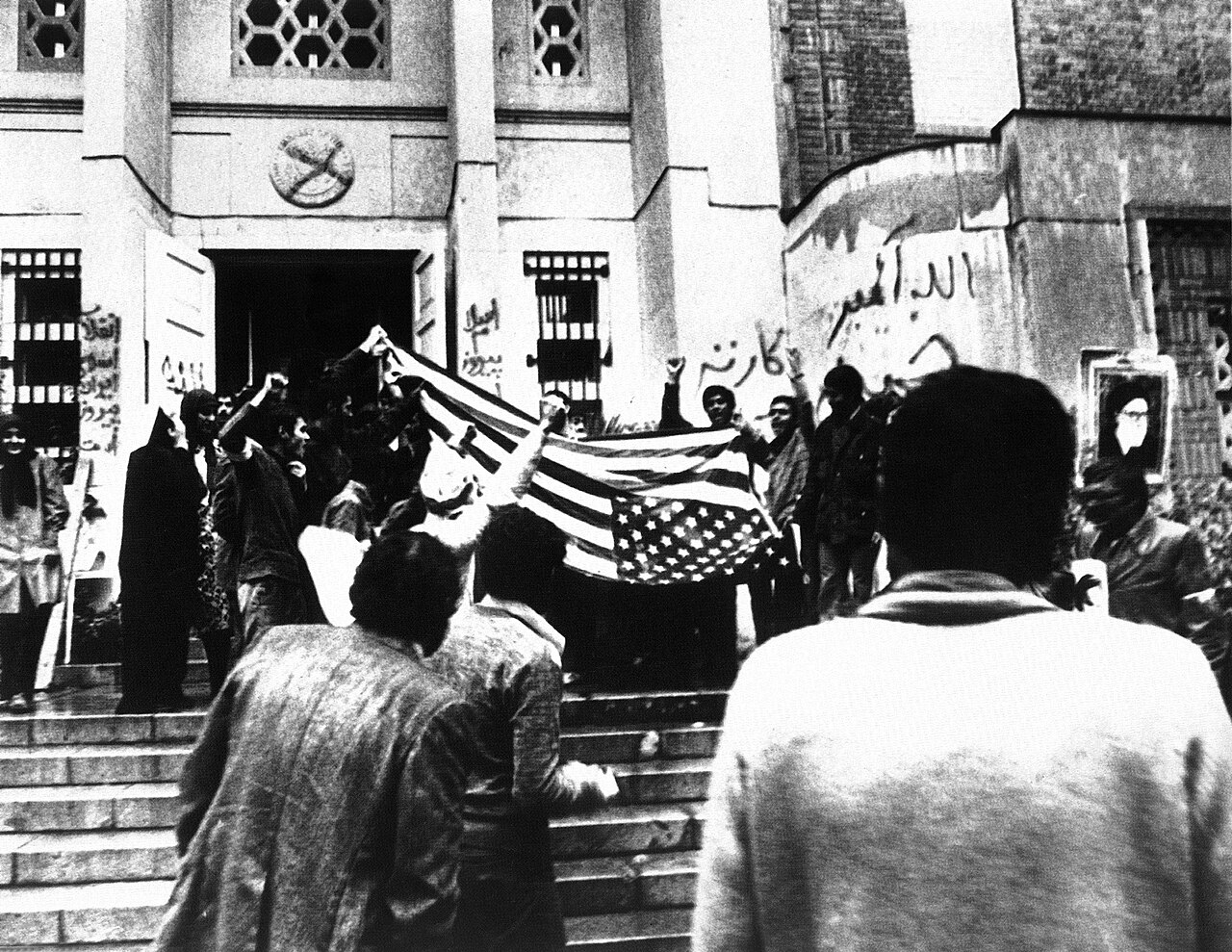
The Iran hostage crisis began on 4 November 1979, when Iranian students loyal to Ayatollah Khomeini stormed the United States embassy in Tehran. Fifty-two American diplomats and citizens were held for 444 days, until 20 January 1981. The crisis broke diplomatic relations between Iran and the United States, which have not been restored, and helped the clerical camp take control of the revolution.
| Dates | 4 November 1979 to 20 January 1981 (444 days) |
|---|---|
| Place | US embassy compound, Taleghani Avenue, Tehran |
| Captors | Muslim Student Followers of the Imam’s Line |
| Hostages | 66 taken; 13 released in November 1979, 1 in July 1980; 52 held to the end |
| Rescue attempt | Operation Eagle Claw, 24–25 April 1980; 8 US servicemen killed |
| Ended by | Algiers Accords, signed 19 January 1981 |
Why the students took the embassy
On 22 October 1979 the deposed shah, who was seriously ill with cancer, was admitted to the United States for treatment. For many Iranians this revived memories of the 1953 coup, organised with the CIA, and they feared Washington was preparing to restore him. On 1 November Prime Minister Mehdi Bazargan met President Carter’s national security adviser, Zbigniew Brzezinski, in Algiers, which radicals in Tehran saw as proof that the provisional government was too close to America.
A group of students from Tehran universities, calling themselves the Muslim Student Followers of the Imam’s Line, planned the takeover with the cleric Mohammad Mousavi Khoeiniha. They later said they intended a sit-in of a few days. On the morning of 4 November several hundred climbed the walls and gates, and the small Marine guard was ordered not to shoot.

Khomeini’s endorsement and Bazargan’s fall
Khomeini had not been told in advance, according to most accounts, but he quickly endorsed the action, calling it a second revolution greater than the first. The students called the embassy a “den of spies” and began publishing the documents they had found, including shredded papers they painstakingly pieced together. These were eventually printed in dozens of volumes and used against Iranian politicians who had had contacts with American officials.
Bazargan, unable to free the hostages or control the students, resigned with his cabinet on 6 November. Power passed to the Revolutionary Council, dominated by clerics. Shaul Bakhash and Ervand Abrahamian both argue that the crisis served the Islamic Republic Party well: it allowed the clerics to cast the liberals and the left as soft on America and to push through the new constitution in a referendum held in December, in the middle of the crisis (see the 1979 referendum and the new constitution).
The hostages
Sixty-three people were seized at the embassy and three more, including the chargé d’affaires Bruce Laingen, were held at Iran’s Foreign Ministry, where they had gone for a meeting. In mid-November Khomeini ordered the release of thirteen women and African-Americans, saying they were victims of American oppression themselves. Richard Queen was freed in July 1980 when he developed multiple sclerosis. The remaining 52 were moved between locations, sometimes blindfolded and paraded before cameras. Several later described beatings, mock executions and long periods of solitary confinement.
Six Americans had escaped from a consular building on the first day and hid in the homes of Canadian diplomats. In January 1980 they left Iran on Canadian passports with help from the CIA, an episode later dramatised in the film Argo (2012).
Sanctions and the failed rescue
The United States froze Iranian assets, stopped buying Iranian oil and on 7 April 1980 broke diplomatic relations. Negotiations through intermediaries made little progress, partly because power in Tehran was divided and President Abolhassan Bani-Sadr could not deliver the students.
On 24 April 1980 Carter launched a rescue mission, Operation Eagle Claw. Helicopters and transport planes met at a desert landing site, known as Desert One, in the Tabas region of eastern Iran. Sandstorms and mechanical failures left too few helicopters to continue, and as the force withdrew a helicopter collided with a refuelling aircraft. Eight American servicemen were killed. In Iran the failure was celebrated as divine intervention, and the burnt wreckage was shown on television. Secretary of State Cyrus Vance, who had opposed the mission, resigned.
The Algiers Accords
Several things changed in the second half of 1980. The shah died in Cairo on 27 July. Iraq invaded Iran in September (see the causes of the Iran–Iraq War), and Iran needed its frozen funds and an end to isolation. Algeria acted as mediator. Under the Algiers Accords of 19 January 1981, the United States agreed to release frozen Iranian assets, much of them used to repay Iran’s loans from American banks, to not intervene in Iran’s internal affairs, and to set up an international tribunal in The Hague to settle claims between the two countries. The Iran–United States Claims Tribunal still sits.
The hostages were flown out of Tehran on 20 January 1981, minutes after Ronald Reagan was sworn in as president. Many observers believe the crisis cost Carter re-election in November 1980.
- 22 October 1979 The shah is admitted to the United States
- 4 November 1979 Students seize the US embassy
- 6 November 1979 Bazargan’s government resigns
- January 1980 Six Americans escape with Canadian help
- 7 April 1980 The US breaks diplomatic relations
- 24–25 April 1980 Operation Eagle Claw fails at Desert One
- 27 July 1980 The shah dies in Cairo
- 19 January 1981 Algiers Accords signed
- 20 January 1981 The 52 hostages are released
Memory and interpretation
In the Islamic Republic, 4 November (13 Aban) is marked each year as the national day of struggle against “global arrogance”, with rallies outside the former embassy, now a museum run by the Revolutionary Guards. The official view presents the takeover as a defence of the revolution against an American plot. American accounts, such as those of the former hostages and of historian David Farber, treat it as a grave breach of diplomatic immunity, the principle that envoys are protected even in wartime.
Views inside Iran have also shifted. Some of the organisers, including Ebrahim Asgharzadeh and Abbas Abdi, later became reformist politicians; Abdi met the former hostage Barry Rosen in Paris in 1998. The spokeswoman for the students, Masoumeh Ebtekar, became a vice-president under Mohammad Khatami. Ray Takeyh and other historians of US–Iranian relations see the crisis as the moment that fixed hostility between the two states for the following decades. The wider story is told in Iran and the United States, and the struggle at home that ran in parallel in power struggles after the revolution.
Persian words from this page
| گروگان | gerowgân | hostage |
| سفارت | sefârat | embassy |
| لانه جاسوسی | lâneh-ye jâsusi | den of spies |
| دانشجو | dâneshju | student |
| طبس | Tabas | town near the Desert One site |
| آبان | Âbân | eighth month of the Iranian calendar |
Sources and further reading
- David Farber, Taken Hostage: The Iran Hostage Crisis and America’s First Encounter with Radical Islam (Princeton University Press, 2005)
- Shaul Bakhash, The Reign of the Ayatollahs: Iran and the Islamic Revolution (Basic Books, 1984)
- Mark Bowden, Guests of the Ayatollah (Atlantic Monthly Press, 2006)
- Massoumeh Ebtekar, Takeover in Tehran: The Inside Story of the 1979 U.S. Embassy Capture (Talonbooks, 2000)
- Ray Takeyh, Hidden Iran: Paradox and Power in the Islamic Republic (Times Books, 2006)
- Text of the Algiers Accords (Declarations of the Government of Algeria, 19 January 1981), Iran–United States Claims Tribunal
Want to learn Persian? Get the free Starter Pack
Get the 14-page printable Starter Pack (all 32 letters, a 7-day reading plan, 100 core words and 20 survival phrases) and a short 5-email course. Free.
More in The Islamic Revolution and the Islamic Republic (1979–present)
- Causes of the 1979 Revolution
- Khomeini’s Return and the Fall of the Monarchy
- Ruhollah Khomeini
- The 1979 Referendum and the New Constitution
- The Iran Hostage Crisis (1979–1981)
- Power Struggles after the Revolution
- The Cultural Revolution and University Closures
- The Iran–Iraq War: Causes and Iraqi Invasion
- Khorramshahr: Fall and Liberation
- The Iran–Iraq War, 1982–1986
- The Basij and Child Soldiers in the Iran–Iraq War
- Chemical Weapons in the Iran–Iraq War
- The Tanker War and Iran Air Flight 655
- The Iran–Contra Affair
- The End of the Iran–Iraq War (1988)
- The 1988 Executions of Political Prisoners
- The Death of Khomeini and the Succession of Khamenei (1989)
- Ali Khamenei
- Rafsanjani and Post-War Reconstruction (1989–1997)
- Khatami and the Reform Era (1997–2005)
- The 1999 Student Protests (18 Tir)
- The Ahmadinejad Presidency (2005–2013)
- The 2009 Election and the Green Movement
- Iran’s Nuclear Program
- Sanctions on Iran
- Rouhani and the Nuclear Deal (JCPOA)
- The Protests of 2017–2018 and November 2019
- The Killing of Soleimani and Flight 752 (January 2020)
- Iran and the COVID-19 Pandemic
- The Raisi Presidency and His Death (2021–2024)
- The 2022 Mahsa Amini Protests: “Woman, Life, Freedom”
- Iran and Israel: From Allies to Open Conflict
- The Pezeshkian Presidency
- The Twelve-Day War of June 2025
- The Protests of Late 2025 and January 2026
- The 2026 War with the United States and Israel
- The Killing of Ali Khamenei (28 February 2026)
- Mojtaba Khamenei and the 2026 Succession
- The Iranian Diaspora
- Iran and Hezbollah
- Major Earthquakes in Modern Iran
- Iranian Cinema after 1979