Women have shaped Iranian history from the Elamite queens of Susa to the protest movements of the 21st century. Persepolis tablets show royal women running estates in the 5th century BCE, two Sasanian queens ruled in their own name in the 7th century CE, and in the modern era Iranian women won schooling, the vote in 1963 and two Nobel Peace Prizes, while the rules on what they must wear changed sharply with each regime.

This page is a long overview. Many of the periods have their own detailed pages, linked in each section.
Elam and the Achaemenid court
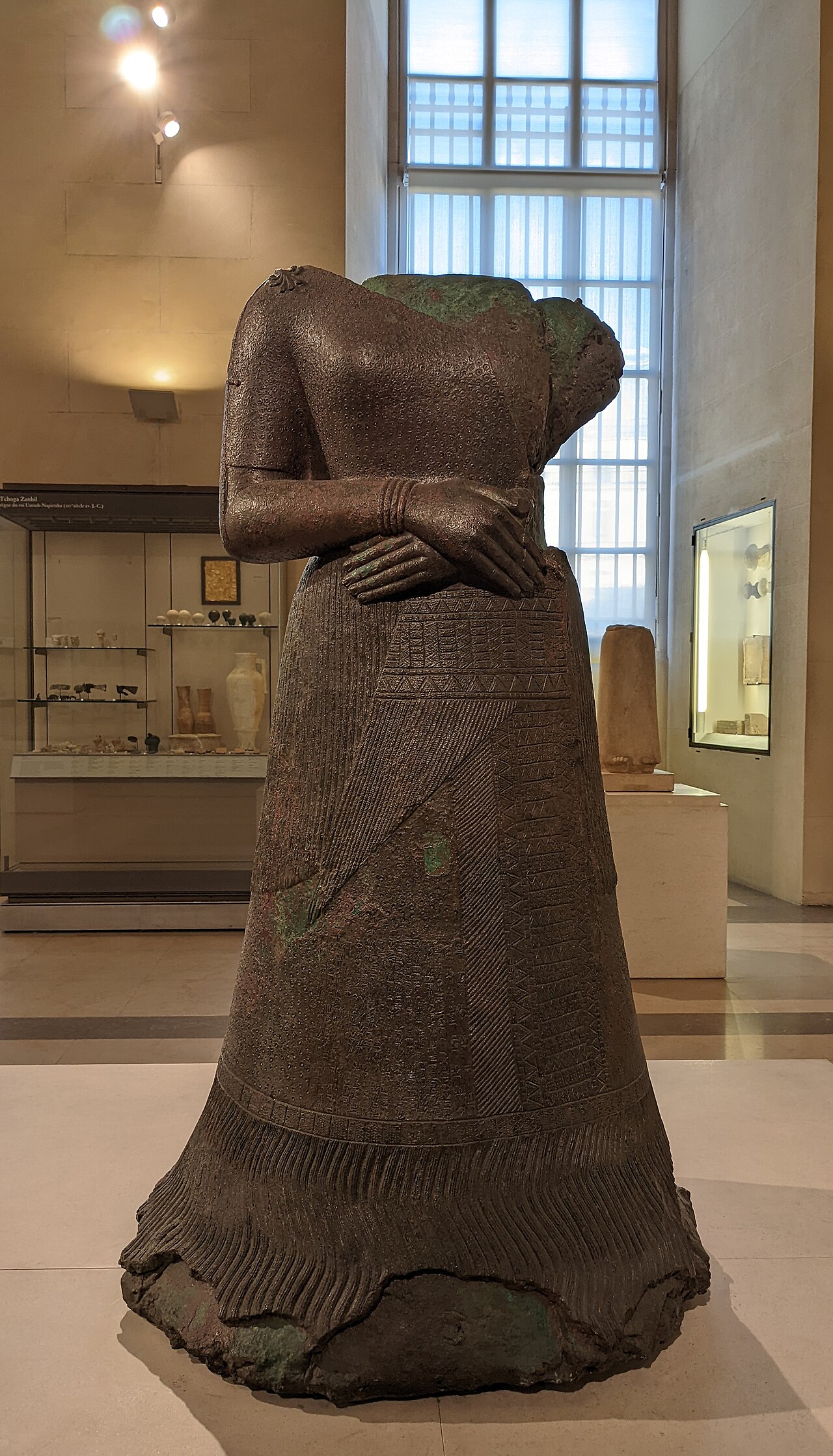
The oldest life-size metal statue from ancient Iran is of a woman: Queen Napir-Asu, cast in bronze around 1300 BCE and weighing about 1,750 kg. Her inscription calls on the gods to curse anyone who damages it. She was the wife of Untash-Napirisha, builder of Chogha Zanbil (see the Middle Elamite kingdom).
Greek writers such as Herodotus and Ctesias portray Persian queens, especially Atossa, daughter of Cyrus and mother of Xerxes, and Parysatis, wife of Darius II, as powerful and often ruthless figures behind the throne. The Persians’ own records give a more practical picture. The Persepolis Fortification Tablets show royal women such as Irdabama and Artystone owning estates, issuing orders under their own seals and employing hundreds of workers. Ordinary women worked in the royal economy too, sometimes as supervisors, and received extra rations after giving birth. Our page on women of the Achaemenid court examines both kinds of evidence.
Parthian and Sasanian queens
Around the turn of the Common Era, Queen Musa of Parthia, once a slave girl sent by Augustus, appears on coins beside her son Phraates V, a rare honour. In the Sasanian empire royal women were named in state inscriptions, and the law book Madayan i Hazar Dadestan shows women holding property and acting in some legal matters, though within a family system controlled by men (see women in the Sasanian empire). In the chaos after 628 two daughters of Khosrow II, Boran and Azarmidokht, ruled as queens in their own right, the only women to do so in pre-modern Iran (see civil war and the queens Boran and Azarmidokht). Khosrow’s wife Shirin became the heroine of one of Persian literature’s great romances.
Poets, regents and patrons in the Islamic centuries
Women rarely held formal office in medieval Iran, but they appear as poets, patrons and, in practice, rulers. Rabia Balkhi in the 10th century is the first Persian woman poet whose verses survive, and Mahsati in the 12th century became famous for her quatrains. Turkic and Mongol traditions gave women of the ruling family more public authority. Terken Khatun, mother of the Khwarazmshah Muhammad, was a power in her own right, and in Kerman the Qutlugh-Khanid princess Qutlugh Terken ruled for about 25 years in the 13th century. The Timurid queen Gawhar Shad built the great mosque beside the shrine of Imam Reza in Mashhad in 1418. Under the Safavids, princesses such as Pari Khan Khanum and the queen Khayr al-Nisa Begum briefly dominated politics in the 1570s, and both were killed in court struggles (see women of the Safavid court).
The Qajar era and the Constitutional Revolution
The 19th century produced Iran’s most radical female figure. The poet and Babi leader Tahirih (Qurrat al-Ayn) appeared unveiled before a gathering of men in 1848 and was executed in 1852. Women joined the Tobacco Protest of 1891–92 and the street politics of the Constitutional Revolution, forming secret societies and funding the new national bank. Bibi Khanum Astarabadi, author of a sharp satire on men called The Vices of Men, opened one of the first schools for girls in Tehran, and the first women’s journals followed. Our page on women in the Constitutional Revolution tells this story in detail.
Pahlavi Iran: reform from above
Reza Shah’s state opened schools and the University of Tehran to women, and in 1936 banned the veil in public, a decree welcomed by some women and experienced by others as a humiliation that kept them at home (see the Unveiling Decree of 1936). Under Mohammad Reza Shah, women won the vote in 1963 as part of the White Revolution, the Family Protection Laws of 1967 and 1975 restricted men’s rights of divorce and polygamy, and Farrokhroo Parsa became the first woman cabinet minister in 1968. Women writers such as Parvin E’tesami and Forough Farrokhzad changed Persian poetry. Our page on women in Pahlavi Iran discusses how far these changes reached beyond the urban middle class.
The Islamic Republic
Women took part in large numbers in the 1979 revolution. The new state then made the hijab compulsory, suspended the Family Protection Law and lowered the legal age of marriage; Farrokhroo Parsa was executed in 1980. At the same time, literacy among women rose sharply, especially in rural areas, and by the 2000s women made up more than half of university students in many years. Women have served in parliament and as vice-presidents, and in 2009 Marzieh Vahid-Dastjerdi became the Islamic Republic’s first woman cabinet minister.
Women’s rights activists, lawyers and journalists have pressed for change throughout, through campaigns such as the One Million Signatures campaign of 2006. The lawyer Shirin Ebadi won the Nobel Peace Prize in 2003, and the activist Narges Mohammadi, while in prison, in 2023. The mathematician Maryam Mirzakhani, the first woman to win the Fields Medal, is described on our page on science in Iranian history. The death of Mahsa Amini in the custody of the morality police in September 2022 set off months of nationwide protests under the slogan “Woman, Life, Freedom” (see the 2022 protests). Supporters of the state present its laws as protecting women’s dignity and family; critics, inside Iran and abroad, see them as legal discrimination. The debate over women’s place in Iranian society remains one of the central questions of the country’s politics.
Persian words from this page
| زن | zan | woman |
| ملکه | malake | queen |
| بانو | bânu | lady |
| حجاب | hejâb | hijab, covering |
| کشف حجاب | kashf-e hejâb | unveiling |
| طاهره | Tâhere | Tahirih |
| زن، زندگی، آزادی | zan, zendegi, âzâdi | woman, life, freedom |
Sources and further reading
- Maria Brosius, Women in Ancient Persia, 559–331 BC, Oxford, 1996.
- Guity Nashat and Lois Beck (eds), Women in Iran from the Rise of Islam to 1800, 2003.
- Janet Afary, The Iranian Constitutional Revolution, 1906–1911, Columbia, 1996.
- Afsaneh Najmabadi, Women with Mustaches and Men without Beards, 2005.
- Encyclopaedia Iranica, “Feminist Movements” (series of articles).
Want to learn Persian? Get the free Starter Pack
Get the 14-page printable Starter Pack (all 32 letters, a 7-day reading plan, 100 core words and 20 survival phrases) and a short 5-email course. Free.
More in Themes Across Iranian History (3000 BCE–today)
- A History of the Persian Language
- Zoroastrianism through the Ages
- Shi’a Islam in Iranian History
- The Jews of Iran
- The Armenians of Iran
- Christians of Iran
- The Baha’i Faith in Iran
- The Kurds in Iranian History
- Azerbaijanis in Iranian History
- The History of the Iranian Calendar
- Nowruz through History
- The Persian Garden (Pardis) through History
- Qanats: Iran’s Ancient Water Tunnels
- A History of Persian Carpets
- A History of Persian Architecture
- A History of Persian Painting
- A History of Persian Music
- Science in Iranian History
- Women in Iranian History
- Iran and the Silk Road
- Iran and China through History
- Iran and India through History
- Iran and Greece: Perceptions and Exchanges
- Persia and Rome: Seven Centuries of Rivalry
- Iran and the Ottoman Empire
- Iran and Russia through History
- Iran and Britain through History
- Iran and the United States
- How Iran’s Borders Changed
- The Capitals of Iran through History
- Coins of Iran through History: From the Daric to the Rial
- Flags and Symbols of Iran through History
- Myth and History in the Shahnameh: The Epic’s Kings and the Real Past
- Timeline of Iranian History: Key Dates from Elam to Today
- A History of Persian Cuisine: From Royal Banquets to Chelow Kabab
- A History of Persian Poetry: From Rudaki to Forough
- Wine in Iranian History: From Hajji Firuz to Hafez and Prohibition
- Sports in Iranian History: Polo, the Zurkhaneh and Wrestling
- List of Iranian Dynasties and Rulers