The “Woman, Life, Freedom” protests were a wave of nationwide demonstrations that began in Iran in September 2022 after the death in custody of Mahsa (Jina) Amini, a 22-year-old Kurdish woman arrested by the morality police for allegedly wearing her hijab improperly. Led to a striking degree by women and teenagers, the protests challenged compulsory veiling and the Islamic Republic itself, and were suppressed over the following months at the cost of hundreds of lives.
| Began | 16–17 September 2022, after Amini’s death in Tehran and her funeral in Saqqez |
|---|---|
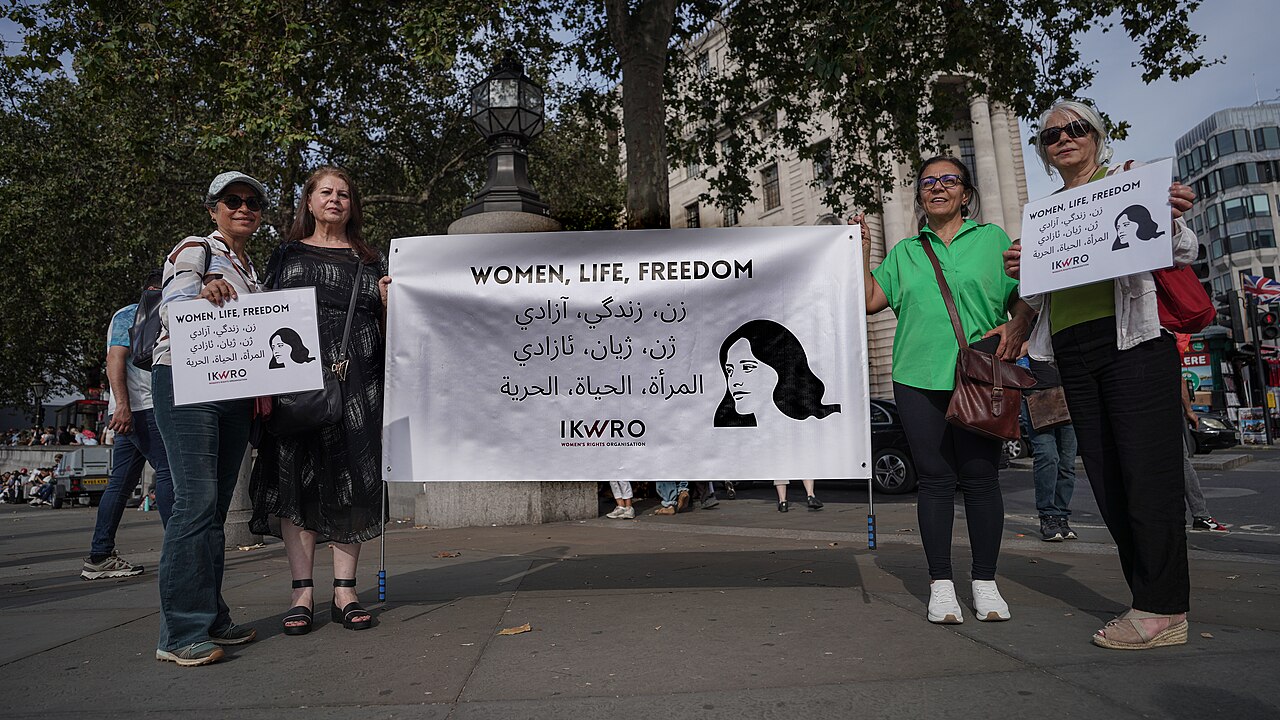
| Slogan | Zan, zendegi, âzâdi (Persian); Jin, jiyan, azadî (Kurdish) |
| Killed | At least 551 protesters, including 68 children (Iran Human Rights, to September 2023; also cited by the UN fact-finding mission). Iranian officials gave lower figures that included security forces. |
| Arrested | About 19,000–22,000 (HRANA count; judiciary pardon figures) |
| Executions | At least ten people executed in connection with the protests by August 2024 (Amnesty International) |
The death of Mahsa Amini
Mahsa Amini, known to her family by her Kurdish name Jina, came from Saqqez in Kurdistan province. On 13 September 2022, while visiting Tehran with her brother, she was detained by the Guidance Patrol (گشت ارشاد, gasht-e ershâd), the unit that enforced the dress code, and taken to a detention centre for “re-education”. Within hours she collapsed. She was taken to hospital in a coma and died on 16 September.
Her family and witnesses said she had been beaten in the van. The police released CCTV footage of her collapsing and said she had suffered heart failure; a forensic report in October attributed her death to organ failure linked to an earlier medical condition. Her family rejected that account, and in 2024 the UN Independent International Fact-Finding Mission on Iran concluded that her death resulted from physical violence while in the custody of the state.
From a funeral to a national movement
At her burial in Saqqez on 17 September, women took off their headscarves and the crowd chanted the Kurdish slogan Jin, jiyan, azadî, which came from the Kurdish women’s movement. Translated into Persian as زن، زندگی، آزادی (zan, zendegi, âzâdi), “woman, life, freedom”, it became the cry of the whole movement. Within days protests had spread to Tehran and dozens of other cities.
The images that travelled round the world were new: women burning headscarves at street bonfires, cutting their hair in public, and walking unveiled; schoolgirls removing their scarves and chanting against the leadership in their classrooms. University students held sit-ins and boycotted classes. Shopkeepers in bazaars and some industrial workers joined strikes in November. The singer Shervin Hajipour’s song “Baraye” (“For”), built from protesters’ posts about why they were marching, became an anthem and won a special Grammy award for social change in 2023.

Kurdistan and Baluchestan
The crackdown was heaviest on the periphery. In Kurdish towns such as Saqqez, Mahabad, Sanandaj and Javanrud, the Revolutionary Guards deployed heavy forces. In Zahedan, capital of the mainly Sunni Baluch province of Sistan and Baluchestan, security forces opened fire on worshippers and protesters after Friday prayers on 30 September 2022, a day that became known as “Bloody Friday”; Amnesty International put the death toll that day at no fewer than 66, and later counts were higher. The protests there were driven also by anger over the alleged rape of a teenage girl by a police commander.
How the state responded
The government described the protests as riots (اغتشاش, eghteshâsh) incited by the United States, Israel and opposition media abroad, and Supreme Leader Ali Khamenei said in October 2022 that the unrest had been planned by Iran’s enemies. Internet access was cut or slowed for long periods, and Instagram and WhatsApp were blocked. Security forces used live ammunition, birdshot and tear gas; doctors told journalists they had treated hundreds of eye injuries from pellets.
Casualty figures depend on who counts. The Norway-based group Iran Human Rights documented at least 551 protesters killed, including 68 children, by September 2023, and the UN fact-finding mission cited the same figure. In late 2022 a Revolutionary Guards commander said more than 300 people had died, including security personnel, and other officials gave figures of around 200. The rights group HRANA estimated that about 19,000 people were arrested; in February 2023 the head of the judiciary said that more than 22,000 people connected to the unrest had been pardoned in an amnesty.
Revolutionary courts sentenced protesters to death on charges such as moharebeh (“waging war against God”). The first execution, of Mohsen Shekari, took place on 8 December 2022. By August 2024 at least ten people had been executed in connection with the protests, according to Amnesty International, which, like the UN mission, said the trials were grossly unfair. The government says those executed had killed or wounded security forces.
Results and legacy
By early 2023 the street protests had largely subsided. The Islamic Republic remained in place and kept the hijab law; parliament passed a stricter “Hijab and Chastity” bill, though in December 2024 the Supreme National Security Council put its implementation on hold. Yet daily life had changed. Many women in Tehran and other cities stopped covering their hair in public, and enforcement became patchy.
Internationally, the European Parliament awarded its 2023 Sakharov Prize to Jina Mahsa Amini and the Woman, Life, Freedom movement, and the imprisoned activist Narges Mohammadi received the 2023 Nobel Peace Prize. In March 2024 the UN fact-finding mission concluded that the repression involved crimes against humanity, including murder, imprisonment, torture and rape; Iran rejected the mission and its findings. Historians place the movement in a line with the Green Movement of 2009 and the protests of 2017–2019, and before the protests of 2025–2026, but it differed in putting women’s bodily freedom at its centre. For the longer story, see women in Iranian history.
Persian words from this page
| زن | zan | woman |
| زندگی | zendegi | life |
| آزادی | âzâdi | freedom |
| حجاب | hejâb | hijab, veiling |
| گشت ارشاد | gasht-e ershâd | Guidance Patrol (morality police) |
| برای | barâye | for, for the sake of |
| اغتشاش | eghteshâsh | riot, unrest (the official term) |
Sources and further reading
- UN Human Rights Council, Report of the Independent International Fact-Finding Mission on the Islamic Republic of Iran, A/HRC/55/67 (March 2024).
- Iran Human Rights (IHRNGO), reports on deaths in the 2022 protests (2022–2023).
- Amnesty International, reports on the Zahedan killings (2022) and on protest-related executions (2023–2024).
- Human Rights Activists News Agency (HRANA), daily and summary reports on the 2022 protests.
- European Parliament, 2023 Sakharov Prize announcement.
Want to learn Persian? Get the free Starter Pack
Get the 14-page printable Starter Pack (all 32 letters, a 7-day reading plan, 100 core words and 20 survival phrases) and a short 5-email course. Free.
More in The Islamic Revolution and the Islamic Republic (1979–present)
- Causes of the 1979 Revolution
- Khomeini’s Return and the Fall of the Monarchy
- Ruhollah Khomeini
- The 1979 Referendum and the New Constitution
- The Iran Hostage Crisis (1979–1981)
- Power Struggles after the Revolution
- The Cultural Revolution and University Closures
- The Iran–Iraq War: Causes and Iraqi Invasion
- Khorramshahr: Fall and Liberation
- The Iran–Iraq War, 1982–1986
- The Basij and Child Soldiers in the Iran–Iraq War
- Chemical Weapons in the Iran–Iraq War
- The Tanker War and Iran Air Flight 655
- The Iran–Contra Affair
- The End of the Iran–Iraq War (1988)
- The 1988 Executions of Political Prisoners
- The Death of Khomeini and the Succession of Khamenei (1989)
- Ali Khamenei
- Rafsanjani and Post-War Reconstruction (1989–1997)
- Khatami and the Reform Era (1997–2005)
- The 1999 Student Protests (18 Tir)
- The Ahmadinejad Presidency (2005–2013)
- The 2009 Election and the Green Movement
- Iran’s Nuclear Program
- Sanctions on Iran
- Rouhani and the Nuclear Deal (JCPOA)
- The Protests of 2017–2018 and November 2019
- The Killing of Soleimani and Flight 752 (January 2020)
- Iran and the COVID-19 Pandemic
- The Raisi Presidency and His Death (2021–2024)
- The 2022 Mahsa Amini Protests: “Woman, Life, Freedom”
- Iran and Israel: From Allies to Open Conflict
- The Pezeshkian Presidency
- The Twelve-Day War of June 2025
- The Protests of Late 2025 and January 2026
- The 2026 War with the United States and Israel
- The Killing of Ali Khamenei (28 February 2026)
- Mojtaba Khamenei and the 2026 Succession
- The Iranian Diaspora
- Iran and Hezbollah
- Major Earthquakes in Modern Iran
- Iranian Cinema after 1979