Nisa, at the northern foot of the Kopet Dag about 18 km west of Ashgabat in Turkmenistan, was one of the earliest centres of the Parthian kings. Its walled royal citadel, known as Old Nisa and renamed Mithradatkert, “fortress of Mithridates”, held palaces, halls for the royal cult and treasuries from the 3rd century BCE to the early 3rd century CE. Excavations there produced the finest Parthian ivories and the largest archive of Parthian documents ever found.
| Location | Near the village of Bagir, Ahal province, Turkmenistan |
|---|---|
| Parts | Old Nisa (royal citadel) and New Nisa (the town) |
| Ancient names | Nisa, Parthaunisa (Isidore of Charax); Mithradatkert in local documents |
| Main period | Mid 3rd century BCE to early 3rd century CE |
| Famous finds | Ivory rhytons, marble statuettes, thousands of inscribed potsherds |
| World Heritage | “Parthian Fortresses of Nisa”, inscribed 2007 |
Two mounds, a citadel and a town
Nisa lies on the fertile strip between the mountains and the Karakum desert, the oasis land the Parni took over when they settled in Parthia (see the Parni and Arsaces I). There are two separate mounds a short distance apart.
New Nisa was the town, surrounded by high mud-brick walls. It continued to be inhabited long after the Parthians, into the Islamic period, when Nisa was a known town of Khorasan.
Old Nisa is the royal citadel: an irregular pentagon on a natural rise, enclosed by a massive wall with dozens of towers. It was not a city where people lived and traded but a fortified complex of state buildings, storerooms and shrines, built of mud brick and baked brick on stone foundations.

What the excavators found
Soviet archaeologists of the South Turkmenistan Archaeological Expedition, led by Mikhail Masson, began large-scale work at Nisa in the 1930s and continued for decades. Since 1990 an Italian mission from Turin, long directed by Antonio Invernizzi, has worked with Turkmen colleagues on the central buildings.
The Square House and the ivory rhytons
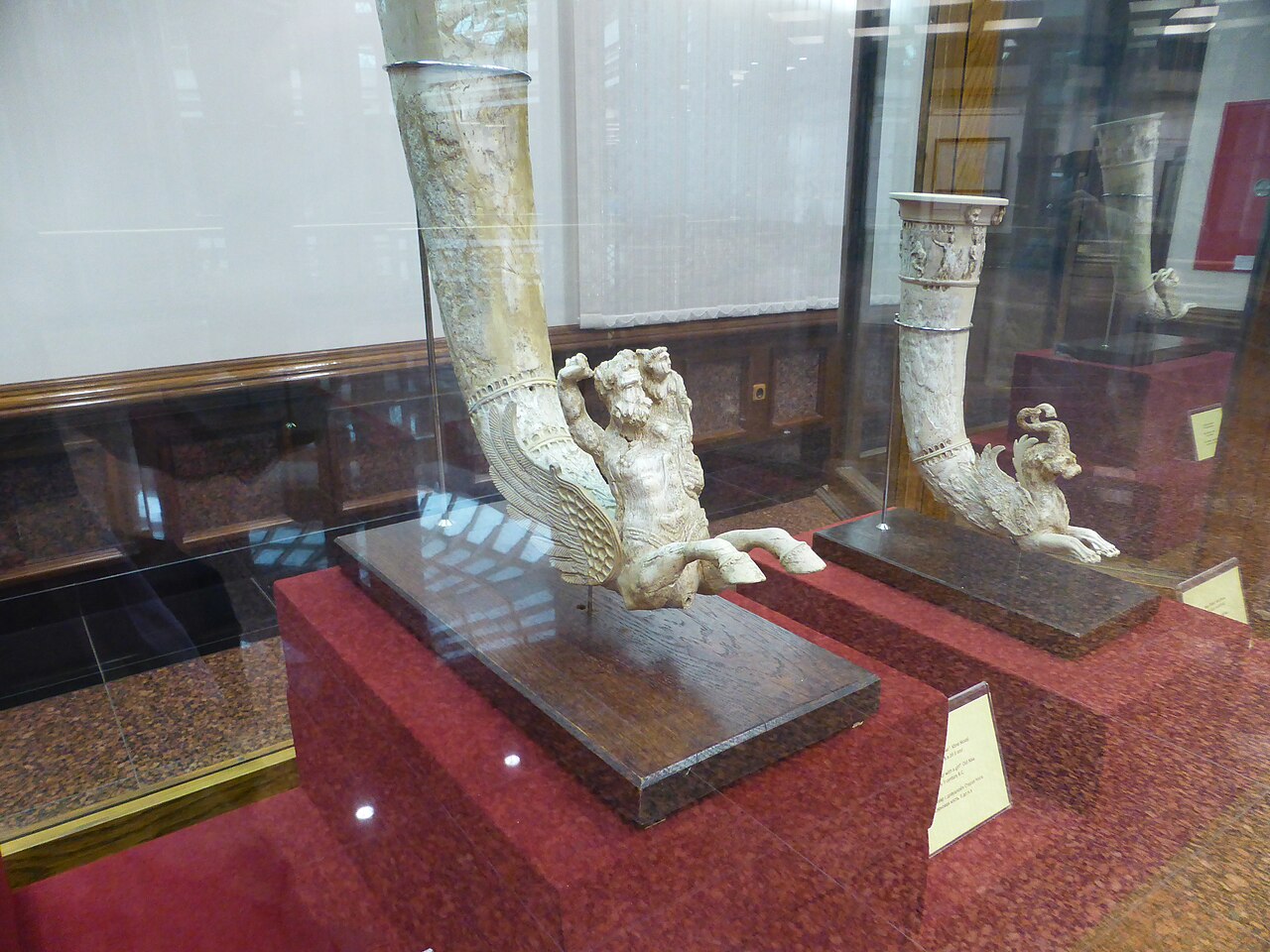
In the so-called Square House, a building of rooms arranged around a courtyard that seems to have served as a treasury, excavators in 1948 found a large group of carved ivory rhytons, drinking horns that end in the front half of an animal or a mythical creature. Their friezes show Greek subjects such as gods, muses and scenes of sacrifice, carved with great skill. They are among the clearest proofs that the early Arsacids, steppe newcomers, surrounded themselves with Hellenistic art. Most scholars think they were used in rituals or royal banquets, not as everyday cups.
The same storerooms produced marble statuettes, including a female figure often called “Rhodogune” after a Parthian princess (the identification is a modern guess), silver and gold objects, and fragments of furniture decorated in ivory. Much had been broken up or looted in antiquity.
The Round Hall and the Square Hall
In the central part of the citadel stood two great ceremonial buildings. The Round Hall was a domed, circular room set inside a square block. The Square Hall, about 20 metres a side, had a roof carried on four massive columns and walls decorated with half-columns and niches. Large statues of unbaked clay, painted, once stood in these niches; fragments of heads and bodies survive. Many researchers see the complex as a place for the cult of the deified royal ancestors. Isidore of Charax, in the late 1st century BCE, wrote that the royal tombs were at Parthaunisa, which fits a dynastic shrine at Nisa, although no royal tombs have been identified with certainty.
The wine archive
In the storerooms of Old Nisa, excavators found more than two thousand ostraca: pieces of broken pottery jars with short notes written in ink. Most record deliveries of wine from royal or temple vineyards in the district, with the quantity, the name of the estate, the official responsible and the date in the Arsacid era. The dated ones fall mainly in the 1st century BCE.
The texts are written in an alphabet derived from Aramaic, the old administrative script of the Achaemenids, and use many Aramaic words as written signs for Parthian words. They are therefore the earliest substantial documents in the Parthian language and show that a well-organised bureaucracy collected produce in kind. They also preserve the name of the citadel, Mithradatkert. For more on these records, see the Parthian language and its records.
Was Nisa really the capital?
The UNESCO listing calls Nisa a capital of the Parthian Empire, and it is often described as the first Parthian capital. The picture is more complicated.
- Ancient writers name other early seats: Dara and Asaak in the time of Arsaces I, and later Hecatompylos, which Strabo calls the royal seat. None of these has been securely located or excavated on the same scale.
- Old Nisa has no ordinary houses, markets or workshops. It looks like a royal and religious centre rather than a place from which the empire was governed day to day.
- As the empire expanded west under Mithridates I and his successors, the kings spent more time in Media and Mesopotamia, and from the 1st century BCE Ctesiphon on the Tigris became the main winter residence.
Most historians therefore describe Nisa as the dynasty’s homeland and ceremonial heart. The renaming after Mithridates, usually thought to be Mithridates I, shows that even the conqueror of Mesopotamia wanted his name attached to the old family fortress.
Nisa in Parthian art
The finds at Nisa show the early stage of Parthian art, when Greek forms dominated and the frontal, Iranian style seen later at Hatra and in Mesopotamia had not yet developed. The four-column hall and the round domed hall also matter for the history of Iranian architecture. For the wider picture, see Parthian art and architecture.
The site today
Old Nisa is open to visitors as part of a protected archaeological park, and the rhytons and other finds are divided between museums in Ashgabat and Russia, where a set of rhytons was restored at the Pushkin Museum in Moscow. The walls have weathered badly in places, and conservation of unbaked mud brick remains a constant task. For opening hours and access, check current local information before travelling.
Persian words from this page
| نسا | Nesâ | Nisa |
| عشقآباد | Eshgh-âbâd | Ashgabat |
| مهرداد | Mehrdâd | Mithridates |
| شراب | sharâb | wine |
| تاکستان | tâkestân | vineyard |
| دژ | dezh | fortress |
Sources and further reading
- UNESCO World Heritage Centre, Parthian Fortresses of Nisa.
- Encyclopaedia Iranica, “Nisa”.
- I. M. Diakonoff and V. A. Livshits, Parthian Economic Documents from Nisa, Corpus Inscriptionum Iranicarum.
- Antonio Invernizzi and Carlo Lippolis (eds.), Nisa Partica: Ricerche nel complesso monumentale arsacide 1990–2006, 2008.
- Isidore of Charax, Parthian Stations.
Want to learn Persian? Get the free Starter Pack
Get the 14-page printable Starter Pack (all 32 letters, a 7-day reading plan, 100 core words and 20 survival phrases) and a short 5-email course. Free.
More in The Parthian Empire (247 BCE–224 CE)
- The Parni and Arsaces I
- Nisa: The First Parthian Capital
- Mithridates I and the Making of an Empire
- Phraates II, Artabanus I and the Saka Invasions
- Mithridates II the Great
- The Parthians and the Silk Road
- Parthian Cavalry: Cataphracts and the Parthian Shot
- Surena and the Battle of Carrhae (53 BCE)
- Orodes II and Prince Pacorus
- Mark Antony’s Parthian War
- Phraates IV and the Peace with Augustus
- Queen Musa of Parthia
- Artabanus II of Parthia
- Gotarzes II and Vardanes: A Royal Rivalry
- Vologases I and the War over Armenia
- Trajan’s Invasion of Parthia
- Osroes I and the Parthian Civil Wars
- Roman Campaigns of the 2nd Century: Lucius Verus and Septimius Severus
- The Last Parthian Kings: Vologases V, Vologases VI and Artabanus IV
- The Fall of the Parthian Empire
- Ctesiphon: Capital of Two Empires
- The Great Houses of Parthia
- Religion and Culture in Parthian Iran
- Parthian Art and Architecture
- Parthian Coins and What They Tell Us
- Hatra: The City that Resisted Rome
- The Parthian Language and Its Records
- The Indo-Parthians and Kushans
- The Parthian Legacy