The Battle of Carrhae, fought in 53 BCE near the town of Carrhae (Harran in south-eastern Turkey), was one of the worst defeats in Roman history. A Parthian army of about 10,000 horsemen under the general Surena destroyed a Roman force of seven legions led by Marcus Licinius Crassus. Crassus was killed, about 30,000 Romans died or were captured, and Rome’s legionary eagles stayed in Parthian hands for more than thirty years.
| Date | Early summer 53 BCE; Ovid gives 9 June |
|---|---|
| Place | Near Carrhae (Harran), northern Mesopotamia |
| Parthian commander | Surena, head of the Suren family |
| Roman commander | Marcus Licinius Crassus, governor of Syria |
| Forces | Parthians: about 1,000 cataphracts and 9,000 horse archers. Romans: seven legions, about 4,000 cavalry and 4,000 light troops (Plutarch) |
| Result | Decisive Parthian victory; Crassus and his son killed |
| Roman losses | 20,000 dead and 10,000 captured, according to Plutarch |
Why Crassus came
Crassus was the richest man in Rome and the third member, with Pompey and Caesar, of the alliance historians call the First Triumvirate. Pompey and Caesar had won glory in the east and in Gaul; Crassus wanted a war of his own. As consul in 55 BCE he obtained the province of Syria, and he made clear that he meant to fight Parthia, although Rome had no treaty grievance worth the name.
The moment seemed good. Parthia had just come through a civil war in which Orodes II defeated his brother Mithridates III. In 54 BCE Crassus crossed the Euphrates, occupied several towns in northern Mesopotamia and left garrisons there, then returned to Syria for the winter. Ancient writers blamed him for giving the Parthians a year to prepare.
Surena
The Parthian commander is known only by his family title, Surena, meaning the head of the house of Suren, one of the great noble families of the empire (see the great houses of Parthia). Plutarch describes him as under thirty, the first man in Parthia after the king in wealth, birth and reputation, with the hereditary right to crown the king. He had helped Orodes win his throne, personally leading the assault on Seleucia.
Surena travelled in style: Plutarch says a thousand camels carried his baggage and two hundred wagons his concubines, and that he wore make-up and parted his hair in the Median fashion. Greek writers liked to contrast such luxury with his skill, but the important detail is military. His force of about 10,000 horsemen was raised from his own estates and dependents, a private army larger than many kingdoms could field.
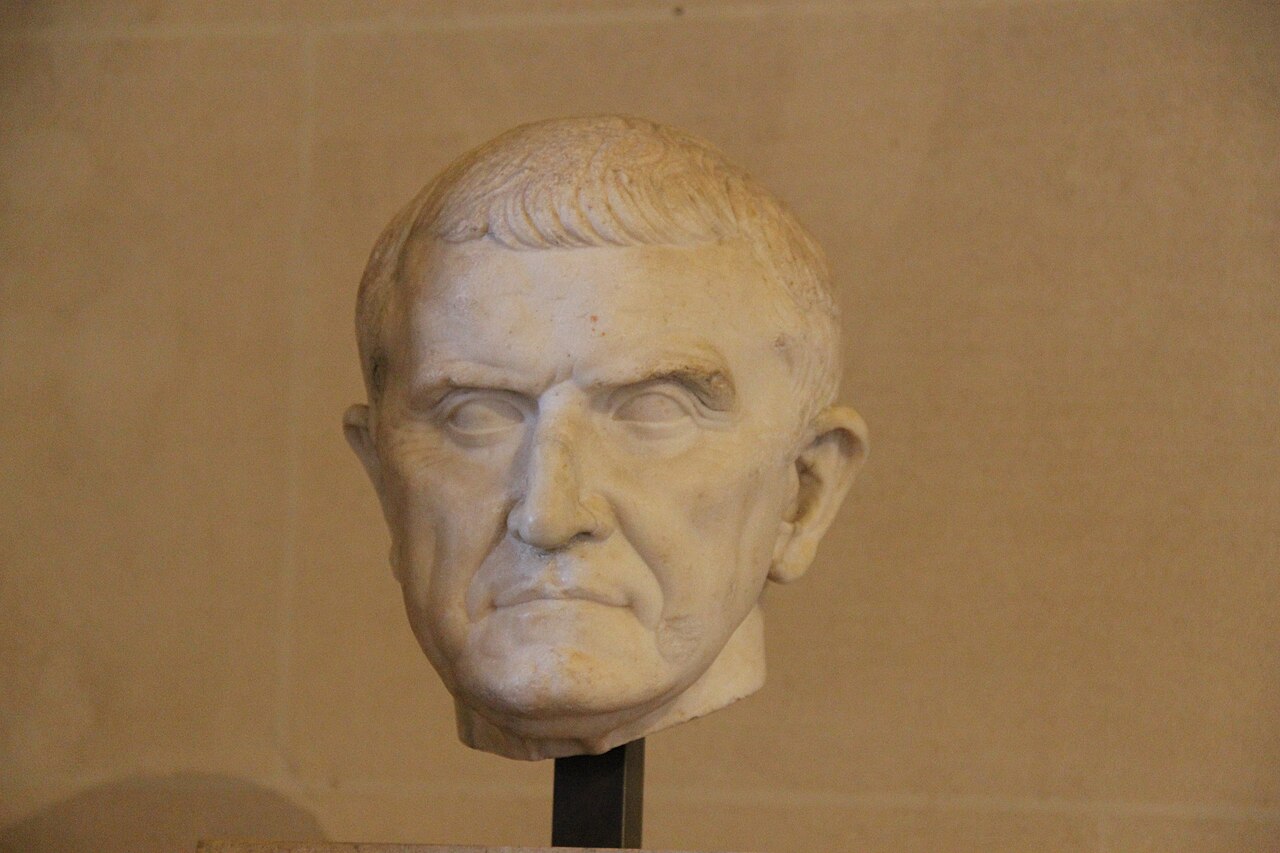

Divided strategy
Orodes split his forces. He took the main army north to invade Armenia, whose king Artavasdes II had offered Crassus help and urged him to march through the Armenian hills, where cavalry would be less effective. With Armenia occupied, Artavasdes could send nothing. Surena, meanwhile, was sent with his cavalry to meet the Romans in Mesopotamia.
Crassus chose the direct route across the plain. He was guided by Abgar, king of Osroene (called Ariamnes by Plutarch), who led him away from the Euphrates into open, waterless country and then left. Roman writers later called Abgar a traitor in Parthian pay. Whether that is true or not, the Roman army was on the worst possible ground for it.
The battle
Surena hid the size of his army behind his advance guard and concealed his armour under cloaks and skins. When the Romans approached, the Parthians beat great drums hung with bronze bells, then threw off their coverings. Crassus formed his men in a hollow square. The horse archers surrounded it and shot steadily into the packed ranks, and when the Romans hoped the arrows would run out, the archers rode back to camels loaded with fresh supplies (see Parthian cavalry).
Crassus sent his son Publius, who had served with Caesar in Gaul, to break out with about 1,300 cavalry, including Gallic horsemen, 500 archers and eight cohorts of infantry. The Parthians fell back, drew him away from the main army, and then surrounded him. The Gauls fought hard, grabbing the cataphracts’ lances and dragging riders down, but the detachment was destroyed. Publius had himself killed by his shield-bearer rather than be captured. The Parthians rode back to the square with his head on a spear.
The archers kept shooting until dark. That night Crassus abandoned about 4,000 wounded and retreated to Carrhae.
The death of Crassus
From Carrhae the survivors tried to escape north towards the Armenian hills. Some, under the quaestor Cassius, got away to Syria. Crassus, misled by another guide, was caught in the open. Surena offered a parley. Crassus suspected a trap, but his soldiers threatened to mutiny if he refused. At the meeting a scuffle broke out over a horse brought for him, and Crassus and his officers were killed.
Plutarch puts the Roman losses at 20,000 dead and 10,000 prisoners. Cassius Dio repeats a story that the Parthians poured molten gold into Crassus’s mouth to mock his greed, but he presents it as something people said, not a fact.
After the battle
The head of Crassus
Crassus’s head and hand were sent to Orodes, who had by then made peace with Armenia; Orodes’ son Pacorus married a sister of Artavasdes. According to Plutarch, the head arrived during a performance of Euripides’ Bacchae at the Armenian court, and the actor playing Agave used it as a prop in the scene where she carries the head of Pentheus. Meanwhile Surena held a mock triumph at Seleucia with a Roman prisoner who resembled Crassus dressed in women’s clothes.
The fate of Surena
Surena did not live long after his victory. Plutarch says Orodes put him to death out of envy and fear. A general with a private army and the glory of beating Rome was a threat to any king. Later writers saw in his fate a pattern that runs through Parthian history: the power of the great houses could save the dynasty or threaten it.
The prisoners and the eagles
The captured Romans were settled, according to Pliny, in the Merv oasis on the north-eastern frontier, and the poet Horace imagined them marrying local wives and serving Parthian kings. A modern theory that some of them ended up in western China has never been supported by firm evidence. The captured eagles became a symbol of Roman shame until Augustus recovered them by diplomacy in 20 BCE (see Phraates IV and the peace with Augustus).
How historians see Carrhae
Ancient writers mostly blamed Crassus: his greed, his choice of route, his refusal of Armenian advice. Modern historians add the Parthian side. Surena had studied his enemy, used ground that suited cavalry, and solved the supply problem that normally limited horse archers. The battle ended Roman hopes of an easy conquest in the east and established the Euphrates as a frontier between two powers of roughly equal strength. It also opened two decades of Parthian offensives into Roman Syria (see Orodes II and Prince Pacorus).
A famous bronze statue of a Parthian nobleman found at Shami in Khuzestan is sometimes said to represent Surena. There is no evidence for this, but it shows how such a man may have looked (see Parthian art and architecture).
Persian words from this page
| سورنا | Surenâ | Surena |
| سورن | Suren | the Suren family |
| حران | Harrân | Harran (Carrhae) |
| کراسوس | Krâsus | Crassus |
| ارد | Orod | Orodes |
| طبل | tabl | drum |
Sources and further reading
- Plutarch, Life of Crassus, chapters 16 to 33.
- Cassius Dio, Roman History, Book 40.
- Pliny the Elder, Natural History, Book 6.
- Encyclopaedia Iranica, “Carrhae”.
- Gareth C. Sampson, The Defeat of Rome: Crassus, Carrhae and the Invasion of the East, 2008.
- Rose Mary Sheldon, Rome’s Wars in Parthia: Blood in the Sand, 2010.
Want to learn Persian? Get the free Starter Pack
Get the 14-page printable Starter Pack (all 32 letters, a 7-day reading plan, 100 core words and 20 survival phrases) and a short 5-email course. Free.
More in The Parthian Empire (247 BCE–224 CE)
- The Parni and Arsaces I
- Nisa: The First Parthian Capital
- Mithridates I and the Making of an Empire
- Phraates II, Artabanus I and the Saka Invasions
- Mithridates II the Great
- The Parthians and the Silk Road
- Parthian Cavalry: Cataphracts and the Parthian Shot
- Surena and the Battle of Carrhae (53 BCE)
- Orodes II and Prince Pacorus
- Mark Antony’s Parthian War
- Phraates IV and the Peace with Augustus
- Queen Musa of Parthia
- Artabanus II of Parthia
- Gotarzes II and Vardanes: A Royal Rivalry
- Vologases I and the War over Armenia
- Trajan’s Invasion of Parthia
- Osroes I and the Parthian Civil Wars
- Roman Campaigns of the 2nd Century: Lucius Verus and Septimius Severus
- The Last Parthian Kings: Vologases V, Vologases VI and Artabanus IV
- The Fall of the Parthian Empire
- Ctesiphon: Capital of Two Empires
- The Great Houses of Parthia
- Religion and Culture in Parthian Iran
- Parthian Art and Architecture
- Parthian Coins and What They Tell Us
- Hatra: The City that Resisted Rome
- The Parthian Language and Its Records
- The Indo-Parthians and Kushans
- The Parthian Legacy