The Parthian Empire sat across the main land routes between China and the Mediterranean, the network later called the Silk Road. Official contact between Iran and China began in the late 2nd century BCE, after the Han envoy Zhang Qian travelled west, and for three centuries Parthian territory and Parthian merchants linked the trade of Han China with Rome. The Chinese called Parthia Anxi, from the dynastic name Arsak.
| Period | Late 2nd century BCE to early 3rd century CE |
|---|---|
| Chinese name for Parthia | Anxi (安息), from Arsak (Arsaces) |
| First Han contact | Embassies following Zhang Qian’s missions, c. 115 BCE onwards |
| Main overland hubs | Merv, Hecatompylos, Ecbatana, Seleucia and Ctesiphon |
| Key written sources | Sima Qian’s Shiji; the Hou Hanshu; Isidore of Charax; Pliny the Elder |
| Persian term | Jâdde-ye Abrisham (جاده ابریشم), “the Silk Road” |
Zhang Qian goes west
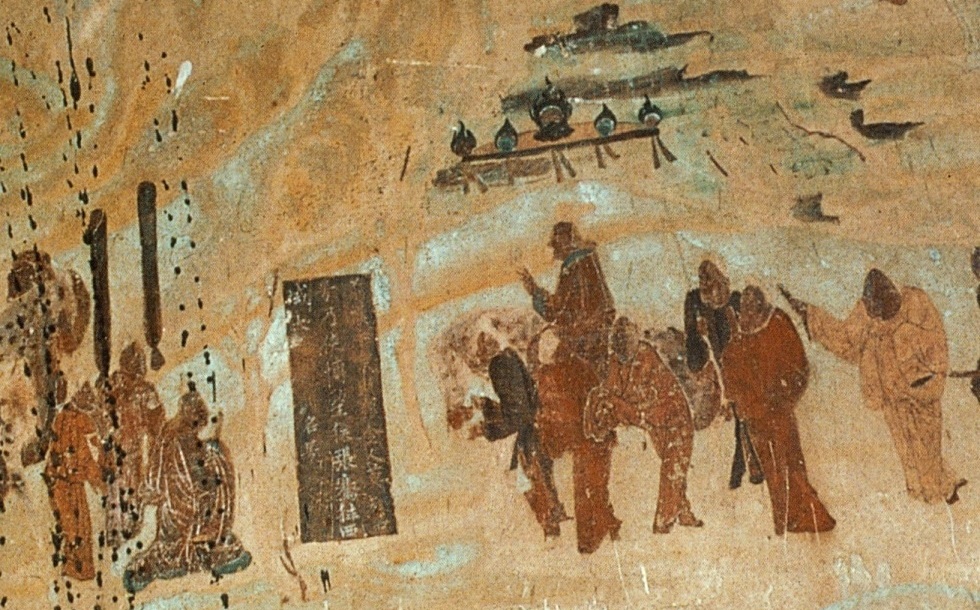
Around 138 BCE the Han emperor Wu sent an officer named Zhang Qian west to find the Yuezhi, a people driven from the Chinese borderlands by the Xiongnu, hoping to win them as allies. Zhang Qian was captured by the Xiongnu and held for about ten years. He escaped, reached the Yuezhi north of the Oxus around 128 BCE, failed to persuade them to fight, and returned to China in 126 BCE with reports on the lands of the far west.
He did not visit Parthia himself, but he learned a great deal about it. On a second mission, around 115 BCE, he sent deputies to several western states, including Anxi.

Anxi in the Chinese record
The historian Sima Qian, writing his Shiji around 100 BCE, preserves Zhang Qian’s description. Anxi, he writes, was a settled country of farmers growing rice and wheat and making wine from grapes, with several hundred cities large and small, the largest state in the region. It lay on a great river, the Oxus. Its merchants travelled by cart and by boat to neighbouring countries, sometimes several thousand li away. Its coins were made of silver and bore the face of the king, and when a king died new coins were struck with the face of his successor. Its people wrote horizontally on strips of leather.
Each of these details fits what is known from Parthian evidence: royal portrait drachms (see Parthian coins), Aramaic-derived writing on parchment, and the wine economy recorded at Nisa.
The embassy and the twenty thousand horsemen
The Shiji adds that when the first Han envoys arrived, the king of Anxi sent 20,000 horsemen to meet them at his eastern frontier, which lay several thousand li from his capital. On the way to the capital the envoys passed dozens of cities with dense populations. When they returned, Parthian envoys went with them to the Han court, bringing the eggs of great birds (ostriches) and conjurors from a western land the Chinese called Lixuan. The Parthian king at the time was Mithridates II.
A middleman empire
Silk was not carried by single caravans from China to Rome. It moved in stages, changing hands many times. Chinese goods reached Central Asian markets; from there merchants carried them through Merv and the Parthian highlands or by sea through India, and on to Mesopotamia and Syria. Parthia controlled the central overland stretch and part of the Persian Gulf route, and taxed everything that passed.
The Parthian Stations
A Greek text written around the turn of the era, the Parthian Stations of Isidore of Charax, lists the road stations across the empire from Zeugma on the Euphrates through Mesopotamia, Media, Hyrcania and Parthia to Merv and on to Arachosia, with the distances between them. It reads like an itinerary for official couriers or traders, and it is the best surviving picture of the Parthian road network.
Merchants and goods
Silk was only one product. China exported iron and lacquer goods as well as silk; Pliny the Elder ranked “Seric” (Chinese) iron first and Parthian iron second. From the west came glass, silver ware, coral, textiles and wine. In the late 1st century CE, Roman writers complained about the gold that flowed east to pay for luxury goods; Pliny put the cost of trade with India, the Seres (Chinese) and Arabia at 100 million sesterces a year.
Some goods carried a Parthian label in China. The pomegranate, for example, was called anshiliu, the “Anxi” or Parthian pomegranate.
In the 1st and 2nd centuries CE, much of the long-distance trade between Mesopotamia and the Mediterranean ran through the caravan city of Palmyra in the Syrian desert. Palmyrene inscriptions record merchants based in Parthian territory, at Vologesias near Seleucia and at Spasinou Charax at the head of the Persian Gulf.
Gan Ying and the closed door
In 97 CE the Chinese general Ban Chao sent an envoy, Gan Ying, to try to reach Da Qin, the Chinese name for the Roman world. According to the Hou Hanshu, Gan Ying reached the shores of a great sea on the western edge of Parthia. Parthian sailors told him the crossing could take from three months to two years with a good wind, and that travellers took provisions for three years. Gan Ying turned back.
Many historians think the Parthians discouraged him on purpose, to stop direct contact between China and Rome and protect their profitable position in the middle. Others point out that the warning may simply have been honest. Either way, Rome and Han China never established regular direct relations.
People as well as goods
The road also carried people and ideas. Roman soldiers captured at Carrhae in 53 BCE were settled in the Merv oasis, according to Pliny. In the 2nd century CE a Parthian prince who had become a Buddhist monk, known in Chinese as An Shigao, arrived in the Han capital Luoyang around 148 CE and became one of the first translators of Buddhist texts into Chinese. His surname, An, marked him as a man from Anxi.
For the land routes of later centuries and the inns built along them, see Persian caravanserais.
Persian words from this page
| جاده ابریشم | jâdde-ye abrisham | the Silk Road |
| ابریشم | abrisham | silk |
| کاروان | kârvân | caravan |
| بازرگان | bâzargân | merchant |
| انار | anâr | pomegranate |
| مرو | Marv | Merv |
| چین | Chin | China |
Sources and further reading
- Sima Qian, Shiji, chapter 123, “The Account of Dayuan”.
- Fan Ye, Hou Hanshu, chapter 88, “The Western Regions”.
- Isidore of Charax, Parthian Stations.
- Pliny the Elder, Natural History, Books 6, 12 and 34.
- Encyclopaedia Iranica, “Chinese-Iranian Relations” (section on the pre-Islamic period).
- Valerie Hansen, The Silk Road: A New History, 2012.
Want to learn Persian? Get the free Starter Pack
Get the 14-page printable Starter Pack (all 32 letters, a 7-day reading plan, 100 core words and 20 survival phrases) and a short 5-email course. Free.
More in The Parthian Empire (247 BCE–224 CE)
- The Parni and Arsaces I
- Nisa: The First Parthian Capital
- Mithridates I and the Making of an Empire
- Phraates II, Artabanus I and the Saka Invasions
- Mithridates II the Great
- The Parthians and the Silk Road
- Parthian Cavalry: Cataphracts and the Parthian Shot
- Surena and the Battle of Carrhae (53 BCE)
- Orodes II and Prince Pacorus
- Mark Antony’s Parthian War
- Phraates IV and the Peace with Augustus
- Queen Musa of Parthia
- Artabanus II of Parthia
- Gotarzes II and Vardanes: A Royal Rivalry
- Vologases I and the War over Armenia
- Trajan’s Invasion of Parthia
- Osroes I and the Parthian Civil Wars
- Roman Campaigns of the 2nd Century: Lucius Verus and Septimius Severus
- The Last Parthian Kings: Vologases V, Vologases VI and Artabanus IV
- The Fall of the Parthian Empire
- Ctesiphon: Capital of Two Empires
- The Great Houses of Parthia
- Religion and Culture in Parthian Iran
- Parthian Art and Architecture
- Parthian Coins and What They Tell Us
- Hatra: The City that Resisted Rome
- The Parthian Language and Its Records
- The Indo-Parthians and Kushans
- The Parthian Legacy