Artabanus II was king of Parthia from about 12 CE to about 38 CE, with at least one interruption. An outsider who came to the throne from Media Atropatene, he drove out the Roman-educated king Vonones I, fought a long diplomatic and military contest with the emperor Tiberius over Armenia, and survived two attempts to replace him before dying in office. His reign marked the end of the period in which Rome could choose Parthian kings.
| Reign | c. 12–38 CE (some scholars end it in 40/41); briefly deposed in 35–36 and again around 37 |
|---|---|
| Before the throne | King of Media Atropatene (northwestern Iran) |
| Family | Arsacid through his mother, generally taken to be a daughter of Phraates IV |
| Rivals | Vonones I; Tiridates III, backed by Tiberius; Kinnamos |
| Persian name | Ardavân (اردوان) |
| Numbering | Called Artabanus III in older books |
A king from the edge of the dynasty
When Phraates IV was murdered in 2 BCE, the Parthian court passed through a run of short, unhappy reigns: his son Phraataces and Queen Musa (told on the page Queen Musa of Parthia), then Orodes III, killed within a few years. The nobles then asked Rome to send back one of the princes Phraates had sent to Augustus as hostages. Vonones I arrived around 8 CE. Tacitus says the Parthians soon despised him for his Roman habits: he rarely hunted, had no interest in horses, was carried in a litter and surrounded himself with Greek companions.
The nobles who wanted him gone turned to Artabanus, then ruling Media Atropatene, the mountain kingdom whose name survives in modern Azerbaijan. Artabanus was an Arsacid only through his mother, and Tacitus reports that he had grown up among the Dahae, the steppe people east of the Caspian. His enemies later sneered at this. At his first attempt he was beaten, but he returned with a larger army and around 12 CE drove Vonones out. Vonones fled to Armenia, where he briefly made himself king.
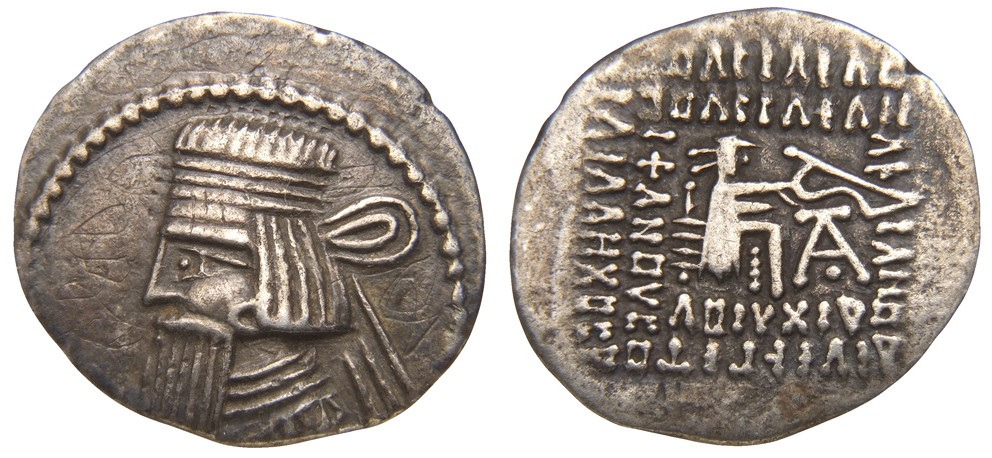

Settling with Rome, 12–19 CE
Tiberius had no wish for a war on Vonones’ behalf. The Roman governor of Syria removed him from Armenia and kept him under guard in Syria. In 18 CE Germanicus, sent east with wide powers, crowned a prince of Pontus, Zeno, as king of Armenia under the name Artaxias. Artabanus sent envoys to Germanicus to renew the old friendship between the empires and asked one favour: that Vonones be moved further from the Parthian border. Germanicus agreed and sent him to Cilicia, where in 19 CE he was killed while trying to escape.
With his rival dead and Armenia in the hands of a king both sides could accept, Artabanus had more than a decade without serious trouble from Rome. That period is poorly covered by the Roman historians, who wrote about Parthia mainly when it touched Roman affairs.
Governing the empire
Two pieces of evidence show Artabanus at work inside his realm. The first is a letter in Greek, inscribed on stone at Susa and dated to 21 CE, in which the king confirms the election of a city official whose appointment had been challenged. It shows a Parthian king dealing directly with the council of an old Greek city and respecting its procedures, while making clear that the final word was his.
The second comes from Josephus, who tells the story of two Jewish brothers, Asinaeus and Anilaeus, weavers from Nehardea in Babylonia who built up a private army and ruled a district of Mesopotamia for some years. According to Josephus, Artabanus received Asinaeus at court and, rather than fight him, entrusted him with keeping order in Babylonia. Whether every detail is true or not, the story fits what other evidence shows: the king ruled through local powers when he could not overrule them.
Artabanus also had to manage the great noble families, whose support he needed but whose loyalty was never secure. Their place in the Parthian state is described on The Great Houses of Parthia.
The crisis of 34–37 CE
Armenia and the letter to Tiberius
When Artaxias of Armenia died around 34 CE, Artabanus placed his own eldest son, Arsaces, on the Armenian throne. Tacitus says he then wrote to Tiberius in an insulting tone, demanded the treasure Vonones had left in Syria, and threatened to claim the old frontiers of the Persian and Macedonian empires. Modern historians take the letter as Tacitus presents it with caution, but the move into Armenia was real and broke the arrangement of 18 CE.
Tiberius strikes back
Tiberius answered with an indirect war. He sent a son of Phraates IV, also named Phraates, to claim the Parthian throne; when that prince died in Syria, he sent a grandson of Phraates IV, Tiridates. At the same time Rome encouraged Pharasmanes, king of Iberia in the Caucasus, to seize Armenia for his brother Mithridates. Arsaces was murdered by bribed servants, and an army under another son of Artabanus, Orodes, was defeated by the Iberians and their allies.
Then the Roman governor of Syria, Lucius Vitellius, brought legions to the Euphrates. Several leading Parthian nobles, already unhappy with Artabanus, went over to Tiridates. Artabanus fled east towards Hyrcania. In 36 CE Tiridates was crowned at Ctesiphon, and Tacitus records that the head of the house of Suren placed the diadem on his head, an old privilege of that family.
The return
Tiridates’ rule lasted only months. His supporters quarrelled, and Artabanus, gathering troops from the peoples of the steppe on the eastern frontier, marched back. Tiridates retreated to Syria without a fight. Having recovered his throne but lost Armenia, Artabanus came to terms. He met Vitellius on a bridge over the Euphrates, accepted that Armenia was outside his reach, and sent his son Darius to Rome as a hostage. Suetonius adds that he honoured the Roman standards and the images of the emperors. The ancient writers do not agree whether this meeting took place under Tiberius (Josephus) or soon after his death in 37 under Caligula (Suetonius and Dio Cassius).
Deposed again, restored again
Josephus reports one more crisis. The nobles, fearing Artabanus’ harshness, expelled him once more and chose a man named Kinnamos as king. Artabanus took refuge with Izates, the king of Adiabene in northern Mesopotamia, who negotiated his return with a promise that the nobles would be pardoned. Kinnamos gave up the crown, and Artabanus rewarded Izates with the city of Nisibis. Meanwhile the great city of Seleucia on the Tigris had broken away around 35 CE and stayed independent for about seven years.
Artabanus died around 38 CE, though some scholars place his death as late as 40 or 41. His sons and kinsmen at once began fighting over the succession; that story continues on Gotarzes II and Vardanes.
- c. 8 CE Vonones I returns from Rome to rule Parthia
- c. 12 CE Artabanus II drives out Vonones
- 18 CE Germanicus crowns Artaxias in Armenia; Artabanus negotiates with him
- 21 CE Artabanus’ letter to Susa
- c. 34–35 CE Arsaces, son of Artabanus, made king of Armenia, then murdered
- 36 CE Tiridates III crowned at Ctesiphon; Artabanus returns and recovers the throne
- c. 37 CE Meeting with Vitellius on the Euphrates
- c. 38 CE Death of Artabanus (or 40/41 on some reckonings)
How historians see Artabanus II
Most of what we know comes from Tacitus, who wrote a century later from a Roman point of view and portrays Artabanus as arrogant and cruel. Read against the grain, his account shows a capable ruler who outlasted every rival Rome sent against him. Vonones, Phraates and Tiridates all depended on Roman support, and all failed. After Artabanus, Rome stopped trying to impose its own candidates on the Parthian throne and argued instead about Armenia, which led to the settlement under Vologases I.
Historians also note what his reign shows about Parthian kingship: a king could be made by one group of nobles and unmade by another, and the founding Arsacid line counted for less than the support of the great houses and the armies of the eastern frontier. For the wider Roman-Iranian rivalry, see Persia and Rome: Seven Centuries of Rivalry.
Persian words from this page
| اردوان | Ardavân | Artabanus |
| اشکانیان | Ashkâniân | the Arsacids |
| ارمنستان | Armanestân | Armenia |
| فرات | Forât | the Euphrates |
| تیسفون | Tisfun | Ctesiphon |
| آذربایجان | Âzarbâyjân | Azerbaijan (ancient Media Atropatene) |
Sources and further reading
- Tacitus, Annals, books 2 and 6 (Vonones, Germanicus, the war of 35–36 CE)
- Josephus, Jewish Antiquities, books 18 and 20 (Asinaeus and Anilaeus; Izates of Adiabene)
- Suetonius, Caligula 14, and Dio Cassius, book 59 (the meeting with Vitellius)
- K. Schippmann, “Arsacids ii. The Arsacid dynasty”, Encyclopaedia Iranica
- A. D. H. Bivar, “The Political History of Iran under the Arsacids”, in The Cambridge History of Iran, vol. 3(1) (1983)
- Edward Dąbrowa, “The Arsacid Empire”, in T. Daryaee (ed.), The Oxford Handbook of Iranian History (2012)
Want to learn Persian? Get the free Starter Pack
Get the 14-page printable Starter Pack (all 32 letters, a 7-day reading plan, 100 core words and 20 survival phrases) and a short 5-email course. Free.
More in The Parthian Empire (247 BCE–224 CE)
- The Parni and Arsaces I
- Nisa: The First Parthian Capital
- Mithridates I and the Making of an Empire
- Phraates II, Artabanus I and the Saka Invasions
- Mithridates II the Great
- The Parthians and the Silk Road
- Parthian Cavalry: Cataphracts and the Parthian Shot
- Surena and the Battle of Carrhae (53 BCE)
- Orodes II and Prince Pacorus
- Mark Antony’s Parthian War
- Phraates IV and the Peace with Augustus
- Queen Musa of Parthia
- Artabanus II of Parthia
- Gotarzes II and Vardanes: A Royal Rivalry
- Vologases I and the War over Armenia
- Trajan’s Invasion of Parthia
- Osroes I and the Parthian Civil Wars
- Roman Campaigns of the 2nd Century: Lucius Verus and Septimius Severus
- The Last Parthian Kings: Vologases V, Vologases VI and Artabanus IV
- The Fall of the Parthian Empire
- Ctesiphon: Capital of Two Empires
- The Great Houses of Parthia
- Religion and Culture in Parthian Iran
- Parthian Art and Architecture
- Parthian Coins and What They Tell Us
- Hatra: The City that Resisted Rome
- The Parthian Language and Its Records
- The Indo-Parthians and Kushans
- The Parthian Legacy