Twice in the late 2nd century Roman armies marched down the Euphrates and sacked the Parthian capital Ctesiphon: under the co-emperor Lucius Verus in 165 CE and under Septimius Severus in late 197 or early 198 CE. Both wars began with Parthian attacks, both ended with Roman gains in northern Mesopotamia, and neither brought Rome any closer to ruling Iran. Together they weakened the Arsacid dynasty in the decades before its fall in 224 CE.
| First war | 161–166 CE: Vologases IV against Marcus Aurelius and Lucius Verus |
|---|---|
| Second war | 195 and 197–199 CE: Vologases V against Septimius Severus |
| Ctesiphon sacked | 165 CE (Avidius Cassius); 197/198 CE (Severus) |
| Roman gains | Dura-Europos and influence in Osrhoene (166); province of Mesopotamia with Nisibis (c. 198) |
| Main sources | Cassius Dio, books 71 and 75–76; Historia Augusta; Lucian; Herodian |
Vologases IV strikes first, 161 CE
The peace that followed Trajan’s failed conquest lasted more than forty years. It ended in 161 CE, the year Antoninus Pius died and Marcus Aurelius and Lucius Verus became joint emperors. The Parthian king Vologases IV (r. c. 147–191) moved quickly. He placed an Arsacid prince, Pacorus, on the throne of Armenia, which Rome claimed the right to approve.
The governor of Cappadocia, Severianus, marched into Armenia with a legion and was trapped at Elegeia. According to Cassius Dio, his force was surrounded and shot down by Parthian archers, and Severianus killed himself; the Greek satirist Lucian later mocked a fortune-teller who had promised him victory. The Parthians then defeated the governor of Syria, Attidius Cornelianus, and raided the Roman province. It was the worst crisis on the eastern frontier since Trajan’s day.
Lucius Verus and his generals, 162–166 CE
Marcus Aurelius stayed in Rome and sent his colleague Lucius Verus east in 162. Verus set up his headquarters at Antioch, and Roman writers complained that he spent much of the war at the pleasure gardens of Daphne. The fighting was done by professional commanders brought from the Danube and elsewhere.
In 163 Statius Priscus took Artaxata, the Armenian capital, and Rome installed a new king, Sohaemus. The decisive campaign came in Mesopotamia under Gaius Avidius Cassius, a Syrian-born general. In 164 and 165 his army defeated the Parthians near Dura-Europos on the Euphrates, advanced down the river, and reached the twin cities of Seleucia and Ctesiphon.
The burning of Seleucia
Seleucia, the great Greek city on the west bank of the Tigris, opened its gates to the Romans. Soon afterwards it was sacked and burned. Roman sources disagree on the reason: the Historia Augusta says the Romans broke faith, while others claim the citizens had plotted against the garrison. Ancient figures for the inhabitants killed or enslaved run into the hundreds of thousands and are not reliable, but Seleucia never recovered its former size. Across the river, Cassius destroyed the royal palace of Vologases at Ctesiphon.

The army brought back something worse than loot. A great epidemic, often called the Antonine Plague and probably smallpox, broke out among the troops in Mesopotamia around 165 and spread across the Roman Empire over the following years. Later Roman writers told a legend that it was released when soldiers broke into a shrine at Seleucia. The disease killed large numbers in Rome’s cities and armies, and it may have struck Parthia as well, though no Parthian source survives to say so.
In 166 Cassius raided into Media, and peace was made. Rome kept Dura-Europos, which became a Roman garrison town, and gained a strong position in Osrhoene around Edessa and Carrhae. Vologases IV kept his throne and the heart of his kingdom.
Septimius Severus: the first campaign, 195 CE
The next war grew out of a Roman civil war. In 193 Septimius Severus fought Pescennius Niger, the governor of Syria, for the empire. Niger asked the Parthians for help, and some eastern client rulers, including the kings of Osrhoene and Adiabene, sided with him and attacked the Roman garrison at Nisibis. After defeating Niger in 194, Severus crossed the Euphrates in 195 to punish them, took the titles Arabicus and Adiabenicus, and strengthened Roman control of northern Mesopotamia.
The second campaign and the sack of Ctesiphon, 197–198 CE
When Severus went west in 196–197 to fight another rival, Clodius Albinus, the Parthian king Vologases V (r. c. 191–208) counterattacked and besieged Nisibis. Severus returned in 197 and repeated Trajan’s route. A fleet carried his army down the Euphrates; Seleucia and Babylon were abandoned; and late in 197 or early in 198 the Romans took Ctesiphon.
Cassius Dio says Severus let his soldiers plunder the city, killed many of the men and took about 100,000 captives, a figure that is probably inflated but shows the scale of the disaster. On 28 January 198, a hundred years to the day after Trajan’s accession, Severus took the title Parthicus Maximus and raised his son Caracalla to the rank of co-emperor. Vologases fled east and kept his throne.
Severus then tried, twice, to take Hatra, the desert city that had already defeated Trajan. Both sieges, in 198 and 199, failed. Dio says the Roman soldiers, and Severus’s own European troops in particular, finally refused to make another assault. The story of the city is on the page Hatra: The City that Resisted Rome.
A new Roman province
The lasting result was a new province of Mesopotamia, centred on Nisibis and guarded by two new legions, I and III Parthica. Rome now held the upper Khabur and the plains between the two rivers, a salient that pushed deep toward the Tigris. Dio thought it a mistake, arguing that it brought Rome into constant wars with its eastern neighbours at great cost. Later events proved him largely right: the Sasanians fought for Nisibis for more than a century, until the treaty that followed Julian’s invasion in 363 gave the city to Persia.
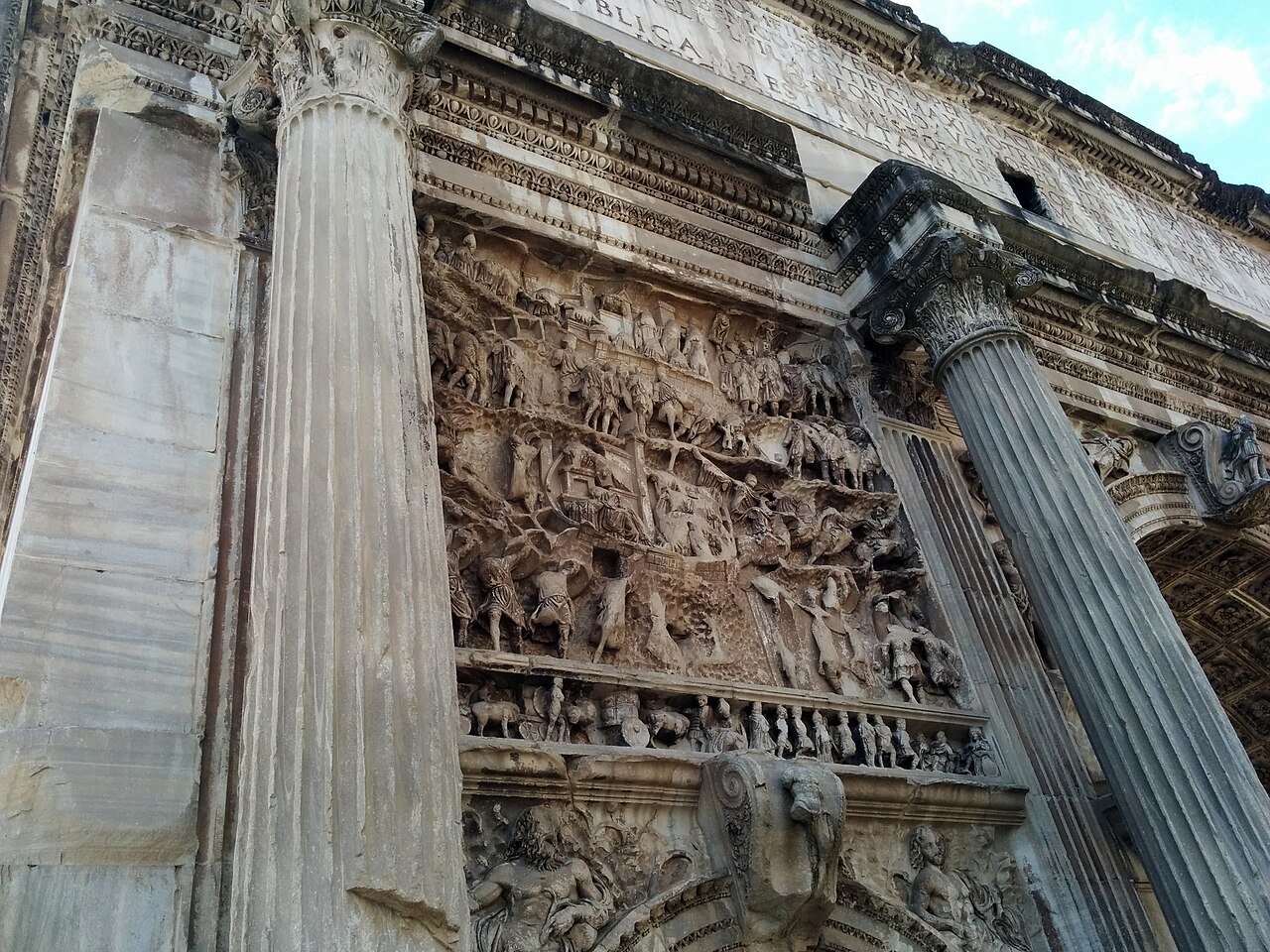
In Rome, the Senate dedicated a triumphal arch to Severus and his sons in the Forum in 203. Four large relief panels on it show scenes from the Parthian wars: armies on the march, siege engines against city walls, and the emperor addressing his troops. They are among the few surviving images of Roman campaigns in Mesopotamia.
Why Parthia could not stop the raids
Each time, the Roman route was the same: down the Euphrates by river, across to the Tigris near Seleucia and Ctesiphon, and back north before the summer heat and the Parthian cavalry made the position untenable. Mesopotamia was the richest part of the Arsacid realm, but the king’s power rested on the noble houses of the Iranian plateau, described on the page The Great Houses of Parthia. A king who could not protect his capital, though, lost prestige. The sack of 198, the loss of Nisibis and a disputed succession all prepared the ground for the crisis covered on the page The Last Parthian Kings.
- 161 CE Vologases IV places Pacorus in Armenia; Roman defeat at Elegeia
- 163 Statius Priscus takes Artaxata
- 165 Avidius Cassius sacks Seleucia and burns the palace at Ctesiphon
- 166 Peace; Rome keeps Dura-Europos
- 195 Severus’s first campaign in northern Mesopotamia
- 197/198 Severus sacks Ctesiphon
- 198–199 Two failed sieges of Hatra
- 203 Arch of Septimius Severus dedicated in Rome
Persian words from this page
| بلاش چهارم | Balâsh-e chahârom | Vologases IV |
| نصیبین | Nasibin | Nisibis |
| فرات | Forât | the Euphrates |
| طاعون | tâ’un | plague |
| امپراتور | emperâtur | emperor |
Sources and further reading
- Cassius Dio, Roman History 71.2 and 75.1–76.12.
- Lucian, How to Write History and Alexander the False Prophet.
- Herodian, History of the Empire book 3.
- Anthony R. Birley, Septimius Severus: The African Emperor (Routledge, rev. ed. 1999).
- Rose Mary Sheldon, Rome’s Wars in Parthia: Blood in the Sand (2010).
- Encyclopaedia Iranica, “Arsacids ii. The Arsacid dynasty” (K. Schippmann).
Want to learn Persian? Get the free Starter Pack
Get the 14-page printable Starter Pack (all 32 letters, a 7-day reading plan, 100 core words and 20 survival phrases) and a short 5-email course. Free.
More in The Parthian Empire (247 BCE–224 CE)
- The Parni and Arsaces I
- Nisa: The First Parthian Capital
- Mithridates I and the Making of an Empire
- Phraates II, Artabanus I and the Saka Invasions
- Mithridates II the Great
- The Parthians and the Silk Road
- Parthian Cavalry: Cataphracts and the Parthian Shot
- Surena and the Battle of Carrhae (53 BCE)
- Orodes II and Prince Pacorus
- Mark Antony’s Parthian War
- Phraates IV and the Peace with Augustus
- Queen Musa of Parthia
- Artabanus II of Parthia
- Gotarzes II and Vardanes: A Royal Rivalry
- Vologases I and the War over Armenia
- Trajan’s Invasion of Parthia
- Osroes I and the Parthian Civil Wars
- Roman Campaigns of the 2nd Century: Lucius Verus and Septimius Severus
- The Last Parthian Kings: Vologases V, Vologases VI and Artabanus IV
- The Fall of the Parthian Empire
- Ctesiphon: Capital of Two Empires
- The Great Houses of Parthia
- Religion and Culture in Parthian Iran
- Parthian Art and Architecture
- Parthian Coins and What They Tell Us
- Hatra: The City that Resisted Rome
- The Parthian Language and Its Records
- The Indo-Parthians and Kushans
- The Parthian Legacy