In 36 BCE Mark Antony led the largest Roman army yet sent against Parthia into Media Atropatene, in what is now Iranian Azerbaijan. The Parthian king Phraates IV destroyed his siege train, the siege of the Median royal city of Phraaspa failed, and Antony’s army lost about 24,000 men on a fighting retreat of 27 days. The campaign confirmed that Rome could not conquer Iran, and its failure weakened Antony in his struggle with Octavian.
| Date | Summer to late autumn 36 BCE |
|---|---|
| Theatre | Armenia and Media Atropatene (Iranian Azerbaijan) |
| Parthian king | Phraates IV, with the king of Media Atropatene, Artavasdes |
| Roman forces | About 60,000 legionaries, 10,000 Spanish and Gallic cavalry and 30,000 allies (Plutarch) |
| Key events | Destruction of the siege train; failed siege of Phraaspa; retreat to Armenia |
| Roman losses | About 20,000 infantry and 4,000 cavalry on the retreat (Plutarch), more in Armenia afterwards |
Why Antony attacked
After Carrhae and the Parthian invasion of Syria (see Orodes II and Prince Pacorus), Rome had a defeat to avenge and lost eagles to recover. Julius Caesar had planned a Parthian war before his murder. Antony, who controlled the Roman east after 40 BCE, took up the plan. A victory over Parthia would give him prestige that Octavian, his rival in the west, could not match.
The moment looked good. The new Parthian king, Phraates IV, had won the throne around 37 BCE by killing his father and brothers, and many nobles had fled. One of them, Monaeses, came to Antony, who gave him three Syrian towns to hold. Antony then sent him back to Parthia, apparently to negotiate, a move ancient writers found hard to explain.
An army of a hundred thousand
Plutarch gives Antony 60,000 Roman foot soldiers, 10,000 Spanish and Gallic cavalry and 30,000 allied troops. The king of Armenia, Artavasdes II, joined him with thousands more. These are large figures, but most historians accept that this was the biggest army Rome had yet sent east, and that Antony had learned from Crassus: he brought far more cavalry, and slingers whose lead bullets outranged the Parthian bows.
Instead of crossing the Mesopotamian plain, Antony marched north through Armenia and then turned south-east into Media Atropatene. This was a separate kingdom under its own king, also named Artavasdes, who was a vassal and ally of Phraates. The aim was to take its royal city and use it as a base, avoiding the open country where Crassus had died.

The siege train is lost
To move faster, Antony went ahead with the main army and left his siege equipment behind with two legions under Oppius Statianus. Plutarch says it filled 300 wagons and included a battering ram 80 feet long. Phraates and the Median king fell on the convoy with their cavalry, killed Statianus and about 10,000 men, and burned the machines. Polemon, the allied king of Pontus, was captured. The Armenian king, seeing the disaster, took his troops home.
The siege of Phraaspa
Antony was now in front of Phraaspa (also spelled Praaspa), the royal city of Media Atropatene, without the means to take it. Its exact site is unknown; scholars have proposed locations near Maragheh and around Takht-e Soleyman, but none is proved. The Romans tried to build siege mounds by hand. When the defenders made a sortie and some Roman troops fled, Antony punished the units by decimation, executing one man in ten.
Supplies were the real problem. Every foraging party had to fight off the Parthian cavalry, and autumn was coming. Antony won one open battle, but the Parthians simply withdrew, and Plutarch says the Romans found only about eighty enemy dead on the field. Phraates let it be known that he would allow the Romans to leave in peace. With winter approaching, Antony gave up the siege.
Twenty-seven days of retreat
Peace was not what the Romans got. On the advice of a local guide, Antony took a route through the hills, where the Parthians had less room for cavalry. Even so, Plutarch says, the army was attacked eighteen times in twenty-seven days.
- Against the arrows, the legionaries formed the testudo, the “tortoise”, kneeling behind a wall and roof of overlapping shields. When the Parthians thought the kneeling soldiers were exhausted and rode close, the legionaries rose and charged.
- Food ran out. Soldiers ate roots and plants they did not know, and Plutarch describes men poisoned by one plant that drove them mad before it killed them.
- Near the end, men drank from a salt stream and fell sick.
When they finally crossed a river into Armenia, Plutarch says, the soldiers wept and embraced one another. He gives the losses on the retreat as 20,000 infantry and 4,000 cavalry, more than half of them from disease. About 8,000 more died in the winter march through Armenia to the Syrian coast, where Cleopatra met Antony with money and clothes for the troops.
Aftermath: Armenia pays
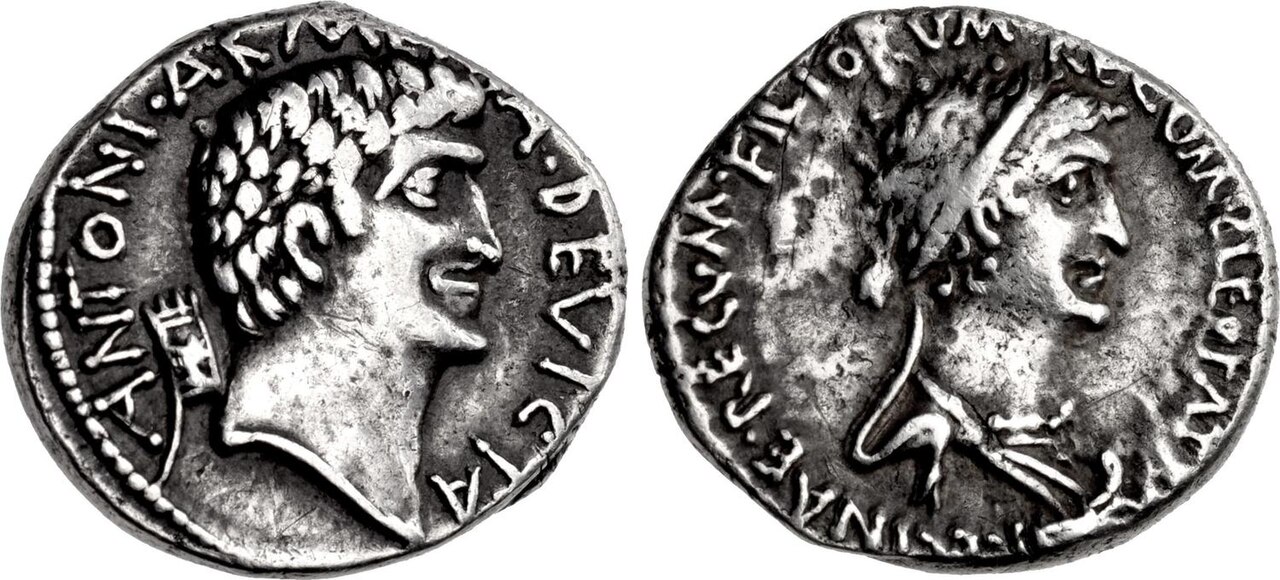
Antony did not admit defeat. He blamed the Armenian king for deserting him. In 34 BCE he invited Artavasdes II to a meeting, seized him and took him in chains to Alexandria, and occupied Armenia. That is the “conquest” celebrated on the coin above. Antony also made an alliance with the king of Media Atropatene, who had quarrelled with Phraates over the spoils, and betrothed his son by Cleopatra to the Median king’s daughter.
In the ceremony known as the Donations of Alexandria, Antony assigned Armenia, Media and Parthia itself to that same son, Alexander Helios. Octavian used such grants, and the defeat in Media, in his propaganda, and in Rome the war was remembered as a costly failure. After Antony’s defeat at Actium in 31 BCE, Phraates recovered his position, and Armenia returned to a ruler friendly to Parthia.
What the war showed
For historians, Antony’s campaign is the counterpart of Carrhae. Antony avoided Crassus’s mistakes and had a much larger and better-balanced army, yet still failed. The lesson was that Parthia could not be defeated quickly by a Roman army operating at the end of long supply lines in the Iranian highlands. Augustus drew that conclusion and chose diplomacy, which brought back the eagles of Carrhae without a war (see Phraates IV and the peace with Augustus). For how the Parthian cavalry fought, see Parthian cavalry: cataphracts and the Parthian shot.
Persian words from this page
| آذربایجان | Âzarbâyjân | Azerbaijan |
| آتورپاتکان | Âturpâtakân | Atropatene (Middle Persian name) |
| مراغه | Marâghe | Maragheh |
| تخت سلیمان | Takht-e Soleymân | Takht-e Soleyman |
| محاصره | mohâsere | siege |
| عقبنشینی | aqab-neshini | retreat |
| فرهاد چهارم | Farhâd-e chahârom | Phraates IV |
Sources and further reading
- Plutarch, Life of Antony, chapters 37 to 52.
- Cassius Dio, Roman History, Book 49.
- Velleius Paterculus, Roman History, Book 2.
- Encyclopaedia Iranica, “Atropatene”.
- Rose Mary Sheldon, Rome’s Wars in Parthia: Blood in the Sand, 2010.
- A. D. H. Bivar, “The Political History of Iran under the Arsacids”, The Cambridge History of Iran, vol. 3(1), 1983.
Want to learn Persian? Get the free Starter Pack
Get the 14-page printable Starter Pack (all 32 letters, a 7-day reading plan, 100 core words and 20 survival phrases) and a short 5-email course. Free.
More in The Parthian Empire (247 BCE–224 CE)
- The Parni and Arsaces I
- Nisa: The First Parthian Capital
- Mithridates I and the Making of an Empire
- Phraates II, Artabanus I and the Saka Invasions
- Mithridates II the Great
- The Parthians and the Silk Road
- Parthian Cavalry: Cataphracts and the Parthian Shot
- Surena and the Battle of Carrhae (53 BCE)
- Orodes II and Prince Pacorus
- Mark Antony’s Parthian War
- Phraates IV and the Peace with Augustus
- Queen Musa of Parthia
- Artabanus II of Parthia
- Gotarzes II and Vardanes: A Royal Rivalry
- Vologases I and the War over Armenia
- Trajan’s Invasion of Parthia
- Osroes I and the Parthian Civil Wars
- Roman Campaigns of the 2nd Century: Lucius Verus and Septimius Severus
- The Last Parthian Kings: Vologases V, Vologases VI and Artabanus IV
- The Fall of the Parthian Empire
- Ctesiphon: Capital of Two Empires
- The Great Houses of Parthia
- Religion and Culture in Parthian Iran
- Parthian Art and Architecture
- Parthian Coins and What They Tell Us
- Hatra: The City that Resisted Rome
- The Parthian Language and Its Records
- The Indo-Parthians and Kushans
- The Parthian Legacy