Parthian coins are small silver drachms and larger tetradrachms struck by the Arsacid kings from the 3rd century BCE to 228 CE, nearly all showing the king’s portrait on one side and a seated archer on the other. Because so few written records survive, they are the main evidence for the order of Parthian kings, the dates of their reigns and the civil wars between rivals. They are also among the most common ancient coins from Iran, so many readers can hold the evidence in their hand.
| Period | c. 3rd century BCE to 228 CE |
|---|---|
| Main coins | Silver drachm (about 4 g), struck at many mints; silver tetradrachm (about 16 g at first), struck only at Seleucia on the Tigris; bronze small change |
| Usual design | Obverse: the king’s bust. Reverse: a seated archer holding a bow |
| Legends | Greek, with Parthian letters added from the 1st century CE |
| Standard reference | David Sellwood, An Introduction to the Coinage of Parthia (1971; 2nd ed. 1980) |
| Persian word | درهم derham, from Greek drachma |
The archer and the king
The design of the Parthian drachm hardly changed in four centuries. On the front is the reigning king in profile, usually facing left, bearded and wearing a diadem, a band tied at the back of the head. Later kings often wear a tall domed tiara instead, decorated with pearls, stars, horns or stags. On the back sits an archer holding a bow. On the earliest coins he sits on an omphalos, the stone that Seleucid coins used as Apollo’s seat; later he sits on a throne. Most scholars take him to be Arsaces, the founder of the dynasty, shown as the model of the archer-horseman the Parthians admired.
The tetradrachms of Seleucia were more varied. Their reverses show the king enthroned, a goddess handing him a diadem or palm, the city goddess of Seleucia kneeling before him, or, on some coins of Mithridates I, the hero Herakles, a design taken over from Seleucid and Greco-Bactrian coins.
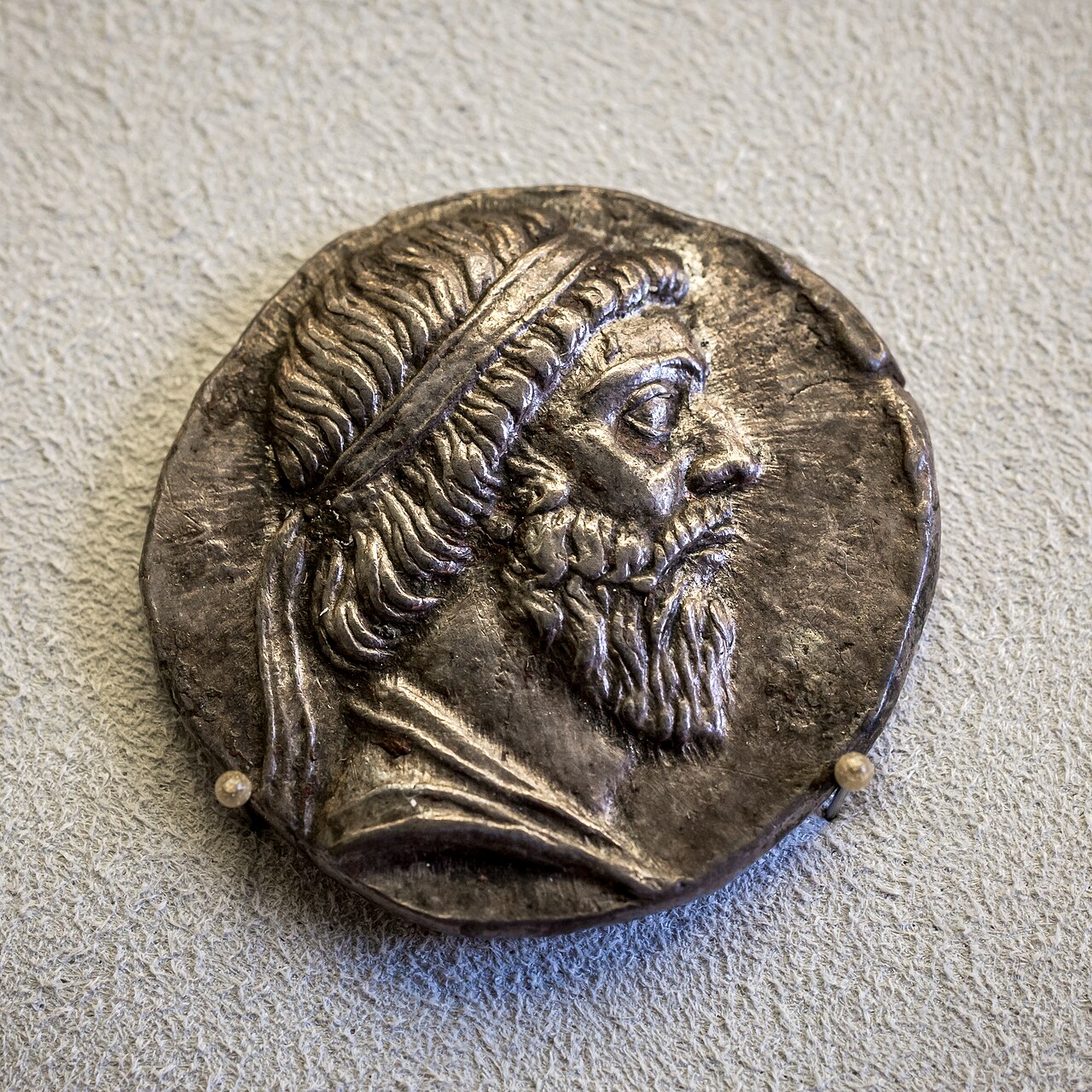

Every king is called Arsaces
The greatest problem with Parthian coins is that the kings almost never put their personal names on them. From the beginning to the end, the legend names the issuer as Arsaces: on the first coins simply ΑΡΣΑΚΟΥ, “of Arsaces”, later surrounded by a growing list of titles. Mithridates I added “Great King” and, as a sign of goodwill to the Greek cities he had conquered, ΦΙΛΕΛΛΗΝΟΣ, “friend of the Greeks”. Mithridates II took the old Achaemenid title ΒΑΣΙΛΕΩΣ ΒΑΣΙΛΕΩΝ, “King of Kings”. Other epithets such as “Benefactor”, “Just” and “Manifest” were mixed and repeated by king after king.
Numismatists therefore identify kings by everything except the name: the portrait and beard, the shape of the tiara, the combination of titles, the mint marks, the style of engraving and, where they exist, the dates. Sellwood’s system divided the coinage into about ninety types and assigned them to known kings. Many of these attributions are secure; others, especially for the 2nd century BCE and the crowded 1st century CE, are still debated. An international project, the Sylloge Nummorum Parthicorum, is publishing the coins of the major collections to refine them.
Dated coins and the chronology of kings
The tetradrachms of Seleucia are the historian’s best tool because they carry a date in the Seleucid era, which began in 312/311 BCE, and often the month as well. A king’s first and last dated coins give the outside limits of his control of Mesopotamia. Coins of two kings in the same year show a civil war.
Examples run through this section of the site. In 26 BCE a rival named Tiridates struck dated tetradrachms at Seleucia while Phraates IV was driven out, then the coins of Phraates resume. The coins of Phraataces with his mother as co-ruler are the main evidence for Queen Musa. Osroes II is known only from coins, and the last dated coin of Vologases VI, from year 539 of the Seleucid era (227/228 CE), shows an Arsacid still ruling in Mesopotamia years after Artabanus IV was killed; see The Last Parthian Kings and Osroes I and the Parthian Civil Wars.
Mints across the empire
Drachms were struck at many cities, and small monograms or abbreviated names in the field of the coin tell experts which mint produced them. Important mints included Ecbatana (modern Hamadan), the most productive for most of the period, Rhagae near modern Tehran, Mithradatkart near Nisa, Susa and Seleucia. The spread of mints, and the sudden appearance of a king’s coins at only one of them, can show which provinces a ruler held. A claimant whose drachms come only from Ecbatana probably controlled Media and little else.
From Greek to Parthian
The Greek legends tell their own story. In the 2nd and 1st centuries BCE they are clear and well cut. From the 1st century CE the lettering becomes increasingly stylised and often garbled, to the point where some legends are rows of strokes that only imitate Greek. Die cutters were copying a form they no longer read. At the same time Parthian, written in a script derived from Aramaic, appears on the coins. Under Vologases I the first letters of his name, wl, were added beside the portrait, and later kings used fuller Parthian legends. The change mirrors the wider shift in Parthian culture described on The Parthian Language and Its Records.
The metal changed too. The tetradrachm of the late 2nd century CE contains much less silver than its predecessors, which reflects the strain that Roman wars and civil conflict placed on the treasury.
What coins cannot tell us
Coins show who struck money, where and sometimes when. They rarely say why. A short reign on the coins may hide a long struggle, and portraits follow conventions, so they are not reliable likenesses. Mint attributions and the sequence of undated drachm types rest partly on judgement of style, and specialists still disagree over the order of several kings. Historians use the coins alongside Roman and Chinese writers, the Babylonian astronomical diaries and the few Parthian documents to build a chronology that is much firmer than it was a century ago, but far from complete.
For coins in Iran before and after the Parthians, from the Achaemenid daric to the modern rial, see Coins of Iran through History.
Persian words from this page
| سکه | sekke | coin |
| درهم | derham | dirham, from Greek drachma |
| دینار | dinâr | dinar, from Latin denarius |
| نقره | noqre | silver |
| کمان | kamân | bow |
| تاج | tâj | crown |
Sources and further reading
- David Sellwood, An Introduction to the Coinage of Parthia, 2nd ed. (1980)
- David Sellwood, “Parthian Coins”, in The Cambridge History of Iran, vol. 3(1) (1983)
- Warwick Wroth, Catalogue of the Coins of Parthia, British Museum (1903)
- Fabrizio Sinisi, Sylloge Nummorum Parthicorum, vol. 7: Vologases I – Pacorus II (2012)
- K. Schippmann, “Arsacids ii. The Arsacid dynasty”, Encyclopaedia Iranica
Want to learn Persian? Get the free Starter Pack
Get the 14-page printable Starter Pack (all 32 letters, a 7-day reading plan, 100 core words and 20 survival phrases) and a short 5-email course. Free.
More in The Parthian Empire (247 BCE–224 CE)
- The Parni and Arsaces I
- Nisa: The First Parthian Capital
- Mithridates I and the Making of an Empire
- Phraates II, Artabanus I and the Saka Invasions
- Mithridates II the Great
- The Parthians and the Silk Road
- Parthian Cavalry: Cataphracts and the Parthian Shot
- Surena and the Battle of Carrhae (53 BCE)
- Orodes II and Prince Pacorus
- Mark Antony’s Parthian War
- Phraates IV and the Peace with Augustus
- Queen Musa of Parthia
- Artabanus II of Parthia
- Gotarzes II and Vardanes: A Royal Rivalry
- Vologases I and the War over Armenia
- Trajan’s Invasion of Parthia
- Osroes I and the Parthian Civil Wars
- Roman Campaigns of the 2nd Century: Lucius Verus and Septimius Severus
- The Last Parthian Kings: Vologases V, Vologases VI and Artabanus IV
- The Fall of the Parthian Empire
- Ctesiphon: Capital of Two Empires
- The Great Houses of Parthia
- Religion and Culture in Parthian Iran
- Parthian Art and Architecture
- Parthian Coins and What They Tell Us
- Hatra: The City that Resisted Rome
- The Parthian Language and Its Records
- The Indo-Parthians and Kushans
- The Parthian Legacy