On Parthia’s eastern frontier, two powers rose in the 1st century CE. The Indo-Parthians, a dynasty of Parthian origin founded by Gondophares I (c. 19–46 CE), ruled Sistan, Arachosia and much of what is now Pakistan. The Kushans, who came from the Yuezhi peoples of Bactria, then took most of the Indo-Parthian lands and built an empire from Central Asia to the Ganges. Both mattered to Iran: they shaped the trade routes, the frontier wars of the Arsacids and, later, the eastern conquests of the Sasanians.
| Indo-Parthian kingdom | c. 19 CE to the late 1st century CE, with successors in Sistan and the Indus delta later |
|---|---|
| Founder | Gondophares I (c. 19–46 CE) |
| Main regions | Sistan (Drangiana), Arachosia (around Kandahar), Gandhara and the Punjab, with Taxila as a major city |
| Kushan Empire | 1st–3rd centuries CE |
| Key Kushan kings | Kujula Kadphises, Vima Takto, Vima Kadphises, Kanishka I (accession c. 127 CE on the most widely accepted dating) |
| Sasanian conquest | The western Kushan lands became the province of Kushanshahr in the 3rd century |
Sakas in Sistan
The story begins with the nomad invasions of the late 2nd century BCE, told on Phraates II, Artabanus I and the Saka Invasions. After Mithridates II stopped the Saka in eastern Iran, many of them settled in Drangiana, the basin of the Helmand river. The region took their name: Sakastan, “land of the Saka”, which became Sistan. Other Saka groups moved on into the Indus valley, where rulers such as Maues and Azes founded what historians call the Indo-Scythian kingdoms.
Sistan was also the home territory of the house of Suren, one of the great Parthian noble families. Some historians, following Ernst Herzfeld, have linked the Indo-Parthian dynasty to the Surens, but this is a hypothesis rather than an established fact; see The Great Houses of Parthia.
Gondophares I and the Indo-Parthians
Around 19 or 20 CE a ruler named Gondophares, of Parthian origin and probably from a line of local princes in Drangiana, began to build a kingdom that stretched from Sistan and Arachosia into Gandhara and the Punjab, taking over lands of the Indo-Scythian kings. His coins call him “Great King of Kings” in Greek and in Kharoshthi, an Indian script, and show him in Parthian dress, sometimes on horseback with Victory flying behind him. Many local rulers seem simply to have switched their allegiance to him, so his kingdom was large but loosely held.
The most important inscription of his reign was found at Takht-i-Bahi, a Buddhist monastery near Mardan in northern Pakistan. It is dated in the 26th year of the king and in the year 103 of an older era, a combination that has let historians place the start of his reign around 19–20 CE.
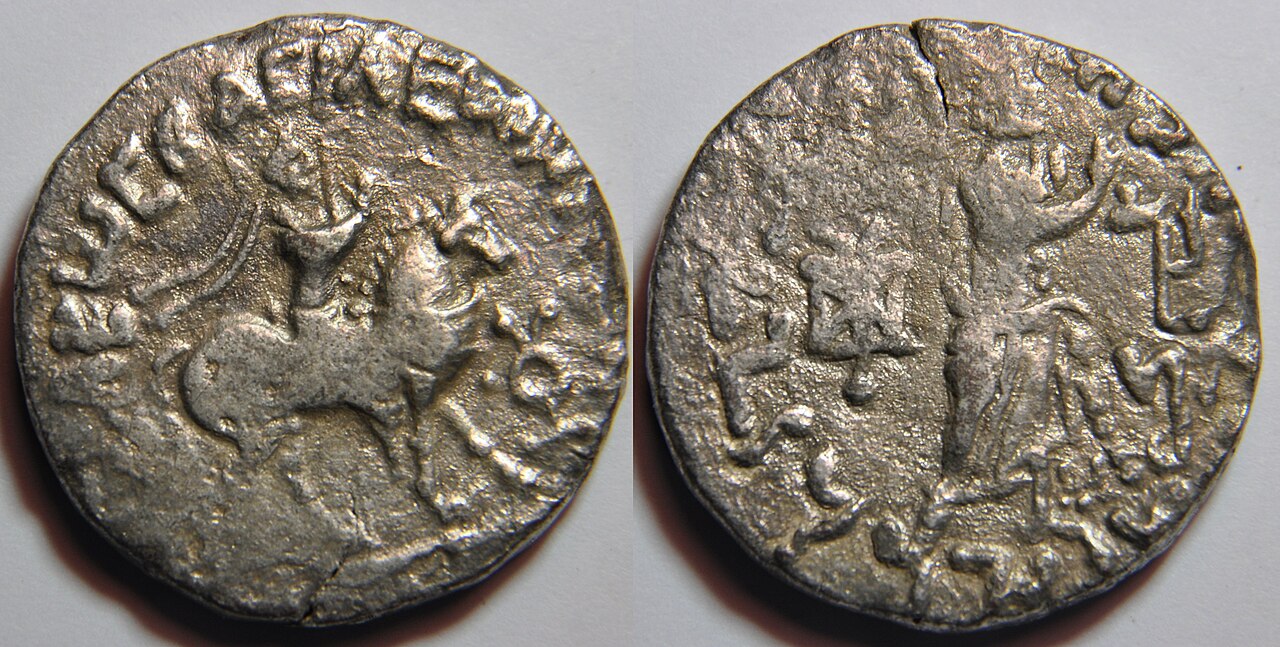

The apostle and the king
Gondophares became famous in Europe for another reason. The Acts of Thomas, a Christian text of the 3rd century, tells that the apostle Thomas was sold as a slave carpenter to an Indian king named Gundaphorus, who ordered a palace from him; Thomas gave the money to the poor and so, in the story, built the king a palace in heaven. When coins of Gondophares were identified in the 19th century, scholars realised that the king of the legend had a real model. That does not prove Thomas went to India, which remains a matter of faith and tradition, but it shows that the author knew the name of a real 1st-century ruler of the region.
After Gondophares
Gondophares’ successors, including his nephew Abdagases and kings named Gondophares-Sases and Pacores, ruled a shrinking realm. Philostratus’ Life of Apollonius of Tyana describes a Parthian-style king at Taxila in the mid-1st century, though its details are more literary than historical. The Periplus of the Erythraean Sea, a Greek guide for merchants written in the 1st century CE, reports that the lower Indus was ruled by Parthian princes who were constantly driving each other out. By then the Kushans had taken the north.
The rise of the Kushans
The Kushans were one branch of the Yuezhi, a people who had been driven west from the borderlands of China by the Xiongnu in the 2nd century BCE and settled in Bactria, the region of Balkh in modern northern Afghanistan. The Chinese history of the Later Han dynasty, the Hou Hanshu, says that the chief of the Kushan tribe, called Qiujiuque in Chinese and identified with Kujula Kadphises, united the five Yuezhi groups, attacked Anxi (Parthia) and took the region of Kabul, and then conquered lands to the south. This is the clearest written evidence for direct fighting between Parthians and Kushans.
His successors Vima Takto and Vima Kadphises extended Kushan rule into northern India, and Vima Kadphises issued large gold coins. Under Kanishka I in the 2nd century the empire reached its greatest size, from Bactria to the Ganges plain. The Rabatak inscription, found in Afghanistan in 1993, is written in Bactrian, an Iranian language in Greek letters, and records Kanishka’s conquests and his decision to use “Aryan”, meaning Bactrian, in place of Greek. Kanishka is also remembered in Buddhist tradition as a great patron, and the Kushan period saw the flowering of Gandharan Buddhist art.
Iranian gods on Kushan coins
Kushan coins show how Iranian the culture of these rulers was. Alongside Greek, Indian and Buddhist figures, they carry Iranian deities with Bactrian names: Miiro, the god Mithra; Athsho, the god of fire; Pharro, the personification of royal glory; and Oado, the wind. Persian learners will recognise these: Mithra is modern Persian mehr, fire is âtash, and the royal glory is farr, the divine radiance of kings in the Shahnameh.
Parthia’s eastern frontier
Roman writers, who supply most of our narrative, say little about Parthia’s eastern wars, but there are hints. Tacitus describes Vardanes pushing east to a river that divided the Dahae from the Arians (see Gotarzes II and Vardanes), and Vologases I was distracted from the Roman war by revolts in Hyrcania. In the 2nd century Vologases III is thought to have strengthened the east in response to the growth of Kushan power, one of the burdens of the divided reign described on Osroes I and the Parthian Civil Wars. The Kushans also controlled key stretches of the overland trade between China, India and the West, which made them partners as well as rivals; see The Parthians and the Silk Road.
The Sasanian conquest of the east
The Sasanians ended the balance. Al-Tabari reports that the kings of the Kushans, of Turan and of Makran submitted to Ardashir I. Shapur I’s inscription on the Ka’ba-ye Zartosht lists Kushanshahr, “the land of the Kushans”, as far as Peshawar among his provinces. From the later 3rd century Sasanian princes ruled the western Kushan lands as Kushanshahs and struck coins in Kushan style. The Kushan kings kept power further east in India for some time, but their empire was broken. See Ardashir I and The Ka’ba-ye Zartosht Inscription of Shapur I.
Disputed dates
The chronology of these kingdoms rests on coins, a few inscriptions dated in eras whose starting points are uncertain, and Chinese and Greek notices. The date of Kanishka’s accession was argued over for a century, with proposals ranging from 78 CE to the 2nd century; most specialists now follow Harry Falk’s date of about 127 CE. The order and dates of the later Indo-Parthian kings are also uncertain. For the wider relationship, see Iran and India through History.
Persian words from this page
| سیستان | Sistân | Sistan, “land of the Saka” |
| کوشان | Kushân | the Kushans |
| بلخ | Balkh | Balkh, ancient Bactra |
| قندهار | Qandahâr | Kandahar |
| مهر | mehr | Mithra; also love, kindness |
| آتش | âtash | fire |
| فر | farr | royal glory |
Sources and further reading
- Hou Hanshu, chapter 88 (the Western Regions), trans. John E. Hill, Through the Jade Gate to Rome (2009)
- The Periplus Maris Erythraei, ed. and trans. Lionel Casson (1989)
- A. D. H. Bivar, “Gondophares and the Indo-Parthians”, in V. S. Curtis and S. Stewart (eds.), The Age of the Parthians (2007)
- Nicholas Sims-Williams and Joe Cribb, “A New Bactrian Inscription of Kanishka the Great”, Silk Road Art and Archaeology 4 (1996)
- Harry Falk, “The yuga of Sphujiddhvaja and the era of the Kuṣāṇas”, Silk Road Art and Archaeology 7 (2001)
- Encyclopaedia Iranica, “Kushan Dynasty”
Want to learn Persian? Get the free Starter Pack
Get the 14-page printable Starter Pack (all 32 letters, a 7-day reading plan, 100 core words and 20 survival phrases) and a short 5-email course. Free.
More in The Parthian Empire (247 BCE–224 CE)
- The Parni and Arsaces I
- Nisa: The First Parthian Capital
- Mithridates I and the Making of an Empire
- Phraates II, Artabanus I and the Saka Invasions
- Mithridates II the Great
- The Parthians and the Silk Road
- Parthian Cavalry: Cataphracts and the Parthian Shot
- Surena and the Battle of Carrhae (53 BCE)
- Orodes II and Prince Pacorus
- Mark Antony’s Parthian War
- Phraates IV and the Peace with Augustus
- Queen Musa of Parthia
- Artabanus II of Parthia
- Gotarzes II and Vardanes: A Royal Rivalry
- Vologases I and the War over Armenia
- Trajan’s Invasion of Parthia
- Osroes I and the Parthian Civil Wars
- Roman Campaigns of the 2nd Century: Lucius Verus and Septimius Severus
- The Last Parthian Kings: Vologases V, Vologases VI and Artabanus IV
- The Fall of the Parthian Empire
- Ctesiphon: Capital of Two Empires
- The Great Houses of Parthia
- Religion and Culture in Parthian Iran
- Parthian Art and Architecture
- Parthian Coins and What They Tell Us
- Hatra: The City that Resisted Rome
- The Parthian Language and Its Records
- The Indo-Parthians and Kushans
- The Parthian Legacy