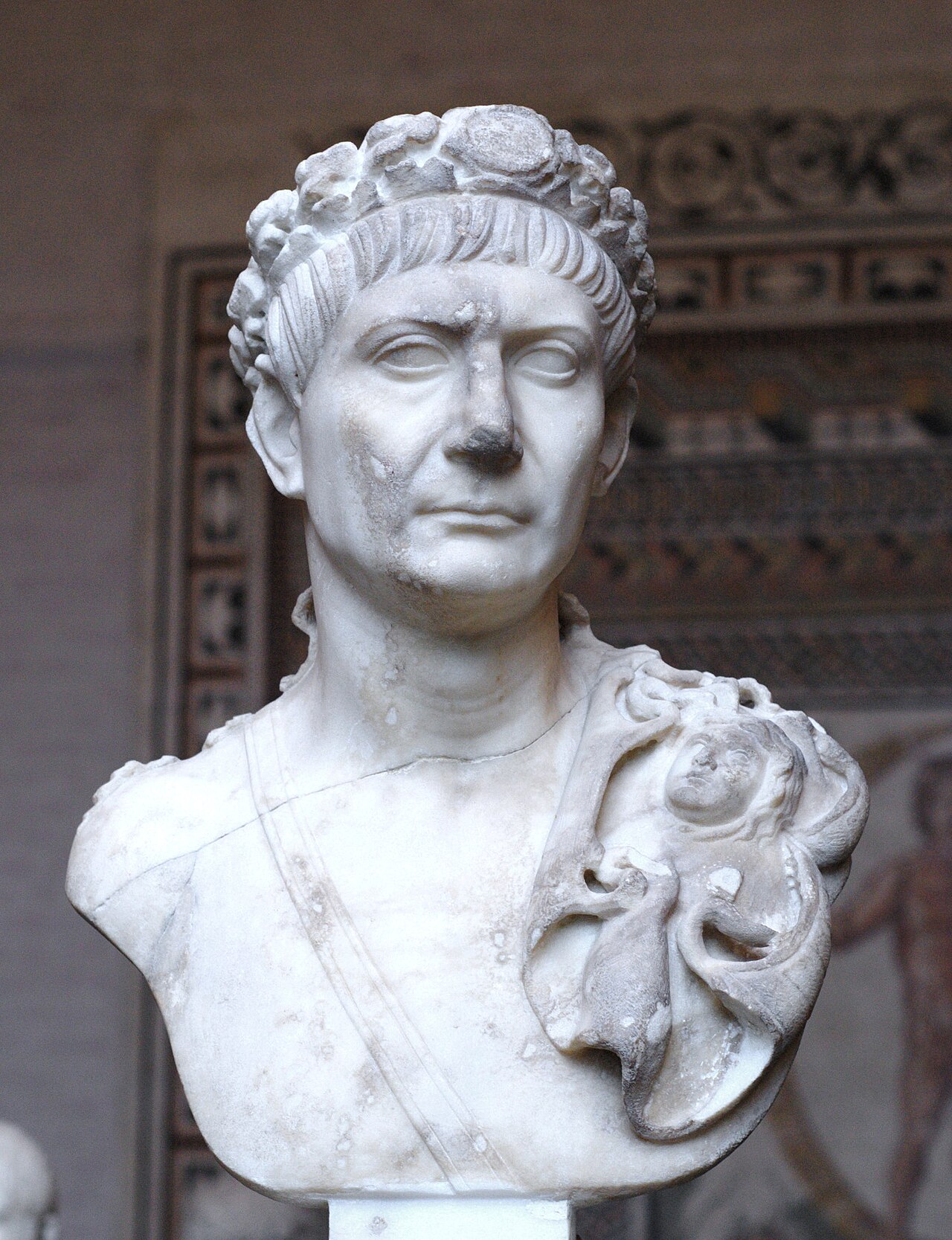
Between 114 and 117 CE the Roman emperor Trajan invaded the Parthian Empire, annexed Armenia and northern Mesopotamia, captured the capital Ctesiphon and reached the Persian Gulf. The conquest collapsed almost at once: revolts broke out behind his lines, he failed to take the desert city of Hatra, and after his death in 117 his successor Hadrian gave the new provinces back. It was the deepest Roman advance into Parthian territory, and it showed that Rome could defeat Parthian armies but could not hold Mesopotamia.
| Date | Trajan leaves Rome autumn 113; campaigns 114–117 CE |
|---|---|
| Roman emperor | Trajan (r. 98–117) |
| Parthian king | Osroes I, contested by Vologases III |
| Cause | Osroes replaced the king of Armenia without Roman approval |
| Furthest point | Charax Spasinou, at the head of the Persian Gulf |
| Result | Conquests abandoned by Hadrian, 117–118 CE; Euphrates frontier restored |
The pretext: a new king for Armenia
Since the agreement of 63 CE, Armenia had been ruled by an Arsacid prince who received his crown from Rome. The arrangement is described on the page Vologases I and the War over Armenia. Around 113 CE the Parthian king Osroes I removed the Armenian king Axidares and installed another prince, Parthamasiris, without asking Rome.
Trajan treated this as a breach of the treaty. Roman writers of the time, and Cassius Dio after them, suggest that he also wanted glory: he had already conquered Dacia, and he admired Alexander the Great. Modern historians add strategic reasons, such as control of the trade routes through Mesopotamia and the weakness of a Parthian kingdom divided between rival kings. Osroes ruled the west, while Vologases III held much of the Iranian plateau. That rivalry is covered on the page Osroes I and the Parthian Civil Wars.
Armenia annexed, 114 CE
Trajan left Rome in October 113. At Athens, envoys from Osroes offered to settle the matter and asked that Parthamasiris be confirmed as king. Trajan refused to give an answer. In 114 he marched into Armenia with a very large army. At Elegeia, Parthamasiris came to his camp and laid his diadem at the emperor’s feet, expecting to receive it back as Tiridates had from Nero. Instead Trajan declared that Armenia would become a Roman province. Parthamasiris was sent away under escort and killed on the road. Even Roman writers found the episode shameful.

Into Mesopotamia, 115 CE
From Armenia, Trajan turned south. In 115 his forces took Nisibis and Batnae, and the small kingdoms of northern Mesopotamia, such as Osrhoene with its capital Edessa, submitted. The Senate had already voted him the title Optimus (“the best”) in 114. That winter he was at Antioch in Syria when a great earthquake struck the city in December 115; he escaped through a window.
Ctesiphon and the Persian Gulf, 116 CE
In 116 the Romans crossed the Tigris into Adiabene and then moved down the rivers with a fleet, partly built from timber cut in the forests near Nisibis. Seleucia and Babylon fell, and Trajan entered Ctesiphon, the Parthian winter capital. Osroes had fled, but the Romans captured one of his daughters and the royal golden throne. Trajan took the title Parthicus, and coins were struck in Rome with the legend PARTHIA CAPTA, “Parthia captured”.
He then sailed down the Tigris to Charax Spasinou, capital of the kingdom of Characene near the head of the Persian Gulf, whose king submitted. Cassius Dio tells how Trajan watched a ship setting out for India and said that if he were younger he would have gone on to India like Alexander. The story may be literary, but it captures how his contemporaries saw the campaign: as an attempt to repeat the Macedonian conquest of the East. The background of Ctesiphon itself is on the page Ctesiphon: Capital of Two Empires.
The revolt behind the lines
The empire Trajan had overrun was not beaten. While he was in the south, cities across Mesopotamia rose against their Roman garrisons, and Parthian forces counterattacked. One Roman general, Appius Maximus Santra, was defeated and killed. Sanatruces, a nephew of Osroes, led resistance in the north before he too was killed. At the same time a great Jewish revolt, which had begun in Cyrenaica and Egypt in 115, spread to the large Jewish communities of Mesopotamia, who had lived under Parthian rule for centuries.
Trajan sent his best commanders to restore control. Lusius Quietus, a Moorish cavalry general, recaptured Nisibis and sacked Edessa. Erucius Clarus and Julius Alexander took Seleucia and burned it. To give the conquest a local face, Trajan crowned Parthamaspates, a son of Osroes who had come over to the Romans, as king of Parthia at Ctesiphon, in a ceremony commemorated on coins as REX PARTHIS DATUS, “a king given to the Parthians”.
Hatra and the retreat, 117 CE
On the way back north Trajan attacked Hatra, a fortified Arab city in the desert west of the Tigris that remained loyal to Parthia. Dio describes the conditions: there was little water or timber, the heat was intense, and swarms of flies spoiled the soldiers’ food. Hatra’s cavalry nearly killed Trajan himself, who was recognised by his grey hair. The siege failed. The city’s later history is covered on the page Hatra: The City that Resisted Rome.
Trajan, now ill, set out for Rome and died at Selinus in Cilicia in August 117. Hadrian, who succeeded him, quickly abandoned the provinces of Mesopotamia and Assyria and returned Armenia to its status as a client kingdom. Parthamaspates was dropped as king of Parthia and given Osrhoene instead. Osroes recovered Ctesiphon. Hadrian later returned Osroes’s captured daughter, though not, according to the Historia Augusta, the golden throne.
What the invasion meant
From the Parthian side, the war is almost silent: no Parthian narrative survives, and the evidence comes from Roman authors, coins and inscriptions. What it shows is that the Arsacid state could lose its capital and still survive, because power rested on the great noble houses of the Iranian plateau rather than on the cities of Mesopotamia. Rome would repeat the pattern twice more, under Lucius Verus and Septimius Severus, each time capturing Ctesiphon and never holding the lands beyond the Euphrates for long.
- c. 113 CE Osroes I installs Parthamasiris in Armenia
- Oct 113 Trajan leaves Rome for the East
- 114 Armenia annexed; Parthamasiris killed
- 115 Northern Mesopotamia occupied; earthquake at Antioch
- 116 Fall of Ctesiphon; Trajan at the Persian Gulf; revolts break out
- 117 Parthamaspates crowned; failed siege of Hatra; Trajan dies in August
- 117–118 Hadrian abandons the new provinces
Persian words from this page
| تیسفون | Tisfun | Ctesiphon |
| خسرو | Khosrow | Osroes (the same Iranian name) |
| دجله | Dejle | the Tigris |
| خلیج فارس | Khalij-e Fârs | the Persian Gulf |
| میانرودان | Miyânrudân | Mesopotamia |
| هترا | Hatrâ | Hatra |
Sources and further reading
- Cassius Dio, Roman History 68.17–33.
- Historia Augusta, Life of Hadrian 5 and 13.
- Julian Bennett, Trajan: Optimus Princeps (Routledge, 2nd ed. 2001).
- F. A. Lepper, Trajan’s Parthian War (Oxford, 1948).
- Encyclopaedia Iranica, “Arsacids ii. The Arsacid dynasty” (K. Schippmann).
Want to learn Persian? Get the free Starter Pack
Get the 14-page printable Starter Pack (all 32 letters, a 7-day reading plan, 100 core words and 20 survival phrases) and a short 5-email course. Free.
More in The Parthian Empire (247 BCE–224 CE)
- The Parni and Arsaces I
- Nisa: The First Parthian Capital
- Mithridates I and the Making of an Empire
- Phraates II, Artabanus I and the Saka Invasions
- Mithridates II the Great
- The Parthians and the Silk Road
- Parthian Cavalry: Cataphracts and the Parthian Shot
- Surena and the Battle of Carrhae (53 BCE)
- Orodes II and Prince Pacorus
- Mark Antony’s Parthian War
- Phraates IV and the Peace with Augustus
- Queen Musa of Parthia
- Artabanus II of Parthia
- Gotarzes II and Vardanes: A Royal Rivalry
- Vologases I and the War over Armenia
- Trajan’s Invasion of Parthia
- Osroes I and the Parthian Civil Wars
- Roman Campaigns of the 2nd Century: Lucius Verus and Septimius Severus
- The Last Parthian Kings: Vologases V, Vologases VI and Artabanus IV
- The Fall of the Parthian Empire
- Ctesiphon: Capital of Two Empires
- The Great Houses of Parthia
- Religion and Culture in Parthian Iran
- Parthian Art and Architecture
- Parthian Coins and What They Tell Us
- Hatra: The City that Resisted Rome
- The Parthian Language and Its Records
- The Indo-Parthians and Kushans
- The Parthian Legacy