Mithridates II (ruled c. 124/123 to c. 91 BCE) rebuilt the Parthian Empire after the nomad invasions that had killed two kings, and made it the dominant power between the Euphrates and Central Asia. He took the old Achaemenid title “King of Kings”, placed Tigranes on the throne of Armenia, received envoys from Han China and, around 96 BCE, held the first official meeting between Parthia and Rome.
| Reign | c. 124/123 to c. 91 BCE (some historians extend it to 88/87) |
|---|---|
| Father | Probably Artabanus I |
| Title | Basileus Basileon, “King of Kings”, from c. 109 BCE |
| Main achievements | Victory over the Saka; recovery of Babylonia; control of Armenia; frontier on the Euphrates |
| First contact with Rome | Meeting with Sulla on the Euphrates, c. 96 BCE (date debated) |
| Monument | Rock relief at Bisotun, now badly damaged |
Restoring the east
Mithridates inherited a crisis. His two predecessors had died fighting nomads in the north-east (see Phraates II, Artabanus I and the Saka invasions), and the ruler of Characene had seized Babylon. Within a few years he had reversed both losses. Justin says he avenged his ancestors on the Scythians, and Saka groups settled in Drangiana now accepted Parthian overlordship. In the south, Babylonia was recovered and Characene became a vassal kingdom again.
West to the Euphrates
He then pushed west. Parthian control reached the middle Euphrates, and the Greek town of Dura-Europos on the river came under Parthian rule around 113 BCE. Smaller kingdoms of northern Mesopotamia, such as Osroene around Edessa and Adiabene east of the Tigris, accepted him as overlord.

Armenia and the hostage prince
To the north lay Armenia, a rich kingdom whose control would be fought over by Parthia and Rome for the next three centuries. Mithridates defeated the Armenian king and took a young prince of the royal family, Tigranes, as a hostage to the Parthian court. Around 95 BCE he released Tigranes and placed him on the Armenian throne. The price, according to Strabo, was a district of “seventy valleys” handed over to Parthia.
The arrangement served Parthia well at first. In the long run it backfired: after Mithridates’ death, Tigranes II, later called “the Great”, took the seventy valleys back, seized northern Mesopotamia from a weakened Parthia and called himself King of Kings.
King of Kings
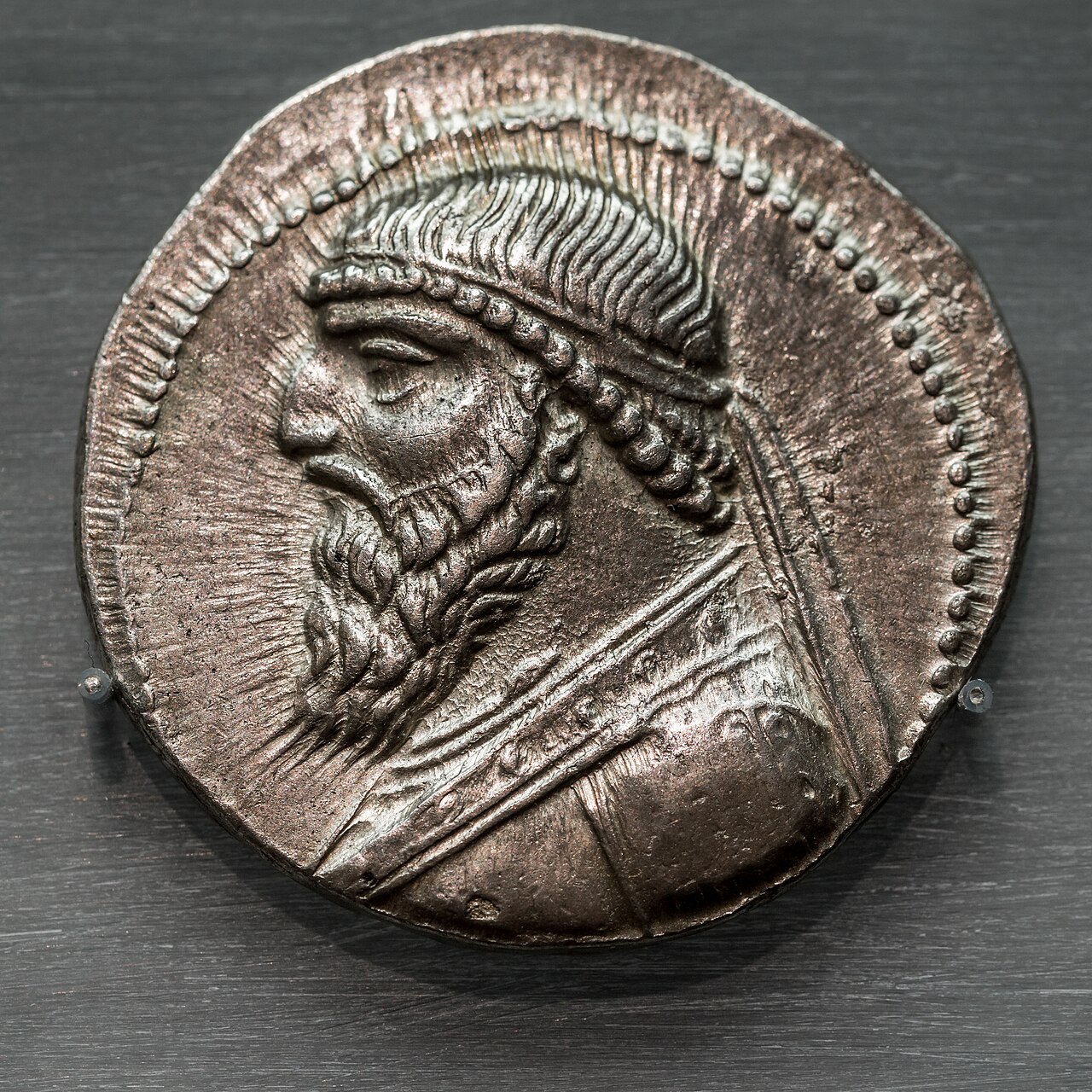
From around 109 BCE Mithridates’ coins carry the Greek title Basileus Basileon, “King of Kings”. This was the title of the Achaemenids, Old Persian xšāyaθiya xšāyaθiyānām, and its revival announced that the Arsacids saw themselves as heirs to the Persian empire, rulers of many subject kings. Later Parthian kings and then the Sasanians kept it, and its Persian form, Shahanshah, was used by Iranian monarchs until 1979.
His coinage also introduced a new royal image. Instead of the bare-headed Hellenistic portrait of Mithridates I, later issues show him wearing a tall tiara decorated with stars or other motifs, a style many later Parthian kings followed (see Parthian coins and what they tell us).
The relief at Bisotun
At Bisotun near Kermanshah, below the great inscription of Darius I, Mithridates had a relief carved showing four officials paying homage to the king. A Greek inscription named the figures, including Gotarzes, called “satrap of satraps”. The relief was later partly destroyed when a much later Persian inscription was cut across it, and it is known in more detail from drawings made by early travellers. It is the first known Parthian royal relief, placed deliberately beside the monument of an Achaemenid king. Visitors can see the remains at Behistun (Bisotun).
Envoys from China
In the east, Mithridates’ reign saw the first official contact between Iran and China. After the travels of Zhang Qian, Han envoys reached Anxi, the Chinese name for Parthia. The Shiji of Sima Qian reports that the Parthian king sent a force of 20,000 horsemen to greet them at his eastern border, and that Parthian envoys later went to the Han court with ostrich eggs and skilled performers as gifts. The full story, and what it meant for trade, is on the Parthians and the Silk Road.
The meeting with Sulla
Rome reached the Euphrates during the same years. Around 96 BCE (some historians prefer 92), the Roman commander Lucius Cornelius Sulla, sent to settle the affairs of Cappadocia, met a Parthian envoy named Orobazus on the river. Plutarch says Sulla had three chairs set out and took the middle seat himself, between the Parthian envoy and the king of Cappadocia, as if he were the senior party. No treaty is recorded, though some modern writers assume an informal understanding on the Euphrates as a boundary. Plutarch adds that Orobazus was executed when he returned home, for allowing the king’s dignity to be slighted.
The episode was small, but both sides read it as a contest of rank, and later Romans used it as the start of their relations with Parthia.
After Mithridates: a dark age
The last years of the reign are obscure. A rival king named Gotarzes, possibly the same man shown on the Bisotun relief, appears in Babylonian records in the 90s and 80s BCE, and after about 91 BCE the empire divided among competing kings. Modern historians call the following three decades the “Parthian Dark Age”, because coins and sources are hard to match to rulers. Armenia under Tigranes took advantage, and Parthia only recovered its strength under Phraates III and Orodes II.
Ancient writers called Mithridates “the Great”, and modern historians largely agree. He gave Parthia the frontiers, titles and diplomatic reach that defined it for the next three centuries.
Persian words from this page
| شاهنشاه | Shâhanshâh | King of Kings |
| ارمنستان | Armanestân | Armenia |
| بیستون | Bisotun | Behistun |
| فرات | Forât | the Euphrates |
| گودرز | Gudarz | Gotarzes |
| چین | Chin | China |
Sources and further reading
- Justin, Epitome of Pompeius Trogus, Book 42.
- Strabo, Geography, Book 11 (Armenia and the “seventy valleys”).
- Plutarch, Life of Sulla, chapter 5.
- Sima Qian, Shiji, chapter 123.
- Encyclopaedia Iranica, “Mithradates II”.
- A. D. H. Bivar, “The Political History of Iran under the Arsacids”, The Cambridge History of Iran, vol. 3(1), 1983.
Want to learn Persian? Get the free Starter Pack
Get the 14-page printable Starter Pack (all 32 letters, a 7-day reading plan, 100 core words and 20 survival phrases) and a short 5-email course. Free.
More in The Parthian Empire (247 BCE–224 CE)
- The Parni and Arsaces I
- Nisa: The First Parthian Capital
- Mithridates I and the Making of an Empire
- Phraates II, Artabanus I and the Saka Invasions
- Mithridates II the Great
- The Parthians and the Silk Road
- Parthian Cavalry: Cataphracts and the Parthian Shot
- Surena and the Battle of Carrhae (53 BCE)
- Orodes II and Prince Pacorus
- Mark Antony’s Parthian War
- Phraates IV and the Peace with Augustus
- Queen Musa of Parthia
- Artabanus II of Parthia
- Gotarzes II and Vardanes: A Royal Rivalry
- Vologases I and the War over Armenia
- Trajan’s Invasion of Parthia
- Osroes I and the Parthian Civil Wars
- Roman Campaigns of the 2nd Century: Lucius Verus and Septimius Severus
- The Last Parthian Kings: Vologases V, Vologases VI and Artabanus IV
- The Fall of the Parthian Empire
- Ctesiphon: Capital of Two Empires
- The Great Houses of Parthia
- Religion and Culture in Parthian Iran
- Parthian Art and Architecture
- Parthian Coins and What They Tell Us
- Hatra: The City that Resisted Rome
- The Parthian Language and Its Records
- The Indo-Parthians and Kushans
- The Parthian Legacy