Orodes II (ruled c. 57 to 37 BCE) was the Parthian king under whom Parthia defeated Crassus at Carrhae and then carried the war into Roman territory. His son and heir Pacorus led two invasions of Syria, and in 40 BCE, together with the Roman exile Quintus Labienus, overran Syria, Judea and much of Asia Minor, before Roman armies drove them back and Pacorus was killed in 38 BCE.
| Orodes II | Ruled c. 57 to 37 BCE |
|---|---|
| Pacorus I | Crown prince, killed at Mount Gindarus in 38 BCE |
| Allies | Quintus Labienus; Antigonus, the Hasmonean claimant in Judea |
| Main invasions | Syria 51 to 50 BCE; Syria, Judea and Asia Minor 40 to 38 BCE |
| Roman opponents | Cassius, Decidius Saxa, Publius Ventidius Bassus |
| Successor | Phraates IV, who killed his father and brothers |
| Persian names | Orod (ارد), Pakor (پاکر) |
A throne won by parricide
Orodes and his brother Mithridates III came to power around 57 BCE by murdering their father, Phraates III. They then fought each other. Mithridates was driven out, fled to the Roman governor of Syria, Aulus Gabinius, and nearly got Roman help before Gabinius turned to Egypt instead. Returning on his own, Mithridates held Babylonia for a time, but he was besieged and surrendered, and Orodes had him executed around 54 BCE. The general who stormed Seleucia for Orodes was the young Surena, the future victor of Carrhae.
Orodes had barely secured his throne when Crassus invaded. The king’s own part was to occupy Armenia, while Surena destroyed the Roman army (see Surena and the Battle of Carrhae). The victory was followed by a dynastic marriage: Pacorus married a sister of the Armenian king Artavasdes II.
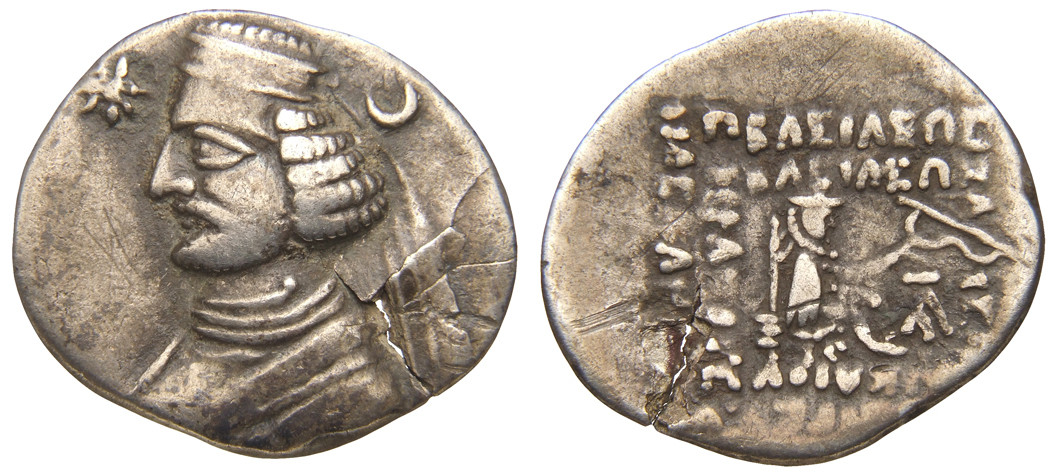

Pacorus’s first invasion, 51 BCE
After Carrhae, Roman Syria lay almost undefended. In 51 BCE Pacorus, still young, crossed the Euphrates with an experienced commander named Osaces. Gaius Cassius Longinus, who had escaped from Carrhae and was holding the province, kept his troops inside Antioch. When the Parthians withdrew towards Antigonea, he ambushed them and Osaces was mortally wounded. The Parthians wintered in northern Syria and withdrew the following year.
Cassius Dio says the new Roman governor, Bibulus, encouraged a Parthian noble to set Pacorus up against his own father, and that this is why the prince was recalled. True or not, the story shows Roman awareness that the Arsacid royal family could be divided.
Parthia and the Roman civil wars
For the next decade Rome fought itself, and each side looked for Parthian help. Pompey asked Orodes for support in 49 to 48 BCE; Orodes asked for Syria in return, and nothing came of it. Parthian horsemen helped the Pompeian commander Caecilius Bassus, besieged by Caesar’s generals at Apamea in Syria. Julius Caesar was preparing a great Parthian expedition when he was murdered in 44 BCE.
His assassins, Brutus and Cassius, sent an envoy to Orodes: Quintus Labienus, son of one of Caesar’s generals who had turned against him. Labienus was still at the Parthian court when Brutus and Cassius were defeated at Philippi in 42 BCE. Unable to go home, he stayed, and urged Orodes to strike while Mark Antony was busy in Egypt.
The great invasion of 40 BCE
In 40 BCE Pacorus and Labienus invaded together. The Roman governor of Syria, Decidius Saxa, was defeated, and many of his soldiers, once followers of Brutus and Cassius, went over to Labienus. The two commanders then divided the work.
- Labienus marched into Asia Minor, took most of Cilicia and pushed as far as Caria in the west, where a few cities such as Stratonicea resisted. He struck coins showing himself with a Parthian horse and called himself Parthicus Imperator, a startling title for a Roman general fighting for Parthia.
- Pacorus took Syria and the cities of the Phoenician coast, except Tyre, which held out behind its walls.
Judea
In Judea, the Hasmonean prince Antigonus saw his chance against his uncle, the high priest Hyrcanus II, and Hyrcanus’s ministers Phasael and Herod. According to the Jewish historian Josephus, Antigonus promised the Parthians a large payment in money and women. A Parthian force entered Jerusalem; Hyrcanus and Phasael were seized during negotiations. Phasael died in captivity, and Hyrcanus was mutilated so that, under Jewish law, he could no longer serve as high priest; Josephus says Antigonus bit off his ears. The Parthians installed Antigonus as king and high priest. Herod escaped and went to Rome, where the Senate named him king of Judea at the end of 40 BCE.
For about two years, then, Parthia controlled the eastern Mediterranean coast from Syria to Palestine. It was the greatest westward advance of any Iranian power since the Achaemenids.
Ventidius and the fall of Pacorus
Antony sent a capable general, Publius Ventidius Bassus, to restore the east. In 39 BCE Ventidius surprised Labienus in the Taurus mountains and routed his army; Labienus fled and was soon captured and killed. Ventidius then defeated a Parthian force under Pharnapates at the Amanus pass, and Syria was recovered.
In 38 BCE Pacorus invaded again. Ventidius waited on high ground near Mount Gindarus, north-east of Antioch, and let the Parthian cavalry charge uphill against his legions and slingers. The Parthians were beaten and Pacorus was killed. Cassius Dio notes that this happened on the anniversary of Crassus’s defeat at Carrhae. Ventidius was awarded the first Roman triumph ever celebrated over the Parthians. Herod, with Roman help, took Jerusalem in 37 BCE, and Antigonus was executed.
Pacorus remembered
Roman writers had good things to say about Pacorus. Dio says the people of Syria were more devoted to him than to any earlier ruler, because of his justice and mildness. Justin says Orodes was so overwhelmed by the news of his son’s death that for days he could not speak or eat. Whether or not these are literary touches, they suggest that Pacorus had been groomed for the throne and that his death left a gap the dynasty could not easily fill.
The end of Orodes
Orodes chose as his new heir another son, Phraates. According to Justin and Plutarch, Phraates IV then killed his brothers, of whom Justin says there were thirty, and finally his aged father, around 37 BCE. The new king’s first test would be the invasion of Mark Antony, and his reign ended with a lasting settlement with Augustus (see Phraates IV and the peace with Augustus).
- c. 57 BCE Orodes and Mithridates III kill their father Phraates III
- c. 54 BCE Mithridates III executed after the siege of Seleucia
- 53 BCE Carrhae: Crassus defeated by Surena
- 51 BCE Pacorus and Osaces invade Syria
- 42 BCE Labienus stranded at the Parthian court after Philippi
- 40 BCE Pacorus and Labienus overrun Syria, Judea and Asia Minor
- 39 BCE Ventidius defeats Labienus and Pharnapates
- 38 BCE Pacorus killed at Mount Gindarus
- c. 37 BCE Orodes killed by his son Phraates IV
Persian words from this page
| ارد | Orod | Orodes |
| پاکر | Pâkor | Pacorus |
| شاهزاده | shâhzâde | prince |
| سوریه | Suriye | Syria |
| اورشلیم | Orshalim | Jerusalem |
| روم | Rum | Rome |
Sources and further reading
- Cassius Dio, Roman History, Books 40, 48 and 49.
- Josephus, Jewish Antiquities, Book 14, and Jewish War, Book 1.
- Justin, Epitome of Pompeius Trogus, Book 42.
- Plutarch, Life of Crassus, chapter 33, and Life of Antony, chapters 33 to 34.
- A. D. H. Bivar, “The Political History of Iran under the Arsacids”, The Cambridge History of Iran, vol. 3(1), 1983.
Want to learn Persian? Get the free Starter Pack
Get the 14-page printable Starter Pack (all 32 letters, a 7-day reading plan, 100 core words and 20 survival phrases) and a short 5-email course. Free.
More in The Parthian Empire (247 BCE–224 CE)
- The Parni and Arsaces I
- Nisa: The First Parthian Capital
- Mithridates I and the Making of an Empire
- Phraates II, Artabanus I and the Saka Invasions
- Mithridates II the Great
- The Parthians and the Silk Road
- Parthian Cavalry: Cataphracts and the Parthian Shot
- Surena and the Battle of Carrhae (53 BCE)
- Orodes II and Prince Pacorus
- Mark Antony’s Parthian War
- Phraates IV and the Peace with Augustus
- Queen Musa of Parthia
- Artabanus II of Parthia
- Gotarzes II and Vardanes: A Royal Rivalry
- Vologases I and the War over Armenia
- Trajan’s Invasion of Parthia
- Osroes I and the Parthian Civil Wars
- Roman Campaigns of the 2nd Century: Lucius Verus and Septimius Severus
- The Last Parthian Kings: Vologases V, Vologases VI and Artabanus IV
- The Fall of the Parthian Empire
- Ctesiphon: Capital of Two Empires
- The Great Houses of Parthia
- Religion and Culture in Parthian Iran
- Parthian Art and Architecture
- Parthian Coins and What They Tell Us
- Hatra: The City that Resisted Rome
- The Parthian Language and Its Records
- The Indo-Parthians and Kushans
- The Parthian Legacy