For most of the period from about 78 to 147 CE, the Parthian Empire had more than one king at a time. The best-known rival was Osroes I, who held Mesopotamia and Ctesiphon from about 109 to 129 while Vologases III ruled the Iranian plateau; their division gave the emperor Trajan his chance to invade. The split ended only when Vologases IV reunited the empire in 147.
| Period | c. 78–147 CE, with a later echo around 190 |
|---|---|
| Main rivals | Pacorus II (78–110); Vologases II (c. 77–80); Artabanus III (c. 79–81); Osroes I (c. 109–129); Vologases III (c. 110–147); Mithridates V (c. 129–140) |
| Roman client | Parthamaspates, son of Osroes, crowned by Trajan in 116 |
| Reunified by | Vologases IV (147–191) |
| Main evidence | Coins, with scattered notices in Dio Cassius and the Historia Augusta |
| Persian names | Khosrow (خسرو) for Osroes; Balâsh (بلاش) for Vologases |
Reading a civil war from coins
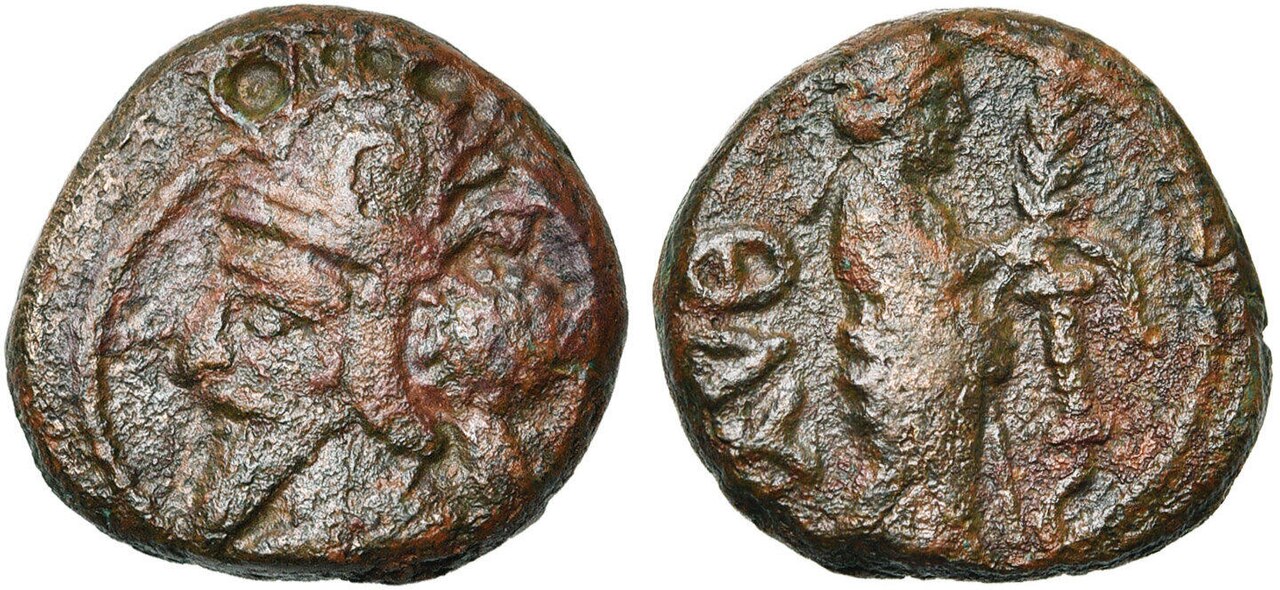
No Parthian chronicle survives for these decades, and Roman writers noticed Parthia only when it touched Rome. Much of what historians know comes from coins. The mint at Seleucia on the Tigris struck large silver tetradrachms that carried the year, and often the month, in the Seleucid era. When two kings issued dated coins in overlapping months, or when one king’s coins stop at Seleucia while his drachms continue at Ecbatana in Media, numismatists can see the empire splitting. The method, and its limits, are explained on Parthian Coins and What They Tell Us.
This evidence has a cost. A king who controlled a mint for a few months may appear in modern lists as a full ruler, while one who never struck coins may vanish. Several of the names below are known almost only from their money.

Pacorus II and his challengers, 78–110
Vologases I, who had settled the Armenian question with Rome, died around 78 CE. His son Pacorus II succeeded him but was challenged almost at once. A Vologases, known today as Vologases II, struck coins as a rival until about 80, and another prince, Artabanus III, held part of the empire around 79–81. Dio Cassius says this Artabanus sheltered a man claiming to be the dead emperor Nero, one of several false Neros who appeared in the East, and briefly considered backing him against Rome.
Pacorus outlasted these rivals and reigned for about three decades, but the coin record suggests that he never controlled the whole empire for long. Near the end of his reign another claimant appeared in the west: Osroes.
Osroes in the west, Vologases III in the east
Osroes rose against Pacorus around 109. When Pacorus died around 110, his son Vologases III took the throne, but Osroes held Mesopotamia, including Seleucia and Ctesiphon, the richest part of the empire and the part closest to Rome. Vologases III ruled the Iranian plateau. For the next twenty years Parthia effectively had two kings, each recognised in his own half.
Armenia and Trajan’s war
Around 113 Osroes removed the king of Armenia, Axidares, and installed another prince, Parthamasiris, without asking Rome. Trajan used this as a pretext for war. Between 114 and 117 the Romans annexed Armenia, took Seleucia and Ctesiphon, captured a daughter of Osroes along with the famous golden throne of the Parthian kings, and reached the Persian Gulf. Osroes could not stop them, and Vologases III, safe on the plateau, did not try very hard. The campaign is told in full on Trajan’s Invasion of Parthia.
A king made in Rome
In 116 Trajan crowned Osroes’ own son, Parthamaspates, as king of Parthia at Ctesiphon. Roman coins celebrated the event with the legend REX PARTHIS DATUS, “a king given to the Parthians”. The Parthians did not accept him. After Trajan’s death in 117, Hadrian gave up the eastern conquests, Osroes returned to Ctesiphon, and Parthamaspates was compensated with the small kingdom of Osrhoene around Edessa.
Hadrian, the daughter and the throne
Osroes spent the following years trying to recover what Trajan had taken. The Historia Augusta reports that Hadrian averted a new war in the early 120s through a personal meeting, and that he later returned Osroes’ daughter and promised to return the golden throne. The throne apparently never went back: the same source says Antoninus Pius later refused a Parthian request for it. The details come from a late and unreliable work, but they agree in showing a Parthian king who negotiated rather than fought.
Vologases III alone, 129–147
Around 129 Vologases III drove Osroes out of Mesopotamia. Little is known of Osroes’ end. His place as western rival was taken by Mithridates V, who struck coins until about 140, and Vologases III again had to share the empire.
He also faced attacks from outside. In the mid-130s the Alans, a nomadic people from north of the Caucasus, broke through into Media and Armenia. Dio Cassius says Pharasmanes, king of Iberia, had let them through, and that Vologases complained to Rome and bought the raiders off. In the east, the rise of the Kushan Empire put pressure on Parthia’s frontier provinces, as described on The Indo-Parthians and Kushans.
Reunion under Vologases IV
When Vologases III died in 147, the throne passed to Vologases IV, a son of Mithridates V. The two branches of the family were joined again, and for more than forty years Parthia had a single king. Vologases IV recovered the kingdom of Mesene at the head of the Persian Gulf around 151 and in 161 felt strong enough to attack Rome in Armenia and Syria, beginning the war told on Roman Campaigns of the 2nd Century.
Unity did not last. Around 190 a new Osroes, Osroes II, struck drachms at Ecbatana, so he must have held at least part of Media against Vologases IV or his successor Vologases V. He is known only from his coins. The final division, between Vologases VI and Artabanus IV, is the subject of The Last Parthian Kings.
- c. 78 Pacorus II succeeds Vologases I; rival kings Vologases II and Artabanus III
- c. 109 Osroes I rises in the west
- c. 110 Vologases III succeeds Pacorus II in the east
- c. 113 Osroes installs Parthamasiris in Armenia
- 114–117 Trajan’s invasion; Parthamaspates crowned at Ctesiphon in 116
- 117 Osroes restored after Trajan’s death
- c. 129 Vologases III drives out Osroes
- c. 129–140 Mithridates V rules in the west
- mid-130s Alan invasion of Media and Armenia
- 147 Vologases IV reunites the empire
- c. 190 Osroes II strikes coins at Ecbatana
Weakness or resilience
Older histories treated the 2nd century as a long Parthian decline, with rival kings opening the door to Roman armies. There is truth in this: Trajan’s success depended on Parthian disunity, and Ctesiphon was sacked three times in eighty years. But many historians now stress how much survived. The empire never broke into separate states, the Arsacid family kept its monopoly on kingship, long-distance trade continued to enrich Mesopotamia, and each Roman conquest proved temporary. Rival kings were, in a sense, the normal working of a system in which the great noble houses chose among Arsacid candidates, as explained on The Great Houses of Parthia.
Persian words from this page
| خسرو | Khosrow | Osroes (the same name) |
| بلاش | Balâsh | Vologases |
| مهرداد | Mehrdâd | Mithridates |
| تیسفون | Tisfun | Ctesiphon |
| بینالنهرین | Beyn-on-nahrein | Mesopotamia |
| تخت | takht | throne |
Sources and further reading
- Dio Cassius, Roman History, books 66, 68 and 69
- Historia Augusta, Lives of Hadrian and Antoninus Pius
- K. Schippmann, “Arsacids ii. The Arsacid dynasty”, Encyclopaedia Iranica
- David Sellwood, An Introduction to the Coinage of Parthia, 2nd ed. (1980)
- A. D. H. Bivar, “The Political History of Iran under the Arsacids”, in The Cambridge History of Iran, vol. 3(1) (1983)
- Edward Dąbrowa, “The Arsacid Empire”, in T. Daryaee (ed.), The Oxford Handbook of Iranian History (2012)
Want to learn Persian? Get the free Starter Pack
Get the 14-page printable Starter Pack (all 32 letters, a 7-day reading plan, 100 core words and 20 survival phrases) and a short 5-email course. Free.
More in The Parthian Empire (247 BCE–224 CE)
- The Parni and Arsaces I
- Nisa: The First Parthian Capital
- Mithridates I and the Making of an Empire
- Phraates II, Artabanus I and the Saka Invasions
- Mithridates II the Great
- The Parthians and the Silk Road
- Parthian Cavalry: Cataphracts and the Parthian Shot
- Surena and the Battle of Carrhae (53 BCE)
- Orodes II and Prince Pacorus
- Mark Antony’s Parthian War
- Phraates IV and the Peace with Augustus
- Queen Musa of Parthia
- Artabanus II of Parthia
- Gotarzes II and Vardanes: A Royal Rivalry
- Vologases I and the War over Armenia
- Trajan’s Invasion of Parthia
- Osroes I and the Parthian Civil Wars
- Roman Campaigns of the 2nd Century: Lucius Verus and Septimius Severus
- The Last Parthian Kings: Vologases V, Vologases VI and Artabanus IV
- The Fall of the Parthian Empire
- Ctesiphon: Capital of Two Empires
- The Great Houses of Parthia
- Religion and Culture in Parthian Iran
- Parthian Art and Architecture
- Parthian Coins and What They Tell Us
- Hatra: The City that Resisted Rome
- The Parthian Language and Its Records
- The Indo-Parthians and Kushans
- The Parthian Legacy