Parthian was the Iranian language of the Arsacid kings and their nobles, a Middle Iranian language closely related to Middle Persian. It was written in a script derived from Aramaic and survives in wine-jar notes from Nisa, a few legal documents, royal inscriptions, coin legends and, above all, religious texts of the Manichaeans found in Central Asia. Its records are thin, but they show how the empire was run and how a language outlived the dynasty that spoke it.
| Language family | Iranian; Northwestern Middle Iranian |
|---|---|
| Homeland | Parthia, roughly modern Khorasan and southern Turkmenistan |
| Script | Parthian script, from Imperial Aramaic; Manichaean script for religious texts |
| Earliest documents | Ostraca from Nisa, 1st century BCE |
| Last royal inscription | Narseh’s inscription at Paikuli, c. 293 CE |
| Persian name | Pahlavi-ye ashkâni (پهلوی اشکانی), “Arsacid Pahlavi” |
Writing Iranian with Aramaic letters
The Achaemenid Empire had used Aramaic as the common language of administration from Egypt to India. When Iranian rulers began to write their own languages after Alexander, they used the Aramaic alphabet, and they also kept many Aramaic words as fixed written signs. A scribe would write the Aramaic word for “king”, MLK’, but readers pronounced it as the Iranian word shah. Scholars call these written-only words heterograms or ideograms. Parthian used them for many common words, including names of months, numbers, family words and verbs, while writing other words in Iranian spelling.
The result looks like Aramaic but is Iranian underneath, which made early decipherment hard. It also hides the sound of the language, so that much of what we know of Parthian pronunciation comes from the later Manichaean texts, written in a clearer alphabet, and from Parthian words borrowed into Armenian.
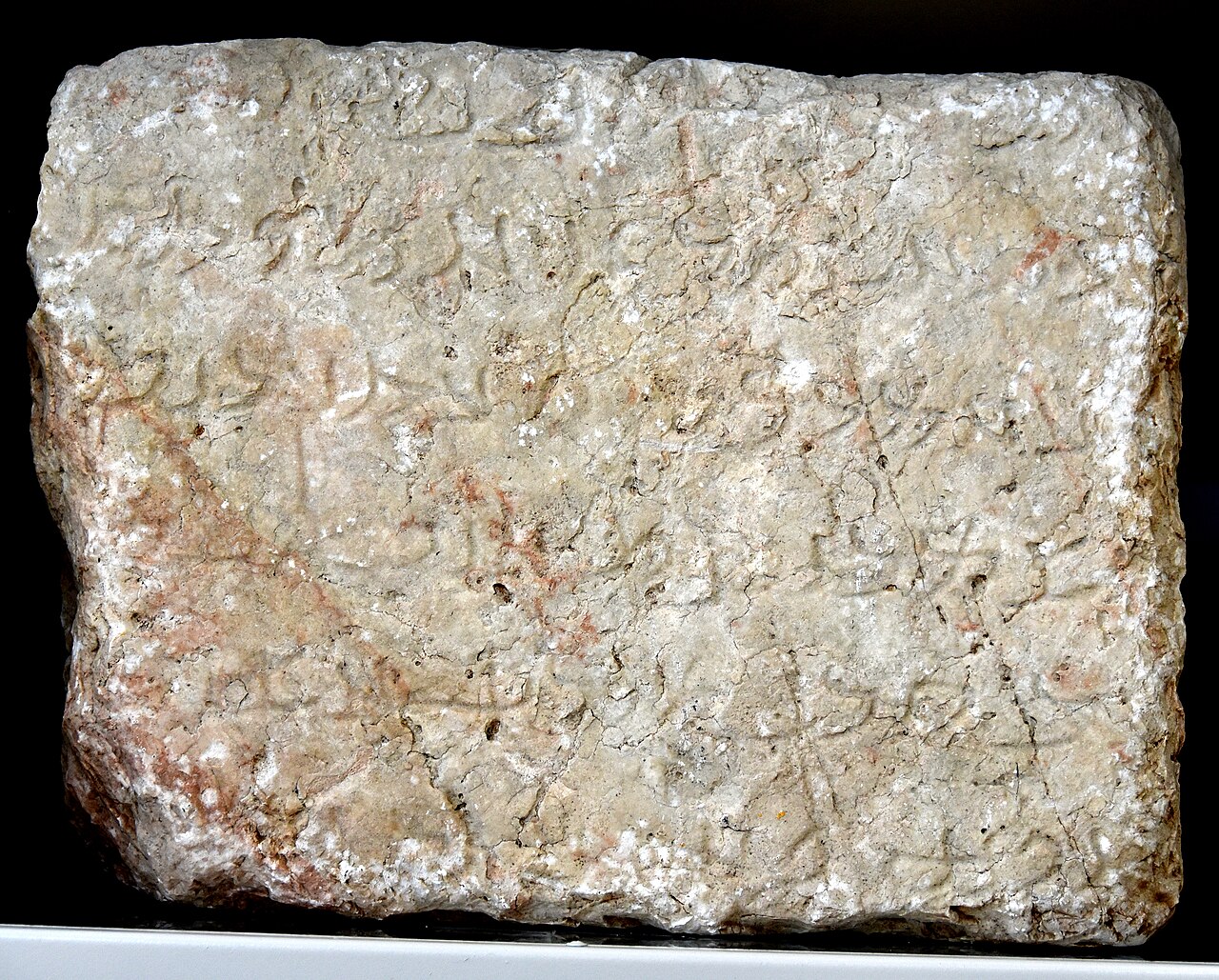

The records of the Parthian state
Nisa: notes on wine jars
The largest group of Parthian texts comes from Old Nisa in Turkmenistan, where Soviet archaeologists found some 2,700 ostraca, sherds of pottery with notes in ink. Most record deliveries of wine from royal estates and are dated by the Arsacid era, which counted from 247 BCE. They show a working bureaucracy with officials, estates and careful accounts, and they show that by the 1st century BCE the language of record in the Parthian homeland was Parthian, not Greek. The archive itself is described on Nisa: The First Parthian Capital.
Parchments from Avroman and Dura
In 1909 villagers in the Avroman mountains of Iranian Kurdistan found a sealed jar containing three parchment documents. Two are in Greek; the third, of the 1st century CE, is in Parthian and records the sale of part of a vineyard. It is one of very few private legal documents to survive from the Parthian world. Fragments of Parthian writing on parchment and pottery were also found at Dura-Europos on the Euphrates, a Parthian frontier town until Rome took it in the 160s.
Inscriptions of kings and governors
Parthian royal inscriptions are rare. A bronze statue of Herakles found at Seleucia on the Tigris carries a Greek and Parthian inscription recording the conquest of Mesene by Vologases IV in 151 CE. At Susa, a stone stele of 215 CE shows Artabanus IV with the local governor and a Parthian text naming them; it is discussed on The Last Parthian Kings. Coin legends add the names of later kings in Parthian letters; see Parthian Coins and What They Tell Us.
Parthian under the Sasanians
The new Sasanian dynasty spoke Middle Persian, the language of Pars. Yet Ardashir and his successors kept Parthian in their monuments, because it was still the language of many great families and of the northern and eastern provinces. Shapur I’s great inscription on the Ka’ba-ye Zartosht at Naqsh-e Rostam was carved in three versions, Middle Persian, Parthian and Greek; see The Ka’ba-ye Zartosht Inscription of Shapur I. The last major royal text with a Parthian version is the inscription of Narseh at Paikuli, in what is now Iraqi Kurdistan, from about 293 CE, told on Narseh and the Peace of Nisibis. After that, Parthian disappears from official use.
Manichaean Parthian: a language of faith
The richest Parthian texts are religious. In the mid-3rd century the prophet Mani sent missionaries east, and Manichaean tradition remembers his disciple Mar Ammo as the leader of the mission to the Parthian lands because he knew the language. Parthian became the church language of Manichaeans in Khorasan and Central Asia and remained so long after it had stopped being spoken.
These texts were found mainly at Turfan in Xinjiang, western China, by German expeditions between 1902 and 1914. Written in the clear Manichaean alphabet, they include sermons, letters, histories of the mission and two long hymn cycles, the Huyadagmān and the Angad Rōšnān, which are among the finest surviving poetry in any Middle Iranian language. For the religion itself, see Mani and Manichaeism.
Oral literature and loanwords
Much Parthian literature was never written down in Parthian. It was performed by minstrels and later passed into Middle Persian and New Persian, as described on Religion and Culture in Parthian Iran. The language left traces in its neighbours instead. Armenian, ruled for centuries by a Parthian dynasty, absorbed hundreds of Parthian words for government, warfare, religion and daily life, so many that 19th-century scholars at first took Armenian for an Iranian language. Persian also contains words of northwestern Iranian origin that probably came through Parthian, though individual cases are often debated.
What “Pahlavi” means
The name of the Parthians lives on in a confusing word. The Old Persian name for Parthia, Parthava, became Pahlav in Middle Iranian, and pahlawīg meant “Parthian”. In the early Islamic centuries, however, Arabic and Persian writers used “Pahlavi” for the Middle Persian of the Sasanians and of Zoroastrian books, and that is how the word is normally used today. Modern Iranian scholars therefore distinguish pahlavi-ye ashkâni, “Arsacid Pahlavi” for Parthian, from pahlavi-ye sâsâni, “Sasanian Pahlavi” for Middle Persian. The same root gave Persian pahlavân, a hero or champion. For the later language, see Middle Persian (Pahlavi) Language and Literature and A History of the Persian Language.
Persian words from this page
| پهلوی | Pahlavi | Pahlavi; originally “Parthian” |
| پهلوان | pahlavân | hero, champion |
| زبان | zabân | language |
| خط | khatt | script, writing |
| آرامی | ârâmi | Aramaic |
| شاه | shâh | king |
| مانی | Mâni | Mani |
Sources and further reading
- I. M. Diakonoff and V. A. Livshits, Parthian Economic Documents from Nisa, Corpus Inscriptionum Iranicarum (1976–2001)
- Werner Sundermann, “Parthisch”, in R. Schmitt (ed.), Compendium Linguarum Iranicarum (1989)
- Mary Boyce, The Manichaean Hymn-Cycles in Parthian (1954)
- Prods Oktor Skjærvø, “Aramaic Scripts for Iranian Languages”, in P. T. Daniels and W. Bright (eds.), The World’s Writing Systems (1996)
- Helmut Humbach and Prods O. Skjærvø, The Sassanian Inscription of Paikuli (1978–1983)
Want to learn Persian? Get the free Starter Pack
Get the 14-page printable Starter Pack (all 32 letters, a 7-day reading plan, 100 core words and 20 survival phrases) and a short 5-email course. Free.
More in The Parthian Empire (247 BCE–224 CE)
- The Parni and Arsaces I
- Nisa: The First Parthian Capital
- Mithridates I and the Making of an Empire
- Phraates II, Artabanus I and the Saka Invasions
- Mithridates II the Great
- The Parthians and the Silk Road
- Parthian Cavalry: Cataphracts and the Parthian Shot
- Surena and the Battle of Carrhae (53 BCE)
- Orodes II and Prince Pacorus
- Mark Antony’s Parthian War
- Phraates IV and the Peace with Augustus
- Queen Musa of Parthia
- Artabanus II of Parthia
- Gotarzes II and Vardanes: A Royal Rivalry
- Vologases I and the War over Armenia
- Trajan’s Invasion of Parthia
- Osroes I and the Parthian Civil Wars
- Roman Campaigns of the 2nd Century: Lucius Verus and Septimius Severus
- The Last Parthian Kings: Vologases V, Vologases VI and Artabanus IV
- The Fall of the Parthian Empire
- Ctesiphon: Capital of Two Empires
- The Great Houses of Parthia
- Religion and Culture in Parthian Iran
- Parthian Art and Architecture
- Parthian Coins and What They Tell Us
- Hatra: The City that Resisted Rome
- The Parthian Language and Its Records
- The Indo-Parthians and Kushans
- The Parthian Legacy