The Parthian army was an army of horsemen. Its two arms, lightly equipped mounted archers and heavily armoured lancers called cataphracts, worked together to wear down and then break enemy infantry, and they gave the Parthians their most famous victories over Rome. The “Parthian shot”, an arrow fired backwards by a rider who seemed to be fleeing, became proverbial in the Roman world.
| Main troops | Horse archers (the majority) and cataphracts (armoured lancers) |
|---|---|
| Weapons | Composite bow; long lance (Greek kontos); sword and mace |
| Armour | Scale or lamellar armour for rider and horse; helmets |
| Recruitment | Royal guard plus contingents of nobles and their dependents |
| Famous use | Carrhae, 53 BCE; Antony’s retreat, 36 BCE |
| Weak points | Sieges, long campaigns, supply |
An army raised by nobles
Parthia had no large standing army of the Roman kind. When the king went to war, he gathered his own guard and called on the great noble houses and vassal kings, each of whom brought horsemen from his estates. Most of these riders were dependents of their lord rather than paid soldiers. Justin, following Pompeius Trogus, claims that of the 50,000 cavalry who faced Mark Antony, only 400 were free men. Historians do not take the number literally, but it reflects a real feature: the army was the nobility and its followers on horseback (see the great houses of Parthia).
This had consequences. A powerful noble could field an army of his own, as Surena did at Carrhae, and the loyalty of the great houses decided civil wars. Infantry existed, often drawn from hill peoples or subject cities, but it played a minor role in the sources.

Horse archers
The bulk of the army were mounted archers, riders trained from childhood in the steppe tradition of the Parni. They wore little or no armour and carried a composite bow made of wood, horn and sinew glued in layers, short enough to use on horseback but able to drive an arrow through shields and light armour at close range.
Horse archers rarely charged home. They rode up in waves, shot, wheeled away and came back, keeping out of reach of infantry. They could not be caught by heavy foot soldiers, and they made any army that stood still pay a steady price in wounded men.
The Parthian shot
The most famous trick was to ride away as if in flight, then turn in the saddle and shoot back at pursuers. This required great skill, since riders of the time had no stirrups and gripped the horse with their legs. Pursuers who broke formation to chase the “fleeing” archers could be cut off and surrounded. Roman poets such as Virgil and Horace mention the backward shot of the Parthians as something every reader knew. The English phrase “parting shot” is often said to come from “Parthian shot”, though the link is not certain.
Arrows by the camel-load
Archers were only dangerous while they had arrows. At Carrhae, Plutarch says, the Romans hoped the Parthians would run out, only to see them ride back to a train of camels loaded with fresh supplies. That organisation, rather than any special bow, may explain why the arrow storm lasted all day (see Surena and the Battle of Carrhae).
The cataphracts
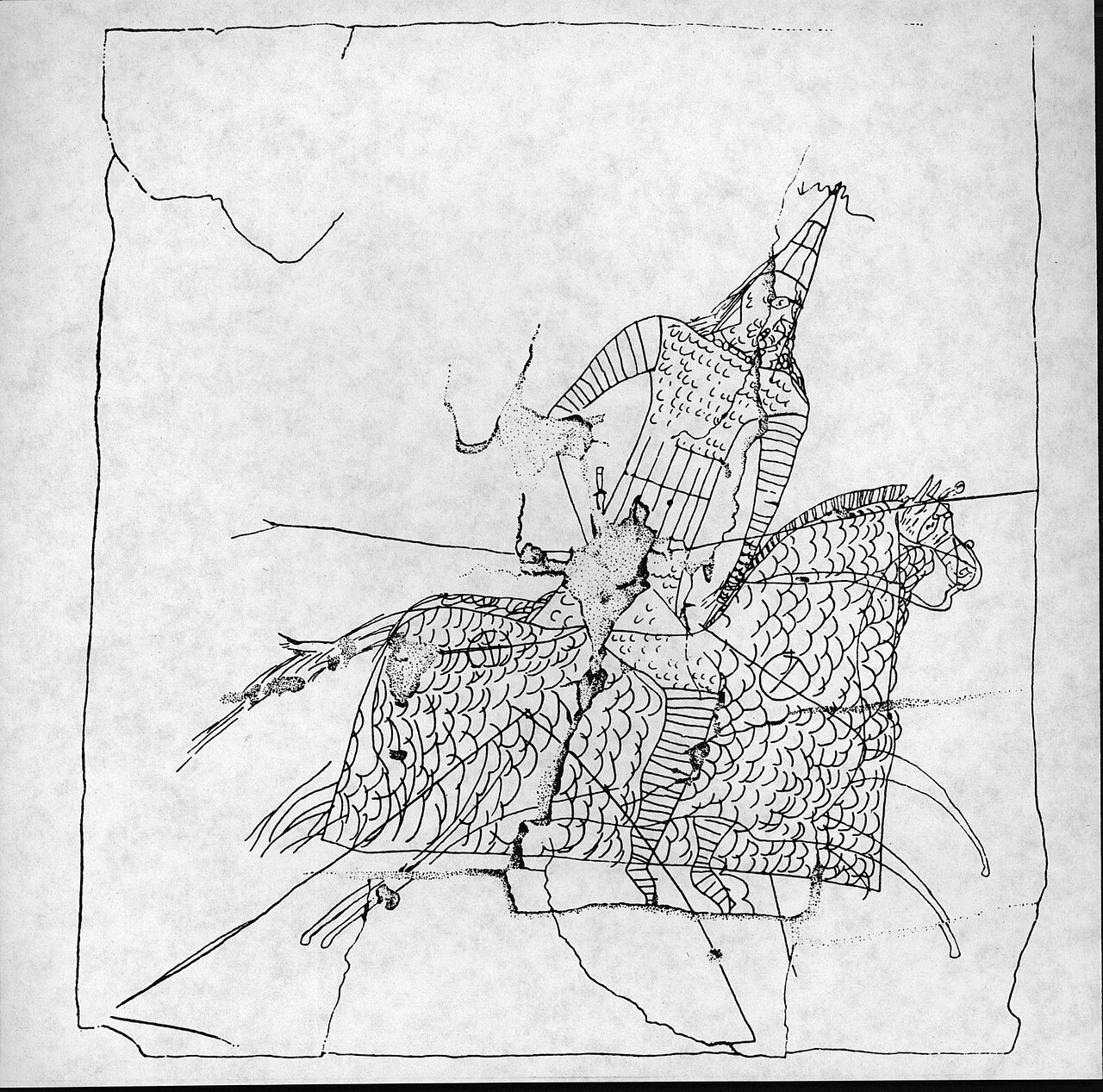
The second arm was the heavy cavalry, called by the Greeks kataphraktoi, “covered over”. Rider and horse were protected by armour made of small scales or plates of iron or bronze sewn or laced together. The rider carried a long lance, the kontos, held in both hands, and a sword or mace for close fighting. Plutarch describes how, at Carrhae, the Parthians threw off the cloaks covering their armour and appeared blazing in helmets and breastplates of Margianian steel, their horses armoured in bronze and steel.
Cataphracts were the nobles and their best-armed followers, and they were far fewer than the archers. Their task was to charge a formation that had already been disordered, or to pin it in place so that the archers could shoot into a packed target. Without stirrups, a charge depended on a deep saddle, strong horses and training. Media was famous for its large horses, and Iranian horse breeding was a source of military strength.
The best physical evidence comes from Dura-Europos on the Euphrates, which was Parthian for over two centuries before Rome took it. Excavators found scale horse armour there, and graffiti such as the one above, though these date from the 3rd century CE, when the town was Roman.
Strengths and limits
The combination worked best in open country against infantry without enough cavalry or missile troops of its own. Crassus at Carrhae had both problems. Mark Antony, sixteen years later, brought large numbers of slingers and cavalry and survived his retreat, though at great cost (see Mark Antony’s Parthian war).
The weaknesses were just as clear. A cavalry army raised from nobles could not easily stay in the field for long, keep an army supplied through winter, or besiege fortified cities. The Roman historian Cassius Dio says the Parthians were poor at sieges and at long campaigns, and Roman armies under Trajan and later emperors repeatedly took the Parthian cities of Mesopotamia, including Ctesiphon, even though they could not hold them.
A model for others
The Parthian way of fighting outlasted the dynasty. The Sasanians kept heavy cavalry at the centre of their armies, and the Romans themselves raised units of armoured cavalry, called cataphractarii and clibanarii, and of mounted archers, partly in response to their eastern enemies. The image of the armoured Iranian horseman became a standard figure in later Iranian art, from Sasanian rock reliefs to the heroes of the Shahnameh.
Persian words from this page
| سوارهنظام | savâre-nezâm | cavalry |
| کمان | kamân | bow |
| تیر | tir | arrow |
| زره | zereh | armour |
| نیزه | neyze | lance, spear |
| اسب | asb | horse |
| شتر | shotor | camel |
Sources and further reading
- Plutarch, Life of Crassus, chapters 21 to 27.
- Justin, Epitome of Pompeius Trogus, Book 41.
- Cassius Dio, Roman History, Book 40.
- Encyclopaedia Iranica, “Army i. Pre-Islamic Iran” (A. Sh. Shahbazi).
- M. Mielczarek, Cataphracti and Clibanarii: Studies on the Heavy Armoured Cavalry of the Ancient World, 1993.
Want to learn Persian? Get the free Starter Pack
Get the 14-page printable Starter Pack (all 32 letters, a 7-day reading plan, 100 core words and 20 survival phrases) and a short 5-email course. Free.
More in The Parthian Empire (247 BCE–224 CE)
- The Parni and Arsaces I
- Nisa: The First Parthian Capital
- Mithridates I and the Making of an Empire
- Phraates II, Artabanus I and the Saka Invasions
- Mithridates II the Great
- The Parthians and the Silk Road
- Parthian Cavalry: Cataphracts and the Parthian Shot
- Surena and the Battle of Carrhae (53 BCE)
- Orodes II and Prince Pacorus
- Mark Antony’s Parthian War
- Phraates IV and the Peace with Augustus
- Queen Musa of Parthia
- Artabanus II of Parthia
- Gotarzes II and Vardanes: A Royal Rivalry
- Vologases I and the War over Armenia
- Trajan’s Invasion of Parthia
- Osroes I and the Parthian Civil Wars
- Roman Campaigns of the 2nd Century: Lucius Verus and Septimius Severus
- The Last Parthian Kings: Vologases V, Vologases VI and Artabanus IV
- The Fall of the Parthian Empire
- Ctesiphon: Capital of Two Empires
- The Great Houses of Parthia
- Religion and Culture in Parthian Iran
- Parthian Art and Architecture
- Parthian Coins and What They Tell Us
- Hatra: The City that Resisted Rome
- The Parthian Language and Its Records
- The Indo-Parthians and Kushans
- The Parthian Legacy