The Parthian Empire was held together less by a central bureaucracy than by a small number of great noble families, above all the houses of Suren and Karen, who owned vast lands, raised their own cavalry and helped choose the king. Alongside them ruled a ring of vassal kings, from Persis to Armenia, who recognised the Arsacid as King of Kings. Historians often call this system “feudal”, though the word is debated, and it explains both the empire’s resilience and its frequent civil wars.
| Leading houses | Suren (Sistan), Karen (Media); the Mihran claimed Parthian roots but are well attested only in Sasanian times |
|---|---|
| Royal title | King of Kings, used on coins from Mithridates II (c. 120s–88 BCE) |
| Vassal kingdoms | 18, according to Pliny the Elder; among them Persis, Elymais, Characene, Adiabene, Osrhoene, Media Atropatene, Armenia |
| Royal councils | A council of royal kinsmen and a council of “wise men and magi” (Strabo, after Posidonius) |
| Key evidence | Greek and Roman writers; Nisa ostraca; Avroman parchments; rock reliefs and inscriptions |
A king among nobles
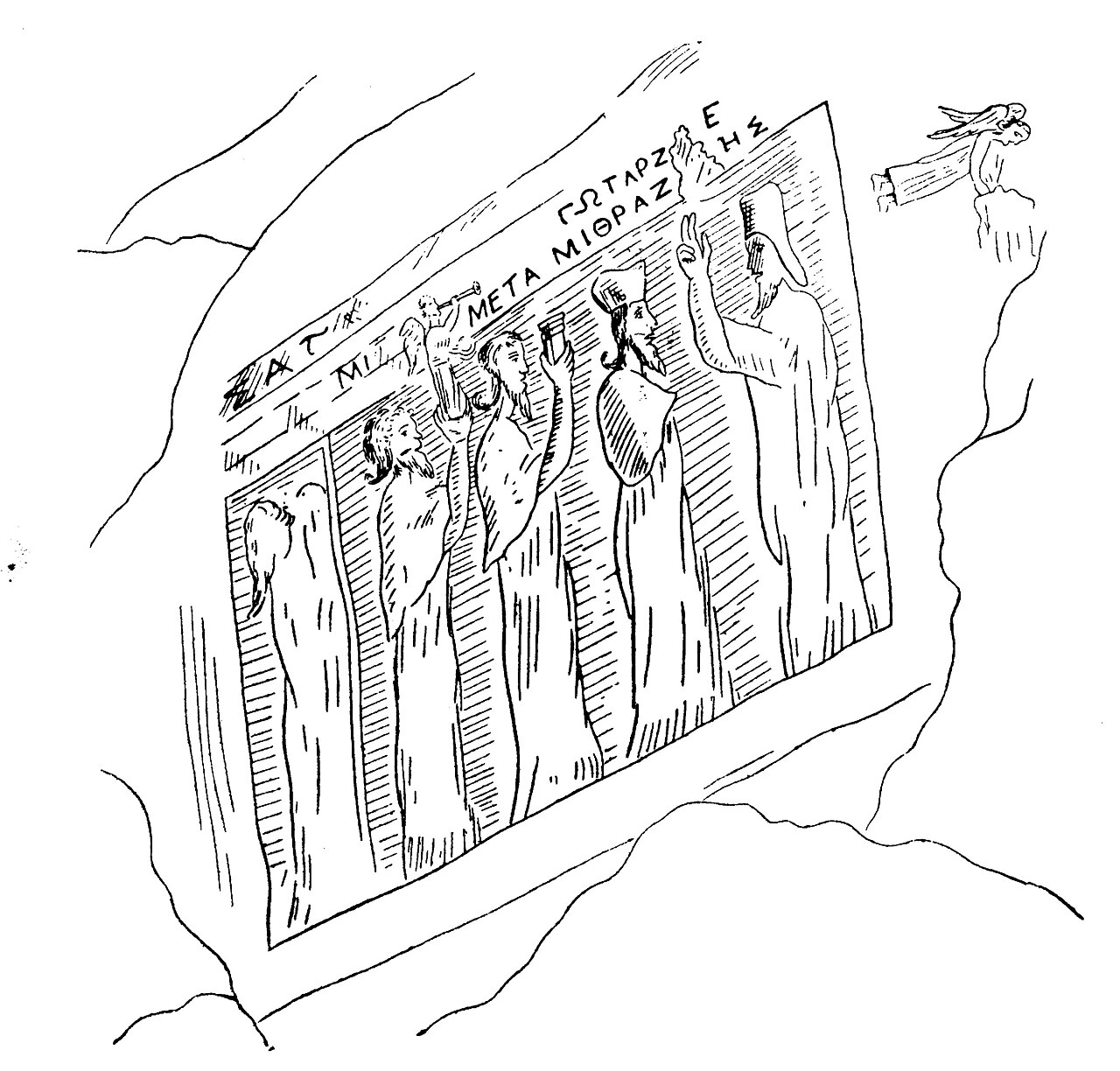
The Arsacid king was the head of a clan, not an absolute monarch in the Achaemenid style. The geographer Strabo, drawing on the earlier writer Posidonius, says the Parthians had two councils: one made up of the king’s kinsmen, and one of “wise men and magi”. Kings were chosen from the royal family by these bodies. Any Arsacid male could in principle claim the throne, which is why the dynasty’s history is full of brothers, uncles and cousins fighting each other, such as the rivals described on the page Gotarzes II and Vardanes.
The great families were the king-makers. Plutarch says the head of the Suren house had the hereditary right to place the crown on a new king’s head, and Tacitus confirms the custom when he describes a Surena crowning a new king in 36 CE “according to ancestral custom”. A king who lost the support of these men could be deposed, as Phraates V and Queen Musa were around 4 CE, or Vonones I a few years later.
The house of Suren
The Suren family held the lands of Sakastan, today’s Sistan on the border of Iran and Afghanistan, which had been settled by Saka nomads in the 2nd century BCE. The most famous member, known to us only by the title Surena, destroyed the army of Crassus at Carrhae in 53 BCE with a force of horse archers and armoured cavalry drawn largely from his own estates. That battle, and Plutarch’s portrait of Surena, are told on the page Surena and the Battle of Carrhae.
A branch of the family may also have ruled in the east. Gondophares, the Indo-Parthian king of the 1st century CE, is often thought to have belonged to the Suren house, though this is not certain; see The Indo-Parthians and Kushans.
The house of Karen
The Karen were based in Media, around Nahavand, south of Hamadan. Tacitus names a general called Carenes who fought in the civil wars of 49 CE. The family remained powerful into Sasanian times and beyond: Karenid princes still ruled parts of Tabaristan, south of the Caspian, in the 8th and 9th centuries. Iranian tradition later linked them to Qaren, son of the blacksmith Kaveh, one of the heroes of the Shahnameh.

Lords, retainers and dependants
Below the great houses stood a wider class of lesser nobles and free warriors. Their wealth came from land and from the peasants and dependants who worked it. Roman writers understood little of these relationships and described the dependants as slaves. Justin, for example, says that of the 50,000 horsemen who fought Mark Antony, only 400 were free men. The figure is not reliable, but it reflects a real feature of Parthian society: a noble rode to war with a large following of men bound to him personally, armed and fed at his expense.
This was the source of Parthian military power. The king did not maintain a large standing army. When war came, the nobles brought their contingents of horse archers and heavily armoured cataphracts, described on the page Parthian Cavalry: Cataphracts and the Parthian Shot. A popular king could raise a huge force; a weak one could find his nobles staying at home or joining a rival.
Estates and documents
A few documents show how land was held. Thousands of ostraca (inscribed pottery sherds) from Nisa, the early capital in Turkmenistan, record deliveries of wine from royal and temple estates in the 1st century BCE, with the names of estate managers and officials. Parchments found in a cave at Avroman in Iranian Kurdistan record the sale of vineyards, and their dating formulas name the reigning king and his queens. These are local glimpses, but they show a society of landowners, written contracts and royal officials beneath the noble elite.
Vassal kings and the King of Kings
Beyond the lands ruled directly by the Arsacids lay a ring of client kingdoms with their own dynasties. In the south, Persis (Pars) was ruled by local kings who struck their own coins, as did Elymais in Khuzestan and Characene at the head of the Persian Gulf. In the west were Adiabene, around Arbela (Erbil), whose royal family converted to Judaism in the 1st century CE; Osrhoene, around Edessa; and the desert city of Hatra. In the north, Media Atropatene and Armenia were often given to younger Arsacid princes.
The title King of Kings, which Mithridates II adopted and his successors kept, expressed this structure. The Arsacid was supreme because other kings stood beneath him. The arrangement was flexible and cheap to run, but it carried an obvious risk: a strong vassal could turn against his overlord. That is exactly what happened in 224 CE, when Ardashir, a ruler of Persis, defeated the last Parthian king; see The Last Parthian Kings.
Was it feudalism?
Earlier historians, such as Geo Widengren, described Parthian society as feudal and compared it to medieval Europe: a king, great vassals, lesser knights and dependent peasants, bound by oaths of loyalty. Many recent historians, among them Josef Wiesehöfer, are more cautious. The comparison captures the dispersal of power and the role of mounted aristocrats, but the sources say almost nothing about formal grants of land in return for service, which is what defines European feudalism. Most now prefer to speak of an aristocratic or decentralised empire and use “feudal” loosely, if at all.
The houses after the Arsacids
The great families outlived the dynasty. The Suren and Karen made terms with Ardashir and the Sasanians, and later Sasanian tradition counted them among the seven great houses of the realm, alongside the Mihran and others. Their memory also passed into Iranian epic. Ehsan Yarshater and other scholars have argued that many heroes of the Shahnameh preserve Parthian names and family traditions: the hero Gudarz, for example, bears the same name as the Parthian king Gotarzes, and the families of Gudarz and Giv look very much like a Parthian noble house. The religion and minstrel culture of these noble courts are described on the page Religion and Culture in Parthian Iran.
Persian words from this page
| سورن | Suren | the house of Suren |
| کارن | Kâren | the house of Karen |
| شاهنشاه | shâhanshâh | King of Kings |
| سیستان | Sistân | Sistan |
| نهاوند | Nahâvand | Nahavand |
| گودرز | Gudarz | Gotarzes; a Shahnameh hero |
| بزرگان | bozorgân | the great ones, nobles |
Sources and further reading
- Strabo, Geography 11.9.3; Plutarch, Life of Crassus 21; Tacitus, Annals 6.42 and 12.12–14; Justin, Epitome 41.2.
- Pliny the Elder, Natural History 6.112 (the eighteen kingdoms).
- Encyclopaedia Iranica, “Arsacids ii. The Arsacid dynasty” (K. Schippmann).
- Josef Wiesehöfer, Ancient Persia from 550 BC to 650 AD (I. B. Tauris).
- Parvaneh Pourshariati, Decline and Fall of the Sasanian Empire: The Sasanian-Parthian Confederacy and the Arab Conquest of Iran (I. B. Tauris, 2008).
- Ehsan Yarshater, “Iranian National History”, in The Cambridge History of Iran, vol. 3(1) (1983).
Want to learn Persian? Get the free Starter Pack
Get the 14-page printable Starter Pack (all 32 letters, a 7-day reading plan, 100 core words and 20 survival phrases) and a short 5-email course. Free.
More in The Parthian Empire (247 BCE–224 CE)
- The Parni and Arsaces I
- Nisa: The First Parthian Capital
- Mithridates I and the Making of an Empire
- Phraates II, Artabanus I and the Saka Invasions
- Mithridates II the Great
- The Parthians and the Silk Road
- Parthian Cavalry: Cataphracts and the Parthian Shot
- Surena and the Battle of Carrhae (53 BCE)
- Orodes II and Prince Pacorus
- Mark Antony’s Parthian War
- Phraates IV and the Peace with Augustus
- Queen Musa of Parthia
- Artabanus II of Parthia
- Gotarzes II and Vardanes: A Royal Rivalry
- Vologases I and the War over Armenia
- Trajan’s Invasion of Parthia
- Osroes I and the Parthian Civil Wars
- Roman Campaigns of the 2nd Century: Lucius Verus and Septimius Severus
- The Last Parthian Kings: Vologases V, Vologases VI and Artabanus IV
- The Fall of the Parthian Empire
- Ctesiphon: Capital of Two Empires
- The Great Houses of Parthia
- Religion and Culture in Parthian Iran
- Parthian Art and Architecture
- Parthian Coins and What They Tell Us
- Hatra: The City that Resisted Rome
- The Parthian Language and Its Records
- The Indo-Parthians and Kushans
- The Parthian Legacy