Hatra was a walled caravan city in the desert of northern Iraq, southwest of Mosul, ruled by Arab lords and kings who were allies and vassals of Parthia. It drove off the Roman emperor Trajan in 117 CE and Septimius Severus twice around 198–200, but fell to the Sasanians in about 240–241 and was never rebuilt. Its temples, the best-preserved buildings of the Parthian world, are a UNESCO World Heritage Site, damaged by the Islamic State group in 2015.
| Location | Nineveh Governorate, northern Iraq, in the steppe west of the Tigris |
|---|---|
| Arabic name | al-Hadr (الحضر) |
| Height of the city | 1st–3rd centuries CE |
| Rulers | Lords, then from the mid-2nd century “kings of the Arabs” |
| Main god | Shamash, the sun god |
| Language of inscriptions | Aramaic, in a local script |
| Sieges | Trajan 117; Septimius Severus c. 198 and 199/200; Ardashir I late 220s; captured c. 240–241 |
| UNESCO | World Heritage Site since 1985; on the List in Danger since 2015 |
A city between Rome and Parthia
Hatra stood in the Jazira, the dry plain between the Tigris and the Euphrates, on routes that linked Mesopotamia with Syria. It began as a sanctuary and caravan stop, probably with a spring and a holy place of the sun god, and grew rich in the 1st and 2nd centuries CE as trade passed through it and pilgrims came to its temples. Its people were largely Arabs, and its inscriptions are in Aramaic, the common written language of the region.
The city’s rulers first called themselves “lord”. From around the middle of the 2nd century they took the title “king of the Arabs”: Sanatruq I is the best-known holder of it. They recognised the Parthian Great King as their overlord, and statues from Hatra show its rulers and nobles in Parthian dress, with long tunics, trousers and belted coats. In return Hatra guarded the western desert approach to Parthian Mesopotamia.

The round city and its temples
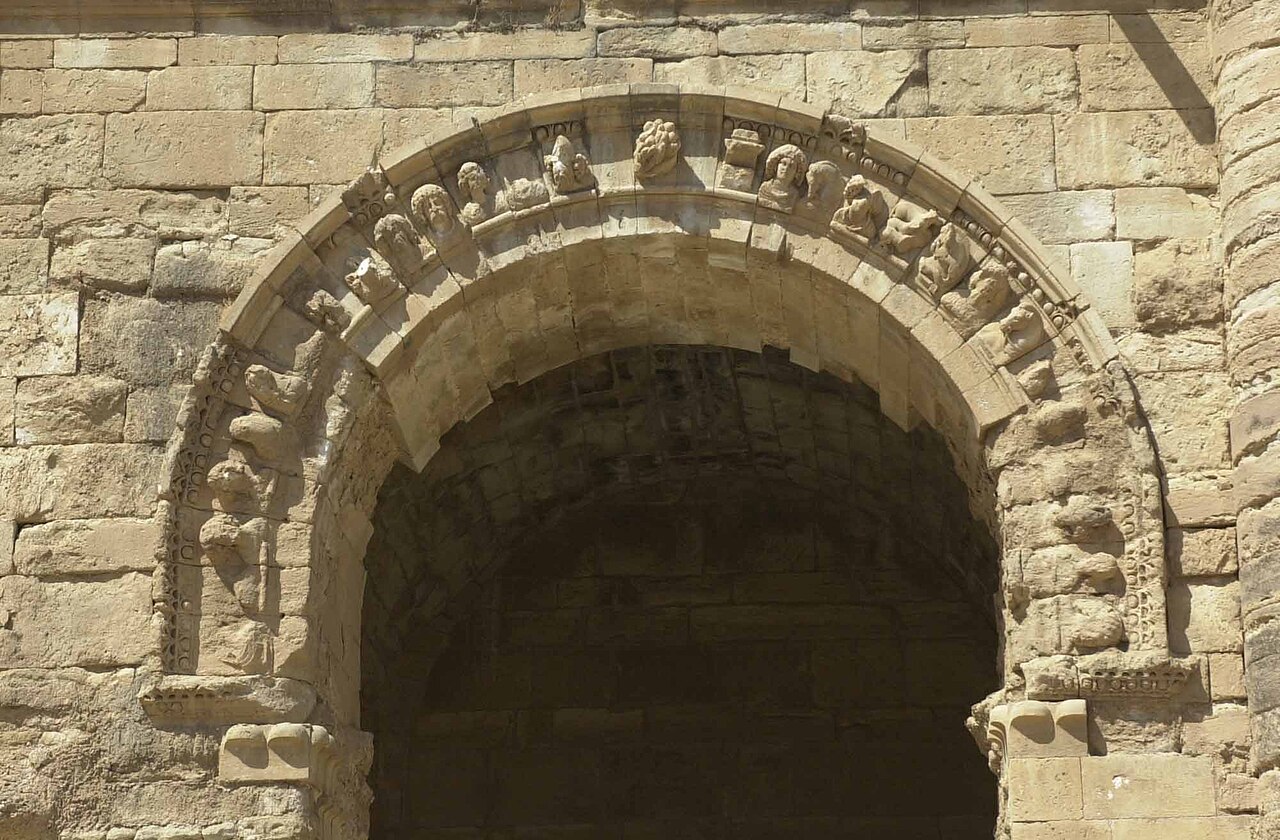
Hatra was laid out as a rough circle about 2 km across, enclosed by a thick mud-brick and stone wall with many towers, and an outer earthwork beyond. At its centre lay a huge walled sacred precinct. Inside it rose the Great Temple, whose façade is made of tall iwans, vaulted halls open at one end, set side by side. The iwans are framed with columns, carved masks and sculpted heads, mixing Greek and Roman architectural ornament with a building form that would become one of the hallmarks of Iranian architecture. Smaller temples to other gods stood inside the precinct and throughout the city.
The main deity was Shamash, the sun. Inscriptions also name a divine family known as “Our Lord”, “Our Lady” and “Son of our Lords”, as well as Allat and other Arab and Mesopotamian gods. Several hundred inscriptions and many statues found at Hatra give the names of its rulers, priests and leading families. The architecture is discussed alongside other Parthian sites on Parthian Art and Architecture.
Trajan’s failure, 117
Hatra first enters Roman history at the end of Trajan’s invasion of Parthia. Retreating north in 117, Trajan tried to take the city. Dio Cassius describes the conditions: little water or wood, intense heat and swarms of flies. Hatra’s horsemen almost killed the emperor himself. The siege was abandoned, and Trajan died a few months later on his way home.
Severus’ two sieges
Eighty years later Septimius Severus, having sacked Ctesiphon, also turned on Hatra, which had supported his rival for the Roman throne. He attacked it twice, around 198 and again in 199 or 200. Dio says that the defenders burned the siege engines with naphtha and that, in the second siege, Roman soldiers broke through the outer wall, only for Severus to recall them, hoping the city would surrender with its treasure intact. The next day his troops would not renew the assault. Herodian adds that the defenders threw clay pots filled with stinging insects onto the attackers. Whatever the details, Hatra held, and its reputation grew. The wider war is told on Roman Campaigns of the 2nd Century.
A new enemy in the east
The fall of the Arsacids changed Hatra’s position. Its kings had been loyal to Parthia, and they would not accept Ardashir. Dio reports that Ardashir attacked Hatra in the late 220s and failed. In the following years the city turned to its old enemy: Latin inscriptions show that a Roman military unit was stationed in Hatra in the 230s.
The alliance did not save it. The Cologne Mani Codex, a Greek life of the prophet Mani, dates one of Mani’s revelations to the year in which Ardashir “subdued the city of Hatra”, which corresponds to about 240. The Sasanian siege was probably led by the crown prince Shapur, and the city was captured around 240–241. It was not rebuilt. When the Roman army of Julian passed nearby in 363, the historian Ammianus Marcellinus described Hatra as an old town in the desert, long abandoned. For the Sasanian side, see Shapur I and The Fall of the Parthian Empire.
The legend of al-Nadira
Arabic tradition, recorded by al-Tabari and in early Arabic poetry, tells the fall of Hatra as a love story. Al-Nadira, daughter of the king of Hatra, fell in love with the Persian king besieging the city and showed him how to break its magical defences. After the city fell, he married her, but then had her put to death, disgusted by her betrayal of her father. The tradition names the besieger as Shapur and calls the king of Hatra al-Daizan. It is legend, but it preserves the memory of a famous siege and a city that fell by treachery rather than force.
Excavation and destruction
The German archaeologist Walter Andrae surveyed Hatra while excavating at Assur between 1906 and 1911. Iraqi archaeologists began systematic excavation and restoration in the 1950s, and many of the statues went to the museums of Mosul and Baghdad. The ruins appeared in the opening scene of the 1973 film The Exorcist, and in 1985 Hatra was inscribed as a UNESCO World Heritage Site.
After the Islamic State group seized the region in 2014, it released videos in 2015 showing fighters smashing Hatran statues in the Mosul Museum and attacking sculptures and carved façades at the site itself. UNESCO placed Hatra on its List of World Heritage in Danger the same year. Iraqi forces retook the area in April 2017. Reports since then indicate that the walls and main buildings survive but that much carved decoration was damaged or destroyed; assessment and restoration work has continued. Anyone hoping to visit should check current official information and their own government’s travel advice.
- 1st century CE Hatra grows as a sanctuary and caravan city
- 117 Trajan’s siege fails
- mid-2nd century Rulers take the title “king of the Arabs”
- c. 198 and 199/200 Septimius Severus besieges Hatra twice and fails
- late 220s Ardashir I attacks Hatra and fails
- 230s Roman garrison in the city
- c. 240–241 Hatra falls to the Sasanians
- 1985 UNESCO World Heritage Site
- 2015 Damaged by the Islamic State group; placed on the List in Danger
Persian words from this page
| ایوان | eyvân | iwan, a vaulted hall open at one end |
| شاپور | Shâpur | Shapur |
| خورشید | khorshid | the sun |
| عرب | arab | Arab |
| دیوار | divâr | wall |
| موصل | Mosel | Mosul |
Sources and further reading
- Dio Cassius, Roman History, books 68, 76 and 80
- Herodian, History of the Empire, book 3
- Ammianus Marcellinus, Res Gestae, book 25
- UNESCO World Heritage Centre, Hatra
- Michael Sommer, Hatra: Geschichte und Kultur einer Karawanenstadt im römisch-parthischen Mesopotamien (2003)
- Lucinda Dirven (ed.), Hatra: Politics, Culture and Religion between Parthia and Rome (2013)
Want to learn Persian? Get the free Starter Pack
Get the 14-page printable Starter Pack (all 32 letters, a 7-day reading plan, 100 core words and 20 survival phrases) and a short 5-email course. Free.
More in The Parthian Empire (247 BCE–224 CE)
- The Parni and Arsaces I
- Nisa: The First Parthian Capital
- Mithridates I and the Making of an Empire
- Phraates II, Artabanus I and the Saka Invasions
- Mithridates II the Great
- The Parthians and the Silk Road
- Parthian Cavalry: Cataphracts and the Parthian Shot
- Surena and the Battle of Carrhae (53 BCE)
- Orodes II and Prince Pacorus
- Mark Antony’s Parthian War
- Phraates IV and the Peace with Augustus
- Queen Musa of Parthia
- Artabanus II of Parthia
- Gotarzes II and Vardanes: A Royal Rivalry
- Vologases I and the War over Armenia
- Trajan’s Invasion of Parthia
- Osroes I and the Parthian Civil Wars
- Roman Campaigns of the 2nd Century: Lucius Verus and Septimius Severus
- The Last Parthian Kings: Vologases V, Vologases VI and Artabanus IV
- The Fall of the Parthian Empire
- Ctesiphon: Capital of Two Empires
- The Great Houses of Parthia
- Religion and Culture in Parthian Iran
- Parthian Art and Architecture
- Parthian Coins and What They Tell Us
- Hatra: The City that Resisted Rome
- The Parthian Language and Its Records
- The Indo-Parthians and Kushans
- The Parthian Legacy