The Parthian Arsacids ruled Iran for about 470 years, from around 247 BCE to 224 CE, longer than any other Iranian dynasty. They held the Euphrates frontier against Rome, kept Iranian kingship alive after Alexander, and handed the Sasanians their noble houses, their title of King of Kings and a body of epic and romance. Yet later Iranian tradition remembered them dimly, and only modern archaeology and coin studies have restored their place in Iranian history.
| Dynasty | Arsacids, Persian Ashkâniân (اشکانیان) |
|---|---|
| Rule in Iran | c. 247 BCE–224 CE (about 470 years) |
| Longest surviving branch | Arsacid kings of Armenia, to 428 CE |
| Lasting legacies | Euphrates frontier with Rome; great noble houses; the iwan; minstrel epic and romance; the word Pahlavi |
| Later image | “Petty kings” (muluk al-tawa’if) in Sasanian and Islamic-era histories |
The longest reign in Iranian history
For comparison, the Achaemenids ruled for about 220 years and the Sasanians for about 427. The Parthians lasted longer than both, through a period that began with Iran under Greek-speaking Seleucid kings and ended with Rome at the height of its power. They did this with a loose system of vassal kings and noble houses that looked weak to outsiders, but which repeatedly survived defeats, civil wars and the sack of its capital. How that system worked, and why it finally failed, is told on The Great Houses of Parthia and The Fall of the Parthian Empire.
A frontier that held
The most visible Parthian achievement was military. At Carrhae in 53 BCE Parthian horse archers and armoured cavalry destroyed a Roman army, and for the next two and a half centuries Rome never held Mesopotamia for long. Mark Antony, Trajan, Lucius Verus and Septimius Severus all invaded; their conquests were temporary. The line of the Euphrates, first agreed between Rome and Parthia, became the frontier between Rome and Iran until the 7th century, and the Sasanians inherited the rivalry along with the border. See Persia and Rome: Seven Centuries of Rivalry.
The English expression “a parting shot” is often said to come from “Parthian shot”, the horse archer’s trick of shooting backwards while riding away. Etymologists are not certain of the link, but the image of the Parthian rider stayed in European memory long after the empire had gone.

Remembered as petty kings
Inside Iran the Parthians fared worse. The Sasanians presented their own rise as the restoration of a true Iranian monarchy after a period of disorder. Through Sasanian court histories that view passed to the Arabic and Persian historians of the Islamic period, who called the Parthian era the time of the muluk al-tawa’if, the “kings of the factions” or petty kings. The phrase lives on in modern Persian as moluk-ot-tavâyef, meaning political fragmentation or feudal anarchy.
The Parthian period was also shortened. Sasanian tradition gave the Arsacids only about 260 years instead of nearly five centuries, and the 10th-century historian al-Mas’udi reported that this was deliberate: according to him, Ardashir shortened the count because of a prophecy about the end of the Persian kingdom a thousand years after Zoroaster. Modern scholars debate the explanation, but the shortened chronology is real and was noticed by medieval scholars such as al-Biruni.
Ferdowsi’s Shahnameh, completed around 1010, devotes only a few lines to the Ashkanian kings, and the poet says he had heard nothing of them but their names. The great epic moves almost directly from Alexander to Ardashir. See Ferdowsi and the Shahnameh and the site’s introduction to the Shahnameh.
What the Sasanians took over
Behind the propaganda, continuity was strong. The Sasanian state kept the title King of Kings, used by the Parthians since Mithridates II, and much of the Parthian system of vassal kings and great families. The houses of Suren and Karen kept their lands, and the Mihran house provided generals and even a usurper king, Bahram Chobin. The vaulted iwan hall, developed in Parthian buildings at Ashur, Hatra and elsewhere, became the core of Sasanian palaces such as the arch of Ctesiphon and later of the four-iwan mosques of Islamic Iran; see Parthian Art and Architecture. Parthian remained an official language in Sasanian royal inscriptions into the 290s.
In Armenia, an Arsacid line ruled until 428, and Armenian Christianity, literature and noble society were built partly on Parthian foundations. Many Armenian words for government and warfare are Parthian in origin.
Epic heroes and lovers
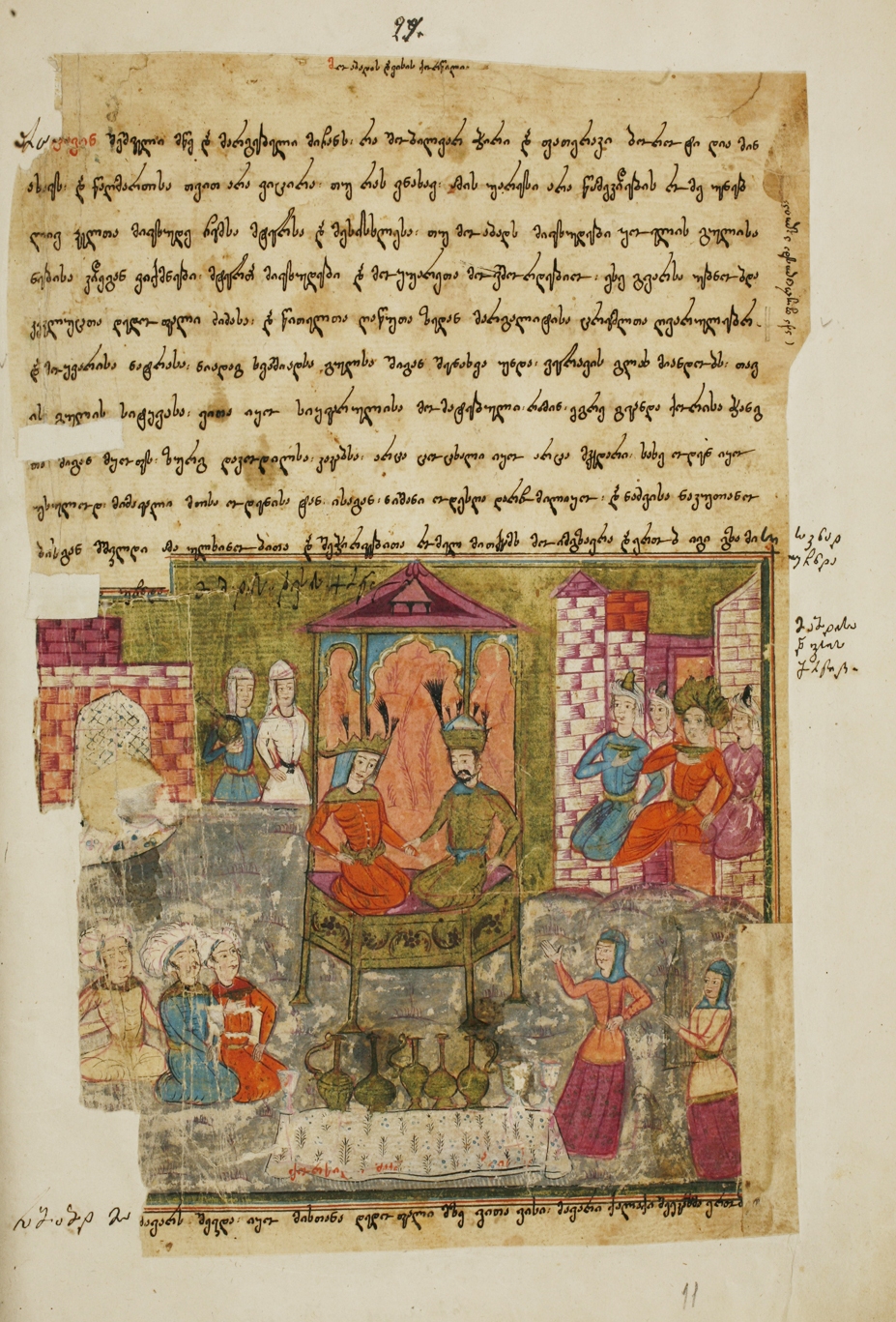
The Parthians’ greatest cultural legacy may be in stories. Parthian minstrels, the gosans, sang of kings, heroes and lovers at noble courts, and their tales passed into Middle Persian and then into Persian poetry. The romance Vis and Ramin, written by Fakhr al-Din Gorgani in the 11th century, is set among Parthian princes and is widely thought to go back to a Parthian original. It travelled beyond Iran: the image on this page comes from Visramiani, a Georgian prose version made in the 12th century and copied for centuries afterwards.
Scholars such as Ehsan Yarshater have also argued that the warrior families of the Shahnameh, the house of Gudarz and Giv above all, preserve memories of Parthian noble houses, so that Parthian heroes survived in the epic under legendary disguise. The argument is set out on Religion and Culture in Parthian Iran and Gotarzes II and Vardanes.
Names and words
The Parthians gave Persian its word for a hero, pahlavân, from Pahlav, the Middle Iranian form of the name of Parthia, and the word Pahlavi itself, which once meant “Parthian” before it came to mean the Middle Persian of the Sasanians (see The Parthian Language and Its Records). In 1925 Reza Khan took Pahlavi as the name of his new dynasty, choosing a word that evoked ancient Iran; see Reza Shah Pahlavi. Ashkan and Ardavan, Persian forms of Arsaces and Artabanus, are still used as boys’ names in Iran today.
Rediscovering the Parthians
For a long time European historians saw the Parthians through Greek and Roman eyes: as horse-riding barbarians who copied Greek culture, called themselves “friends of the Greeks” on their coins and had little of their own. Twentieth-century work changed that picture. Excavations at Nisa, Dura-Europos, Hatra and Shami, the reading of the Nisa ostraca, and the systematic study of Parthian coins showed an Iranian dynasty with its own administration, art and religious life. Historians such as Józef Wolski and Josef Wiesehöfer stressed the Iranian character of the Arsacid state and the continuity between Parthian and Sasanian Iran. In 2007 the Parthian fortresses of Nisa in Turkmenistan were inscribed as a UNESCO World Heritage Site.
For the Sasanians’ own legacy, which built on this foundation, see The Sasanian Legacy.
Persian words from this page
| اشکانیان | Ashkâniân | the Arsacids, the Parthian dynasty |
| اشکان | Ashkân | Arsaces; a modern given name |
| ملوکالطوایف | moluk-ot-tavâyef | petty kings; political fragmentation |
| پهلوان | pahlavân | hero, champion |
| ویس و رامین | Vis o Râmin | Vis and Ramin |
| شاهنامه | Shâhnâme | the Shahnameh, “Book of Kings” |
Sources and further reading
- K. Schippmann, “Arsacids ii. The Arsacid dynasty”, Encyclopaedia Iranica
- Ehsan Yarshater, “Iranian National History”, in The Cambridge History of Iran, vol. 3(1) (1983)
- Mary Boyce, “The Parthian gōsān and Iranian Minstrel Tradition”, Journal of the Royal Asiatic Society (1957)
- Josef Wiesehöfer, Ancient Persia from 550 BC to 650 AD (1996)
- Vesta Sarkhosh Curtis and Sarah Stewart (eds.), The Age of the Parthians (2007)
- UNESCO World Heritage Centre, Parthian Fortresses of Nisa (World Heritage listing, 2007)
Want to learn Persian? Get the free Starter Pack
Get the 14-page printable Starter Pack (all 32 letters, a 7-day reading plan, 100 core words and 20 survival phrases) and a short 5-email course. Free.
More in The Parthian Empire (247 BCE–224 CE)
- The Parni and Arsaces I
- Nisa: The First Parthian Capital
- Mithridates I and the Making of an Empire
- Phraates II, Artabanus I and the Saka Invasions
- Mithridates II the Great
- The Parthians and the Silk Road
- Parthian Cavalry: Cataphracts and the Parthian Shot
- Surena and the Battle of Carrhae (53 BCE)
- Orodes II and Prince Pacorus
- Mark Antony’s Parthian War
- Phraates IV and the Peace with Augustus
- Queen Musa of Parthia
- Artabanus II of Parthia
- Gotarzes II and Vardanes: A Royal Rivalry
- Vologases I and the War over Armenia
- Trajan’s Invasion of Parthia
- Osroes I and the Parthian Civil Wars
- Roman Campaigns of the 2nd Century: Lucius Verus and Septimius Severus
- The Last Parthian Kings: Vologases V, Vologases VI and Artabanus IV
- The Fall of the Parthian Empire
- Ctesiphon: Capital of Two Empires
- The Great Houses of Parthia
- Religion and Culture in Parthian Iran
- Parthian Art and Architecture
- Parthian Coins and What They Tell Us
- Hatra: The City that Resisted Rome
- The Parthian Language and Its Records
- The Indo-Parthians and Kushans
- The Parthian Legacy